

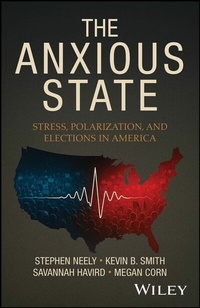
The Anxious State
Description

An exploration of how politics is undermining Americans' mental health
The Anxious State: Stress, Polarization, and Elections in America examines the increasing political stress and emotional polarization in the United States. It examines the physiological toll of exposure to political conflict, the role of media and social media in heightening anxiety, and the strain on personal relationships caused by polarization. The authors argue that politics has moved from the periphery of American life into its most intimate spaces, creating a state of heightened vigilance and emotional exhaustion. The Anxious State:
- Examines the empirical health and stress impacts of politics in America today
- Reports original data from a year-long series of surveys examining political stress and polarization during the 2024 election
- Offers insights into the relationship between political stress and anxiety, generational cohort, and media consumption
An excellent text for both academic and general audiences, fits with curricula on political science, political behavior, political psychology, and political communications.
More details
Other editions
Additional editions
Persons
Stephen Neely, PhD, is an Associate Professor in the School of Public Affairs at the University of South Florida. He is Director of the School's Master's program in Public Administration, a Senior Faculty Fellow with the Global and National Security Institute at the University of South Florida, and an Academic Program Director with the Florida Center for Cybersecurity.
Kevin B. Smith is the Leland J. and Dorothy H. Olson Professor in the Department of Political Science at the University of Nebraska-Lincoln. He is also the Director of the Political Pyschophysiology Lab in the Center for Brain, Biology and Behavior at the University of Nebraska-Lincoln.
Savannah Havird is a Graduate Teaching Associate and PhD student in the School of Interdisciplinary Global Studies at the University of South Florida. She holds an MPA from the University of South Florida and a BA in political science from Saint Leo University. She has published survey research in the Tampa Bay Times and presented at multiple research conferences across various disciplines.
Megan Corn is a Graduate Teaching Associate and PhD student in the School of Inter-disciplinary Global Studies at the University of South Florida. She also holds an MPA from the University of South Florida and has published survey research in the Tampa Bay Times and South Florida Sun Sentinel.
Content
Acknowledgments vii
1 The Anxious State 1
Section 1 Stress 17
2 Political Stress: A Primer for the Anxious Citizen 19
3 The Public Health Problem Hiding in Plain Sight 36
4 Age, Gender, and Education: Understanding the Comorbidities of Political Stress 52
5 How "Breaking News" Is Breaking Us 62
6 Political Stress and Social Relationships 78
Section 2 Polarization 91
7 Understanding Affective Polarization 93
8 Unwarranted Disdain 114
9 Cross-pressures and (More) Comorbidities 132
10 Does the Media Really Divide Us? 145
Section 3 Conclusion 163
11 The Big Picture 165
12 The Anxious Cycle 181
Appendix: Survey Respondents 191
Index 193
