

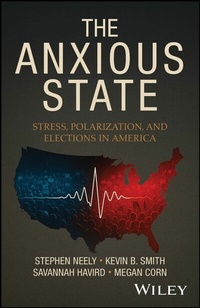
The Anxious State
Description

An exploration of how politics is undermining Americans' mental health
The Anxious State: Stress, Polarization, and Elections in America examines the increasing political stress and emotional polarization in the United States. It examines the physiological toll of exposure to political conflict, the role of media and social media in heightening anxiety, and the strain on personal relationships caused by polarization. The authors argue that politics has moved from the periphery of American life into its most intimate spaces, creating a state of heightened vigilance and emotional exhaustion. The Anxious State:
- Examines the empirical health and stress impacts of politics in America today
- Reports original data from a year-long series of surveys examining political stress and polarization during the 2024 election
- Offers insights into the relationship between political stress and anxiety, generational cohort, and media consumption
An excellent text for both academic and general audiences, fits with curricula on political science, political behavior, political psychology, and political communications.
More details
Other editions
Additional editions
Persons
Stephen Neely, PhD, is an Associate Professor in the School of Public Affairs at the University of South Florida. He is Director of the School's Master's program in Public Administration, a Senior Faculty Fellow with the Global and National Security Institute at the University of South Florida, and an Academic Program Director with the Florida Center for Cybersecurity.
Kevin B. Smith is the Leland J. and Dorothy H. Olson Professor in the Department of Political Science at the University of Nebraska-Lincoln. He is also the Director of the Political Pyschophysiology Lab in the Center for Brain, Biology and Behavior at the University of Nebraska-Lincoln.
Savannah Havird is a Graduate Teaching Associate and PhD student in the School of Interdisciplinary Global Studies at the University of South Florida. She holds an MPA from the University of South Florida and a BA in political science from Saint Leo University. She has published survey research in the Tampa Bay Times and presented at multiple research conferences across various disciplines.
Megan Corn is a Graduate Teaching Associate and PhD student in the School of Inter-disciplinary Global Studies at the University of South Florida. She also holds an MPA from the University of South Florida and has published survey research in the Tampa Bay Times and South Florida Sun Sentinel.
Content
Acknowledgments vii
1 The Anxious State 1
Section 1 Stress 17
2 Political Stress: A Primer for the Anxious Citizen 19
3 The Public Health Problem Hiding in Plain Sight 36
4 Age, Gender, and Education: Understanding the Comorbidities of Political Stress 52
5 How "Breaking News" Is Breaking Us 62
6 Political Stress and Social Relationships 78
Section 2 Polarization 91
7 Understanding Affective Polarization 93
8 Unwarranted Disdain 114
9 Cross-pressures and (More) Comorbidities 132
10 Does the Media Really Divide Us? 145
Section 3 Conclusion 163
11 The Big Picture 165
12 The Anxious Cycle 181
Appendix: Survey Respondents 191
Index 193
Chapter 1
The Anxious State
If you were asked to describe American politics in a single word, how would you reply? You might pick something like "polarized," "hostile," or "divided"; and there would be good reasons for doing so. Partisan animosity is certainly one of the dominant narratives of our time. Deep divisions among voters are the subject of innumerable news reports.1 Popular books have done their best to explain this hostility.2 And according to academics and journalists, politics is increasingly responsible for dividing families, social groups, workplaces, and whole communities into mutually suspicious tribes.3
Or perhaps you might choose a word like "annoying," "stressful," or "loud." After all, whatever damage politics is or isn't doing to social cohesion, there's no denying its increasingly intrusive presence in our lives. Thanks to advances in modern technology, we're now more connected to ideas and information than at any time in human history. The digital age means living with a constant 24-hour news cycle, bottomless social media feeds, and political commentary launched from nearly every direction, whether you want to hear it or not. In an era defined by polarization and pervasive political coverage, it seems that everything becomes politicized eventually: companies and brands, sports, children's cartoons, and even the weather.4 To be a modern American means you can run, but you can't hide from the stress of politics.
While we cannot forecast your precise response, we can confidently make two guesses about whatever word popped into your mind. First, it was negative. A few glass-half-full types might have said "open" or even "hopeful." But we're positive that they're outnumbered by a much larger group who would choose words like "scary" or "irritating." Second, that word either has something to do with polarization or something to do with the ubiquitous presence of politics in our lives (especially on social media) and how it is driving us nuts. Our self-assurance on this matter is more than a whim. It's based on our own research. In early 2024, we asked a sample of American voters to pick the adjectives that best described the political discussions they encountered on social media. The most common choices were words like "one-sided" (50%), "frustrating" (49%), "informative" (42%), "angry" (33%), "hateful" (31%), and "stressful" (30%). Less than one-in-five selected words like "thoughtful" or "constructive."5 While we were specifically asking about social media, the results almost certainly generalize to politics in America writ large. With a single exception - "informative" - the words chosen by our respondents mostly fit into one of two categories: stress and polarization. These, increasingly, appear to be the defining features of twenty-first century American politics.
You don't need to take our word for it. There's plenty of evidence suggesting that politics is a major source of individual stress. Surveys by the American Psychological Association (APA) indicate that in 2024, more than two-thirds of adults identified the presidential election as a significant source of stress, a jump of 15 percentage points over the 2016 election cycle. The same survey suggests that more than three-quarters of people get stressed out just thinking about the future of the nation.6 A number of research studies have directly linked political engagement - even just paying attention to the news - to a range of adverse, stress-related mental health effects.7 For many of us, these effects are increasingly hitting close to home. For example, Americans frequently tell stories of friendships and even family ties falling apart over political disagreements.8
The evidence regarding polarization is even more overwhelming. Survey data consistently show that Democrats and Republicans think poorly of each other. This partisan animosity is increasingly driven by what political scientists call "affective polarization," meaning it's characterized less by a love for one's own party than an intense dislike of the other. Between 2016 and 2022, the Pew Research Center observed a double-digit increase in the percentage of both Democrats and Republicans who described one another as "closed-minded," "dishonest," "immoral," and "unintelligent."9 In fact, by 2022, a majority of voters in each party described the other in these terms. Not only have these trends undermined public civility and the ability of political leaders to effectively compromise, but they may also contribute to the effects of political stress on individual well-being. For example, Americans who feel most polarized within their communities are more likely to experience poorer physical health outcomes as a result.10
It doesn't take a degree in political science to recognize that this assessment of the political climate is not good. Don't get us wrong - it's not simply that we're somehow more divided over politics today than those Americans who came before us. After all, Alexander Hamilton and Aaron Burr engaged in a duel to the death. The nation slid into a bloody civil war in the nineteenth century. The twentieth century saw Vietnam, Watergate, and McCarthyism, events that triggered powerfully divisive political movements. But something about the twenty-first century feels different. And perhaps that's the keyword: politics has increasingly become not something we simply think or talk about, but something we feel. Bombarded by endless streams of political content - and primed by political influencers to interpret the ebbs and flows of politics as threats to our own safety and identity - our differences of opinion have given way to outright distress. Americans are increasingly worn out, exhausted, and overwhelmed by politics.
In the face of these trends, perhaps the best one-word description of American politics today isn't "polarized," "hostile," or "annoying," but rather "anxious." And that anxiousness is the focus of this book. In framing our discussion around the idea of "The Anxious State," we don't intend to coin or define a new academic construct. It's simply a term meant to capture the convergence of political polarization, emotional exhaustion, and social fragmentation that defines life for so many in modern America. Over the course of the 2024 presidential election, we set out to develop a deeper understanding of what we perceive to be the two pillars of the anxious state: (1) political stress and (2) affective polarization. In the chapters that follow, we will define these terms more clearly, summarize what the fields of political science and psychology have to say about them, and examine the extent to which they define America's modern political culture.
We're far from the first to undertake an in-depth examination of these concepts. Affective polarization has attracted the interest of political scientists for a long time. An interest that has become more intense over the past 20 years as partisan animus has steadily increased. Political stress has received considerably less attention, both in the academic and popular press. Nonetheless, over the past decade, a growing body of academic research has documented clear and consistent trends linking politics to stress, anxiety, and negative health outcomes.
While this extensive body of data and research - discussed in the coming chapters - has helped us to understand the increasingly anxious state of American politics, we're unaware of any prior effort to track these phenomena closely over the course of an entire election cycle. That is what we did in 2024, conducting four large, national surveys to measure and track both political stress and affective polarization among American voters. That data collection effort not only makes possible a comprehensive assessment of America's modern political climate, but it also allows us to examine how stress and polarization vary and respond to political events and outcomes. Perhaps most importantly, this understanding opens the door to empirically informed discussions about whether and how we can protect ourselves from the negative impacts of politics on our own individual and collective well-being.
It's important to set the proper expectations up front. Our primary goal is not to explain how we got here - how twenty-first century America became The Anxious State. There's plenty of time for those discussions, and more than a few possible answers. Our goal is to demonstrate that America is an anxious state by sharing and assessing the extensive data that we collected throughout 2024. We'll tell you more about this data and how it was procured, but first we'd like to provide some context. Not only is our data unique, but so too were the circumstances that it was gathered in.
The Unexpected Twists of a Historic Election
We planned this study in late 2023, motivated by the opportunity to contribute something unique to our collective understanding of America's political climate. What we didn't realize at the time is that...
