

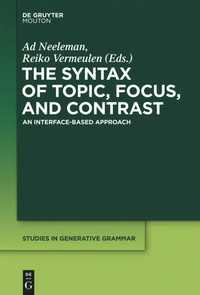
The Syntax of Topic, Focus, and Contrast
Description

This book addresses how core notions of information structure (topic, focus and contrast) are expressed in syntax. The authors propose that the syntactic effects of information structure come about as a result of mapping rules that are flexible enough to allow topics and foci to be expressed in a variety of positions, but strict enough to capture certain cross-linguistic generalisations about their distribution. In particular, the papers argue that only contrastive topics and contrastive foci undergo movement and that this is because such movement has the function of marking the scope of contrast. Several predications are derived from this proposal: such as that a focus cannot move across a topic - whether the latter is in situ or not. Syntactic and semantic evidence in support of this proposal is presented from a wide range of languages (including Dutch, English, Japanese, Korean and Russian) and theoretical consequences explored. The first chapter not only outlines its theoretical aims, but also provides an introduction to information structure. As a consequence, the book is accessible to advanced students as well as professional linguists.
More details
Other editions
Additional editions
Persons
Content
2 - Chapter 2. Towards a Unified Encoding of Contrast and Scope [Seite 47]
3 - Chapter 3. Word Order Variation and Information Structure in Japanese and Korean [Seite 85]
4 - Chapter 4. Encoding Focus and Contrast in Russian [Seite 127]
5 - Chapter 5. Against FP Analyses of Clefts [Seite 165]
6 - Chapter 6. Focus Movement Can be Destressing, but it Need not Be [Seite 197]
7 - Chapter 7. Types of Focus and their Interaction with Negation [Seite 235]
8 - Chapter 8. Concluding Remarks [Seite 273]
9 - References [Seite 283]
10 - Index [Seite 309]
