

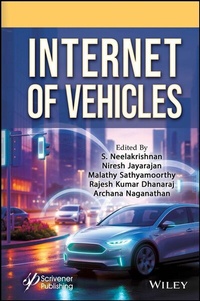
Internet of Vehicles
Description

Position yourself at the forefront of the transportation revolution with this guide to mastering computational intelligence that serves as the essential linchpin for the safe, sustainable, and hyper-connected Internet of Vehicular Things.
The rapid adoption of the Internet of Things has transformed the way we interact with our environment, ushering in an era of unprecedented connectivity and data sharing. One of the most dynamic and influential manifestations of this technological revolution is the Internet of Vehicular Things, a paradigm that connects the digital and physical worlds through the integration of intelligent vehicles, smart infrastructure, and advanced communication networks. In this fast-evolving landscape, computational intelligence emerges as the linchpin that enables IoVT to realize its full potential. This book addresses the fascinating intersection of vehicle technology and computational intelligence. It explores the transformative power of algorithms, machine learning, artificial intelligence, and data analytics shaping the future of transportation. As vehicles become smarter, safer, and more efficient, the opportunities for innovation and optimization are limitless. The IoVT ecosystem encompasses a wide range of applications, from autonomous vehicles and traffic management systems to driver assistance technologies and predictive maintenance. By harnessing the collective intelligence of vehicles and infrastructures, IoVT promises to revolutionize not only our daily commute, but the broader transportation landscape, paving the way for sustainable, efficient, and safe mobility solutions. This book is a comprehensive guide for researchers, engineers, practitioners, and policymakers looking to navigate the complex terrain of IoVT using computational intelligence. It provides a multidisciplinary perspective and draws on recent advances in computer science, data science, electrical engineering, and transportation science to facilitate a deep understanding of the key concepts, challenges, and opportunities associated with IoVT and computational intelligence.
More details
Other editions
Additional editions
Persons
S. Neelakrishnan, PhD is a Professor and the Head of the Department of Automobile Engineering at the PSG College of Technology. He has been instrumental in the development of vocational programs for the automotive domain and set up 15 specialized state of the art laboratories in the automotive and textile domain.
Niresh Jayarajan, PhD is an Assistant Professor in the Department of Automobile Engineering at the PSG College of Technology and a member of the Society of Automotive Engineers of India. His research interests include electric and hybrid vehicles, vehicle acoustics, and energy management systems.
Malathy Sathyamoorthy, PhD is an Assistant Professor in the Department of Information Technology at the KPR Institute of Engineering and Technology. She has published more than 25 research papers in international journals, 22 papers in international conferences, eight book chapters, one book, and two patents. Her research interests include wireless sensor networks, networking, security, and machine learning.
Rajesh Kumar Dhanaraj, PhD is a Professor at Symbiosis International University. He has contributed more than 100 articles to international journals and conferences, authored and edited more than 50 books, and holds 21 patents. His research interests encompass machine learning, cyber-physical systems, and wireless sensor networks.
Archana Naganathan, PhD is an Assistant Professor in the Department of Electrical and Electronics Engineering at the PSG College of Technology and a member of the Institute of Engineers of India. Her research interests cover the areas of power electronics, optimisation techniques, and hybrid electric vehicles.
Content
- Cover
- Series Page
- Title Page
- Copyright Page
- Contents
- Preface
- Chapter 1 Computational Intelligence and Internet of Vehicle Things: An Introduction
- 1.1 Introduction to Computational Intelligencei n Internet of Vehicle Things
- 1.1.1 Emergence of Intelligent Vehicle Networks
- 1.1.2 Role of Computational Intelligence in Connected Mobility
- 1.1.3 Advantages and Motivations for CI-IoVT Integration
- 1.2 Evolution of Vehicle Communication and IoVT Frameworks
- 1.2.1 From Traditional VANETs to Intelligent IoVT Systems
- 1.2.2 Key Components and Protocols in IoVT
- 1.2.3 Trends in Smart Vehicle Ecosystem Development
- 1.3 System Architecture for CI-Enabled IoVT Networks
- 1.3.1 Edge, Fog, and Cloud Integration Layers
- 1.3.2 Real-Time Data Processing and Predictive Analytics in IoVT
- 1.4 Security, Privacy, and Trust Models in CI-Based IoVT
- 1.4.1 Threat Landscape and Vulnerabilities in Intelligent Vehicle Networks
- 1.4.2 Computational Intelligence for Anomaly Detection and Cybersecurity
- 1.5 Performance Metrics and Benchmarking of CI-Driven IoVT Systems
- 1.5.1 Defining Key Performance Indicators (KPIs) for IoVT Networks
- 1.5.2 Benchmarking Learning Accuracy, Latency, and Energy Efficiency
- 1.5.3 Case Studies on Real-World CI-IoVT Deployments
- 1.6 Challenges and Future Trends in CI-Enabled IoVT
- 1.6.1 Scalability and Interoperability Issues in Heterogeneous Networks
- 1.6.2 Emerging Trends: 6G Integration, Federated Learning, and Quantum Enhancements
- 1.7 Conclusion and Research Directions
- 1.7.1 Summary of Key Contributions of Computational Intelligence in IoVT
- 1.7.2 Vision for Next-Generation Autonomous Vehicle Networks
- References
- Chapter 2 Internet of Things in Vehicular Technologies: Past, Present, and Future
- 2.1 Introduction
- 2.1.1 Definition of Internet of Things in Vehicular Technologies
- 2.1.2 Significance and Relevance in the Automotive Industry
- 2.1.3 Brief Overview of the Evolution of IoT in Vehicular Technologies
- 2.2 The Past: Mechanical Vehicles to Early Electronic Systems
- 2.2.1 Evolution of Automotive Technology from Mechanical to Electronic
- 2.2.2 Emergence of Basic Electronic Control Units (ECUs)
- 2.2.3 Challenges Faced in the Early Stages
- 2.3 Current State of IoT in Vehicular Technologies
- 2.3.1 Overview of the Current Landscape
- 2.3.2 V2X (Vehicle-to-Everything) Communication and Its Impact on Road Safety
- 2.3.3 Advanced Driver Assistance Systems and IoT Integration
- 2.3.4 Challenges and Limitations Faced in the Present Scenario
- 2.4 Current Framework and Design Issues of IoT
- 2.4.1 Layers of IoT
- 2.4.2 Protocols Used in IoT
- 2.4.3 Design Patterns Related to IoT
- 2.5 IoT-Enabled Applications in Vehicular Technologies
- 2.5.1 Connected Vehicles and Their Impact
- 2.5.2 V2V (Vehicle-to-Vehicle) Communications
- 2.5.3 V2I (Vehicle-to-Infrastructure) Communications
- 2.5.4 V2P (Vehicle-to-Pedestrian) Communications
- 2.5.5 V2N (Vehicle-to-Network) Communication
- 2.6 Security and Privacy Concerns
- 2.6.1 Addressing Security Challenges in IoT for Vehicular Technologies
- 2.6.2 Privacy Issues and Potential Solutions
- 2.6.3 Regulatory Frameworks and Standards
- 2.7 Emerging Technologies and Trends
- 2.7.1 Edge Intelligence in Vehicular IoT
- 2.7.1.1 Edge Computing Platform for Autonomous Vehicles
- 2.7.1.2 Challenges in Autonomous Vehicles (AVs)
- 2.7.2 Evolution of Wireless Communication: 5G Networks
- 2.7.2.1 Challenges in 5G V2X Communications
- 2.7.3 Decentralized Ledger Technology: Blockchain
- 2.7.3.1 Challenges in Blockchain Applications for AVs
- 2.8 Future Research Directions
- 2.8.1 Emergence of High-Definition (HD) Maps with Big Data and HPC
- 2.8.2 Risk Assessment
- 2.8.3 Enhanced Simulation Tested with AR/VR
- 2.8.4 Green Energy Solutions
- 2.8.5 Improvement of Quality of Service (QoS)
- 2.8.6 Smart Contracts
- 2.9 Case Study
- 2.9.1 Case Study of Successful Implementations
- 2.10 Conclusion
- Bibliography
- Chapter 3 IoT-Based Network Architectures and Communication Protocols for UAV Communications
- 3.1 Introduction
- 3.1.1 Components of IoT Architecture for UAVs
- 3.1.2 Instance of the UAV's Architecture
- 3.2 Classification of UAVs
- 3.2.1 UAVs Based on Autonomy
- 3.2.2 UAVs Based on Communication Architectures
- 3.3 IoT Architectures
- 3.3.1 Three-Layer Model
- 3.3.2 Four-Layer Model
- 3.3.3 Five-Layer Model
- 3.3.4 Six-Layer Model
- 3.3.5 Seven-Layer Model
- 3.4 IoT Communication Protocols for UAV
- 3.5 Conclusion
- Bibliography
- Chapter 4 Mobility as a Service (MaaS): A Paradigm Shift in Intelligent Transportation
- 4.1 Introduction
- 4.2 Working of Intelligent Transport Systems
- 4.3 Mobility as a Service in the Context of ITS
- 4.3.1 Evolution of MaaS
- 4.3.2 Importance and Benefits of MaaS
- 4.4 Functional Components of MaaS
- 4.4.1 Integration of Transport Modes
- 4.4.2 Digital Platforms
- 4.5 Design Considerations for MaaS
- 4.5.1 User Interface (UI) Considerations
- 4.5.2 User Experience (UX) Considerations
- 4.5.3 Practical Steps for Implementation
- 4.6 MaaS Payment Systems
- 4.6.1 Key Components of MaaS Payment Systems
- 4.6.2 Types of MaaS Payment Systems
- 4.6.3 Challenges and Considerations
- 4.6.4 Unified Payment Systems for Multi-Modal Transport
- 4.6.4.1 Key Features of Unified Payment Systems
- 4.6.4.2 Implementation Strategies
- 4.6.4.3 Challenges and Solutions
- 4.6.5 Security and Privacy Concerns in Payment Integration
- 4.6.5.1 Security Concerns
- 4.6.5.2 Privacy Concerns
- 4.6.5.3 Best Practices for Security and Privacy in MaaS Payment Integration
- 4.7 Technological Foundations of MaaS
- 4.7.1 Role of Big Data in Data Integration and Analytics
- 4.7.2 Predictive Analytics for Demand Forecasting and Route Optimization
- 4.7.3 Role of IoT and Connectivity in MaaS
- 4.7.4 Policy and Regulatory Considerations
- 4.7.4.1 Government Roles in Promoting MaaS Adoption
- 4.7.4.2 Regulatory Challenges and Solutions in Multi-Modal Transport
- 4.8 Future Trends and Innovations
- 4.8.1 Artificial Intelligence (AI) and Machine Learning (ML) Applications in MaaS
- 4.8.2 Autonomous Vehicles (AV) and Their Potential Impact on MaaS
- 4.9 Conclusion
- References
- Chapter 5 Green Energy Solutions for Sustainable Vehicular Technologies
- 5.1 Introduction
- 5.2 EV Charging: Standards and Protocols
- 5.3 Alternative Energy Sources and Fuels
- 5.3.1 Solar-Powered EVs
- 5.3.2 Biofuels
- 5.3.2.1 Alcohol-Based Fuels
- 5.3.2.2 Biodiesel
- 5.3.2.3 Straight and Waste Vegetable Oils
- 5.3.2.4 Gaseous Biofuels
- 5.3.3 Hydrogen Fuel Cell Vehicles
- 5.4 Renewable Energy for Charging Infrastructure
- 5.4.1 Solar Energy
- 5.4.2 Wind Energy
- 5.4.3 Hybrid System
- 5.5 Conclusion
- References
- Chapter 6 Internet of Vehicle Things-Assisted Green Edge Computing: Path for Pollution Monitoring and Control
- 6.1 Introduction
- 6.2 Monitoring and Detection
- 6.3 Future Scope
- 6.3.1 IoT-Based Pollution Control
- 6.3.2 IoT-Based Pollution Detection
- 6.3.3 IoT-Based Air Purification
- 6.3.4 Edge Computing-Based Pollution Monitoring
- 6.3.5 On-Board Pollution Monitoring
- 6.4 Conclusion
- References
- Chapter 7 Security and Privacy Issues in Vehicular Communication: A Blockchain-Based Approach
- 7.1 Overview of VC (V2V, V2I, V2X) and Its Role in Smart Transportation Systems
- 7.1.1 Benefits of VC
- 7.2 Security and Privacy Challenges in VANETs
- 7.2.1 Security Issues
- 7.2.2 Privacy Issues
- 7.3 Blockchain Overview
- 7.3.1 Core Components of Blockchain
- 7.3.1.1 Blocks and Chains
- 7.3.1.2 Cryptographic Hashing
- 7.3.1.3 Consensus Mechanisms
- 7.3.1.4 Smart Contracts
- 7.3.2 Advantages of Blockchain in VC
- 7.4 Blockchain-Based Framework for VC
- 7.4.1 System Architecture
- 7.4.2 Functional Modules
- 7.5 Blockchain Use Cases in VC Systems
- 7.5.1 Use Cases
- 7.5.1.1 Secure Message Broadcasting
- 7.5.1.2 Privacy-Preserving Data Sharing
- 7.5.1.3 Incident Reporting and Forensics
- 7.5.1.4 Authentication and Authorization
- 7.5.1.5 Data Integrity and Immutability
- 7.5.1.6 Privacy Enhancement in VC
- 7.5.1.7 Smart Contracts for Automated Trust and Control
- 7.5.1.8 Consensus Algorithms for Data Validity
- 7.5.1.9 Decentralized Network Architecture
- 7.5.1.10 Forensic Support and Legal Accountability
- 7.6 Conclusion
- References
- Chapter 8 Regulatory Standards and Policies in Shaping IoVT with Computational Intelligence
- 8.1 Introduction
- 8.2 Regulations for ITS with Computational Intelligence
- 8.3 Specific Standards for ITS with Computational Intelligence
- 8.4 Connected and Automated Vehicles with Computational Intelligence
- 8.5 European AI Act
- 8.6 Conclusion
- References
- Chapter 9 Modern World of Travel Projection Smart-Sustainable Cities: Vehicular Ad Hoc Networks (VANETs) and Computational Intelligence for Revolutionizing Future of Transportation
- 9.1 Introduction
- 9.1.1 Imperative for Advanced Transportation Solutions in Urban Environments
- 9.1.2 Vehicular Ad Hoc Networks and Computational Intelligence-Overview and Relevance
- 9.1.3 Objectives of the Chapter
- 9.1.4 Structure of the Chapter
- 9.2 VANETs: Functionality of VANETs
- 9.3 CI in Transportation
- 9.3.1 ML and AI Applications in Traffic Optimization
- 9.3.2 Intelligent Decision-Making Algorithms for Dynamic Traffic Scenarios
- 9.4 VANETs and CI: Synergy
- 9.5 Environmental Sustainability: Impact of Intelligent Transportation
- 9.5.1 Reduction of Greenhouse Gas Emissions through Optimized Traffic Flow
- 9.6 Safety and Security in Smart-Sustainable Cities
- 9.6.1 Cybersecurity Measures for Protecting Connected Vehicles
- 9.7 Challenges in Implementation of VANETs and CI: Futuristic Transportation in Smart-Sustainable Cities
- 9.8 Conclusion
- 9.9 Future Scope
- Bibliography
- Chapter 10 AI-Enabled Decision-Making and Predictive Analytics in Autonomous Vehicles
- 10.1 Introduction
- 10.1.1 Communication of Autonomous Vehicle
- 10.1.2 Traffic Management System Among Autonomous and Human-Driven Vehicle
- 10.2 Literature Review
- 10.3 Background
- 10.3.1 Phase 1
- 10.3.2 Synchronous Intersection Protocols
- 10.3.3 Cooperative Perception
- 10.3.4 DSIP for Mixed Traffic
- 10.3.5 Decentralized Vehicle Synchronization
- 10.3.6 Cooperative Perception-Based High-Definition Map
- 10.3.7 Phase 2
- 10.3.8 I2V-Based Smart Rerouting
- 10.4 Experimental Setup and Result of Phases 1 and 2
- 10.4.1 Phase 1: Implementation and Evaluation
- 10.4.2 Performance Metric
- 10.4.3 Evaluation of DSIP Using Mixed and Homogeneous Traffic
- 10.4.4 Phase 2
- 10.5 Conclusion
- References
- Chapter 11 Reinforcement Learning in Autonomous Vehicle Control: Role of Machine Learning in Action
- 11.1 Introduction
- 11.1.1 Reinforcement Learning
- 11.1.1.1 RL for Autonomous Driving
- 11.2 ML in Autonomous Driving
- 11.2.1 ML Techniques for Autonomous Vehicle Object Detection Lane Changing and Collision-Free Path Planning
- 11.2.1.1 Strengths
- 11.2.1.2 Weakness
- 11.2.1.3 Opportunities of ML in Autonomous Driving
- 11.2.1.4 Threats to ML in Autonomous Driving
- 11.2.2 Deep Learning Techniques in Autonomous Driving
- 11.2.2.1 Deep Learning Techniques for Autonomous Vehicle Object Detection, Lane Changing, and Path Planning
- 11.2.2.2 Strengths
- 11.2.2.3 Weakness
- 11.2.2.4 Subtasks in Autonomous Driving Using Deep Learning Techniques
- 11.2.3 RL Techniques for Autonomous Driving
- 11.2.3.1 RL Techniques for Autonomous Traffic Congestion Control
- 11.2.3.2 Reinforcement Learning Techniques for Autonomous Multiple-Lane Changing Task
- 11.2.3.3 RL Techniques for Autonomous Path Planning Task in Complex Traffic Environment
- 11.3 Conclusion
- References
- Chapter 12 Transformative Role of Artificial Intelligence in Empowering Decision-Making through Predictive Analytics for Autonomous Vehicles
- 12.1 Introduction
- 12.1.1 Levels of Automation
- 12.2 AI and Predictive Analytics: The Perfect Synergy
- 12.3 AI-Enabled Decision-Making Framework for AV System
- 12.3.1 Perception System
- 12.3.1.1 Sensor Fusion and Data Processing
- 12.3.1.2 Object Detection Using CNNs
- 12.3.1.3 Object Tracking Algorithm Using SORT
- 12.3.1.4 Ego-Vehicle Localization
- 12.3.1.5 Decision-Making Algorithms
- 12.3.1.6 Control and Execution
- 12.4 Conclusion
- References
- Chapter 13 Quantum Computing Implications on Internet of Vehicle Technologies
- 13.1 Unveiling the Mystery: An Introduction to Quantum Computing
- 13.1.1 Tapping into the Quantum World
- 13.1.2 The Building Blocks: Qubits
- 13.1.3 The Power of Entanglement
- 13.1.4 Untangling the Potential
- 13.1.5 Challenges and the Road Ahead
- 13.2 Cruising into the Future: A Deep Dive into Internet of Vehicles Technology
- 13.2.1 The Connected Car: Building Blocks of IoV
- 13.2.2 The Symphony of Communication: V2X in Action
- 13.2.3 The Benefits of a Connected Future
- 13.2.4 Trials and Contemplations
- 13.3 Merging Minds: The Powerful Convergence of Internet of Things and Quantum Computing
- 13.3.1 The Power of IoT: A Masterpiece of Sensors
- 13.3.2 The Quantum Advantage
- 13.3.3 Synergy in Action: Real-World Applications
- 13.3.4 Contests and Reflections: Bridging the Gap
- 13.4 Instrumental Navigation
- 13.4.1 IoV
- 13.4.2 Quantum Computing
- 13.4.3 The Combined Effect
- 13.4.4 The Overall Benefit
- 13.4.5 Encounters and the Road Ahead While the Capability is Significant, Demanding Situations Remain
- 13.5 Implications of Quantum Computing over IoV Technology
- 13.5.1 Data Processing and Analysis
- 13.5.2 Optimization Problems
- 13.5.3 Secure Communication
- 13.5.4 Machine Learning and AI
- 13.5.5 Sensor Data Fusion
- 13.5.6 Energy Optimization
- 13.5.7 Simulation and Modeling
- 13.6 Classic Encryption Techniques Utilized in IoV for Security Enhancements
- 13.6.1 Symmetric Encryption
- 13.6.2 Asymmetric Encryption (Public-Key Encryption)
- 13.6.3 Hash Function
- 13.6.4 Message Authentication Codes
- 13.6.5 Digital Signatures
- 13.6.6 Key Management Systems
- 13.7 Need of Quantum-Resistant Cryptographic Techniques in IoV
- 13.7.1 Vulnerability of Current Cryptography to Quantum Attacks
- 13.7.2 Long-Term Security
- 13.7.3 Protection of Sensitive Information
- 13.7.4 Preservation of Trust and Reliability
- 13.7.5 Administrative Consistence and Principles
- 13.8 Communication Networks: A Key Component for IoV Technology
- 13.8.1 Wireless Communication Technologies
- 13.8.2 Ad Hoc Networking
- 13.8.3 DSRC
- 13.8.4 V2I Communication
- 13.8.5 V2C Communication
- 13.8.6 Security and Protection Considerations
- 13.8.7 Quality-of-Service Management
- 13.8.8 Scalability and Resilience
- 13.9 The Effective Use of Quantum Technologies into IoV Communication Frameworks the Overall Network Performance
- 13.9.1 QKD for Secure Communication
- 13.9.2 Quantum Entanglement for Instantaneous Communication
- 13.9.3 Quantum Teleportation for Efficient Data Transfer
- 13.9.4 Quantum-Secure Communication Protocols
- 13.9.5 Quantum Machine Learning for Traffic Prediction and Optimization
- 13.10 Overall Challenges and Consideration in Integrating Quantum Computing with IoV
- 13.10.1 Existing Quantum Hardware Constraints
- 13.10.2 Scaling Issues
- 13.10.3 Necessity for a Seamless Integration Plan
- 13.11 Conclusion and Future Scope
- References
- Chapter 14 5G and B5G Networks: Algorithms, Architectures, and Implementations
- Introduction
- Bibliography
- Chapter 15 Revolutionizing Automotive Industry with Cloud-Based AI Analytics and IoT-Enabled Autonomous Vehicles
- 15.1 Introduction
- 15.1.1 Role of Cloud Computing, AI, and IoT
- 15.1.2 Cloud Developments in Future in Automobile Industry
- 15.1.3 Benefits of Cloud Computing in the Automobile Sector
- 15.2 Cloud-Based AI Analytics in Automotive Industry
- 15.3 AI Technologies in Automotive Applications
- 15.4 IoT in Automotive Industry
- 15.4.1 IoT Applications in Automotive Industry
- 15.4.1.1 Enhanced Driver Experience and Safety
- 15.4.1.2 Infotainment
- 15.4.1.3 Effective Supply Chain and Inventory Management
- 15.4.2 Future Trends and Successful Opportunities for IoT in Automotive Industry
- 15.5 Trends in Data Analytics and Automotive Industry
- 15.5.1 Autonomous Vehicles
- 15.5.2 Connected Cars
- 15.5.3 Smart City Integration
- 15.5.4 Digital Twins
- 15.5.5 Mobility-as-a-Service
- 15.5.6 Automotive App Ecosystems
- 15.6 Types of Connectivity in AVs
- 15.7 Case Studies on AI-Based Analytics in the Automotive Industry
- 15.7.1 Tesla Autopilot and Full Self-Driving
- 15.7.2 Waymo's AVs
- 15.7.3 GM and OnStar
- 15.7.4 BMW and Intelligent Personal Assistant
- 15.8 Conclusion
- References
- Chapter 16 Agricultural Applications of UAVs: Precision Farming Challenges
- 16.1 Introduction
- 16.1.1 Background and Motivation
- 16.1.2 Objectives of the Chapter
- 16.2 Overview of UAV Technology
- 16.2.1 UAV Classification and Types
- 16.2.2 UAV Components and Specifications
- 16.2.3 Sensors and Payloads
- 16.2.4 Flight Planning and Data Collection Techniques
- 16.3 Precision Farming: Concepts and Technique
- 16.3.1 Impact of Precision Farming in Modern Agriculture
- 16.3.2 Key Components
- 16.3.3 Historical Development History of Precision Agriculture
- 16.3.3.1 AI-Powered Crop Yield Forecast Model
- 16.3.3.2 AI-Enabled Agricultural Sensors
- 16.4 Applications of UAVs in Precision Farming
- 16.4.1 Crop Health Monitoring and Assessment
- 16.4.2 Soil and Field Analysis
- 16.4.3 Irrigation Management
- 16.5 Challenges in Using UAVs for Precision Farming
- 16.5.1 Technical Challenges
- 16.5.1.1 Data Quality and Resolution
- 16.5.1.2 Battery Life and Flight Duration
- 16.5.1.3 Weather Dependency
- 16.5.1.4 Integration with Existing Technologies
- 16.5.2 Operational Issues
- 16.5.2.1 Regulatory and Legal Issues
- 16.5.2.2 Pilot Training and Experience
- 16.5.2.3 Pilot Training and Expertise
- 16.5.3 Economic Challenges
- 16.5.3.1 Costs of UAV and Sensor
- 16.5.3.2 Return on Investment
- 16.5.3.3 Access to Finance and Support
- 16.6 Case Studies and Real-World Applications
- 16.6.1 Successful Implementations
- 16.6.1.1 Case Study 1: Vineyard Management in California
- 16.6.1.2 Case Study 2: Rice Farming in Japan
- 16.6.1.3 Case Study 3: Cereal Crops in the United Kingdom
- 16.6.1.4 Real-World Application: Potato Farming in the Netherlands
- 16.6.2 Lessons Learned
- 16.6.3 Comparative Analysis
- 16.7 Future Trends and Directions
- 16.7.1 Advances in UAV Technology
- 16.7.2 Integration with AI and Machine Learning
- 16.7.3 Potential for Autonomous Operations
- 16.7.4 Emerging Standards and Best Practices
- 16.8 Conclusion
- References
- Chapter 17 Integrating Blockchain and IoV for Secure and Efficient Autonomous Mobility Solutions
- 17.1 Introduction
- 17.2 Overview of IoV and Blockchain
- 17.2.1 Basic Architecture of IoV
- 17.2.2 Overview of Blockchain for IoV
- 17.2.2.1 Security Services for Blockchain
- 17.2.2.2 Consensus Algorithms for Autonomous Vehicles
- 17.2.3 Sensors Used in Autonomous Driving
- 17.2.3.1 LiDAR Sensors
- 17.2.3.2 GNSS Sensors
- 17.2.3.3 Camera Systems
- 17.2.3.4 Inertial Measurement Units
- 17.2.3.5 Radar Systems
- 17.2.4 Levels of Automation in Vehicles
- 17.3 Blockchain for IoV
- 17.3.1 Blockchain and IoV Architecture
- 17.3.1.1 Sensing Layer
- 17.3.1.2 Communication Layer
- 17.3.1.3 Blockchain Layer
- 17.3.1.4 Computing Layer
- 17.3.1.5 Application Layer
- 17.3.2 V2G Technology
- 17.3.3 Vehicular Communication and Crowdsharing Applications
- 17.3.4 Traffic Monitoring and Prediction
- 17.3.5 Collision Avoidance
- 17.3.6 Traditional Blockchain Architecture for Autonomous Vehicles
- 17.3.7 Challenges in the Traditional Approach
- 17.4 Integration of ML and Blockchain for IoV
- 17.4.1 Computational Offloading
- 17.4.2 Predictive Maintenance
- 17.4.3 Security in Data Sharing and Analytics
- 17.4.4 Vehicle Charging and Payment Infrastructure
- 17.5 Conclusion
- References
- Index
- Also of Interest
- EULA
