

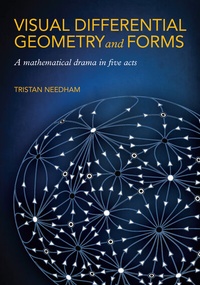
Visual Differential Geometry and Forms
A Mathematical Drama in Five Acts
1st Edition
Published on 5. July 2021
536 pages
978-0-691-21989-9 (ISBN)
Description

An inviting, intuitive, and visual exploration of differential geometry and forms
Visual Differential Geometry and Forms fulfills two principal goals. In the first four acts, Tristan Needham puts the geometry back into differential geometry. Using 235 hand-drawn diagrams, Needham deploys Newton's geometrical methods to provide geometrical explanations of the classical results. In the fifth act, he offers the first undergraduate introduction to differential forms that treats advanced topics in an intuitive and geometrical manner.
Unique features of the first four acts include: four distinct geometrical proofs of the fundamentally important Global Gauss-Bonnet theorem, providing a stunning link between local geometry and global topology; a simple, geometrical proof of Gauss's famous Theorema Egregium; a complete geometrical treatment of the Riemann curvature tensor of an n-manifold; and a detailed geometrical treatment of Einstein's field equation, describing gravity as curved spacetime (General Relativity), together with its implications for gravitational waves, black holes, and cosmology. The final act elucidates such topics as the unification of all the integral theorems of vector calculus; the elegant reformulation of Maxwell's equations of electromagnetism in terms of 2-forms; de Rham cohomology; differential geometry via Cartan's method of moving frames; and the calculation of the Riemann tensor using curvature 2-forms. Six of the seven chapters of Act V can be read completely independently from the rest of the book.
Requiring only basic calculus and geometry, Visual Differential Geometry and Forms provocatively rethinks the way this important area of mathematics should be considered and taught.
Visual Differential Geometry and Forms fulfills two principal goals. In the first four acts, Tristan Needham puts the geometry back into differential geometry. Using 235 hand-drawn diagrams, Needham deploys Newton's geometrical methods to provide geometrical explanations of the classical results. In the fifth act, he offers the first undergraduate introduction to differential forms that treats advanced topics in an intuitive and geometrical manner.
Unique features of the first four acts include: four distinct geometrical proofs of the fundamentally important Global Gauss-Bonnet theorem, providing a stunning link between local geometry and global topology; a simple, geometrical proof of Gauss's famous Theorema Egregium; a complete geometrical treatment of the Riemann curvature tensor of an n-manifold; and a detailed geometrical treatment of Einstein's field equation, describing gravity as curved spacetime (General Relativity), together with its implications for gravitational waves, black holes, and cosmology. The final act elucidates such topics as the unification of all the integral theorems of vector calculus; the elegant reformulation of Maxwell's equations of electromagnetism in terms of 2-forms; de Rham cohomology; differential geometry via Cartan's method of moving frames; and the calculation of the Riemann tensor using curvature 2-forms. Six of the seven chapters of Act V can be read completely independently from the rest of the book.
Requiring only basic calculus and geometry, Visual Differential Geometry and Forms provocatively rethinks the way this important area of mathematics should be considered and taught.
More details
Other editions
Additional editions
Book
07/2021
Princeton University Press
€52.50
Shipment within 10-20 days
Book
07/2021
Princeton University Press
€155.50
Shipment within 10-20 days
Person
Tristan Needham is professor of mathematics at the University of San Francisco. He is the author of Visual Complex Analysis.
Content
- Cover
- Contents
- Prologue
- Acknowledgements
- ACT I. The Nature of Space
- 1. Euclidean and Non-Euclidean Geometry
- 1.1 Euclidean and Hyperbolic Geometry
- 1.2 Spherical Geometry
- 1.3 The Angular Excess of a Spherical Triangle
- 1.4 Intrinsic and Extrinsic Geometry of Curved Surfaces
- 1.5 Constructing Geodesics via Their Straightness
- 1.6 The Nature of Space
- 2. Gaussian Curvature
- 2.1 Introduction
- 2.2 The Circumference and Area of a Circle
- 2.3 The Local Gauss-Bonnet Theorem
- 3 Exercises for Prologue and Act I
- ACT II. The Metric
- 4. Mapping Surfaces: The Metric
- 4.1 Introduction
- 4.2 The Projective Map of the Sphere
- 4.3 The Metric of a General Surface
- 4.4 The Metric Curvature Formula
- 4.5 Conformal Maps
- 4.6 Some Visual Complex Analysis
- 4.7 The Conformal Stereographic Map of the Sphere
- 4.8 Stereographic Formulas
- 4.9 Stereographic Preservation of Circles
- 5. The Pseudosphere and the Hyperbolic Plane
- 5.1 Beltrami's Insight
- 5.2 The Tractrix and the Pseudosphere
- 5.3 A Conformal Map of the Pseudosphere
- 5.4 The Beltrami-Poincaré Half-Plane
- 5.5 Using Optics to Find the Geodesics
- 5.6 The Angle of Parallelism
- 5.7 The Beltrami-Poincaré Disc
- 6. Isometries and Complex Numbers
- 6.1 Introduction
- 6.2 Möbius Transformations
- 6.3 The Main Result
- 6.4 Einstein's Spacetime Geometry
- 6.5 Three-Dimensional Hyperbolic Geometry
- 7 Exercises for Act II
- ACT III. Curvature
- 8. Curvature of Plane Curves
- 8.1 Introduction
- 8.2 The Circle of Curvature
- 8.3 Newton's Curvature Formula
- 8.4 Curvature as Rate of Turning
- 8.5 Example: Newton's Tractrix
- 9. Curves in 3-Space
- 10. The Principal Curvatures of a Surface
- 10.1 Euler's Curvature Formula
- 10.2 Proof of Euler's Curvature Formula
- 10.3 Surfaces of Revolution
- 11. Geodesics and Geodesic Curvature
- 11.1 Geodesic Curvature and Normal Curvature
- 11.2 Meusnier's Theorem
- 11.3 Geodesics are "Straight
- 11.4 Intrinsic Measurement of Geodesic Curvature
- 11.5 A Simple Extrinsic Way to Measure Geodesic Curvature
- 11.6 A New Explanation of the Sticky-Tape Construction of Geodesics
- 11.7 Geodesics on Surfaces of Revolution
- 11.7.1 Clairaut's Theorem on the Sphere
- 11.7.2 Kepler's Second Law
- 11.7.3 Newton's Geometrical Demonstration of Kepler's Second Law
- 11.7.4 Dynamical Proof of Clairaut's Theorem
- 11.7.5 Application: Geodesics in the Hyperbolic Plane (Revisited)
- 12. The Extrinsic Curvature of a Surface
- 12.1 Introduction
- 12.2 The Spherical Map
- 12.3 Extrinsic Curvature of Surfaces
- 12.4 What Shapes Are Possible?
- 13. Gauss's Theorema Egregium
- 13.1 Introduction
- 13.2 Gauss's Beautiful Theorem (1816)
- 13.3 Gauss's Theorema Egregium (1827)
- 14. The Curvature of a Spike
- 14.1 Introduction
- 14.2 Curvature of a Conical Spike
- 14.3 The Intrinsic and Extrinsic Curvature of a Polyhedral Spike
- 14.4 The Polyhedral Theorema Egregium
- 15. The Shape Operator
- 15.1 Directional Derivatives
- 15.2 The Shape Operator S
- 15.3 The Geometric Effect of S
- 15.4 DETOUR: The Geometry of the Singular Value Decomposition and of the Transpose
- 15.5 The General Matrix of S
- 15.6 Geometric Interpretation of S and Simplification of [S]
- 15.7 [S] Is Completely Determined by Three Curvatures
- 15.8 Asymptotic Directions
- 15.9 Classical Terminology and Notation: The Three Fundamental Forms
- 16. Introduction to the Global Gauss-Bonnet Theorem
- 16.1 Some Topology and the Statement of the Result
- 16.2 Total Curvature of the Sphere and of the Torus
- 16.2.1 Total Curvature of the Sphere
- 16.2.2 Total Curvature of the Torus
- 16.3 Seeing K(Sg) via a Thick Pancake
- 16.4 Seeing K(Sg) via Bagels and Bridges
- 16.5 The Topological Degree of the Spherical Map
- 16.6 Historical Note
- 17. First (Heuristic) Proof of the Global Gauss-Bonnet Theorem
- 17.1 Total Curvature of a Plane Loop: Hopf's Umlaufsatz
- 17.2 Total Curvature of a Deformed Circle
- 17.3 Heuristic Proof of Hopf's Umlaufsatz
- 17.4 Total Curvature of a Deformed Sphere
- 17.5 Heuristic Proof of the Global Gauss-Bonnet Theorem
- 18. Second (Angular Excess) Proof of the Global Gauss-Bonnet Theorem
- 18.1 The Euler Characteristic
- 18.2 Euler's (Empirical) Polyhedral Formula
- 18.3 Cauchy's Proof of Euler's Polyhedral Formula
- 18.3.1 Flattening Polyhedra
- 18.3.2 The Euler Characteristic of a Polygonal Net
- 18.4 Legendre's Proof of Euler's Polyhedral Formula
- 18.5 Adding Handles to a Surface to Increase Its Genus
- 18.6 Angular Excess Proof of the Global Gauss-Bonnet Theorem
- 19. Third (Vector Field) Proof of the Global Gauss-Bonnet Theorem
- 19.1 Introduction
- 19.2 Vector Fields in the Plane
- 19.3 The Index of a Singular Point
- 19.4 The Archetypal Singular Points: Complex Powers
- 19.5 Vector Fields on Surfaces
- 19.5.1 The Honey-Flow Vector Field
- 19.5.2 Relation of the Honey-Flow to the Topographic Map
- 19.5.3 Defining the Index on a Surface
- 19.6 The Poincaré-Hopf Theorem
- 19.6.1 Example: The Topological Sphere
- 19.6.2 Proof of the Poincaré-Hopf Theorem
- 19.6.3 Application: Proof of the Euler-L'Huilier Formula
- 19.6.4 Poincaré's Differential Equations Versus Hopf's Line Fields
- 19.7 Vector Field Proof of the Global Gauss-Bonnet Theorem
- 19.8 The Road Ahead
- 20. Exercises for Act III
- ACT IV. Parallel Transport
- 21. An Historical Puzzle
- 22. Extrinsic Constructions
- 22.1 Project into the Surface as You Go!
- 22.2 Geodesics and Parallel Transport
- 22.3 Potato-Peeler Transport
- 23. Intrinsic Constructions
- 23.1 Parallel Transport via Geodesics
- 23.2 The Intrinsic (aka, "Covariant") Derivative
- 24. Holonomy
- 24.1 Example: The Sphere
- 24.2 Holonomy of a General Geodesic Triangle
- 24.3 Holonomy Is Additive
- 24.4 Example: The Hyperbolic Plane
- 25. An Intuitive Geometric Proof of the Theorema Egregium
- 25.1 Introduction
- 25.2 Some Notation and Reminders of Definitions
- 25.3 The Story So Far
- 25.4 The Spherical Map Preserves Parallel Transport
- 25.5 The Beautiful Theorem and Theorema Egregium Explained
- 26. Fourth (Holonomy) Proof of the Global Gauss-Bonnet Theorem
- 26.1 Introduction
- 26.2 Holonomy Along an Open Curve?
- 26.3 Hopf's Intrinsic Proof of the Global Gauss-Bonnet Theorem
- 27. Geometric Proof of the Metric Curvature Formula
- 27.1 Introduction
- 27.2 The Circulation of a Vector Field Around a Loop
- 27.3 Dry Run: Holonomy in the Flat Plane
- 27.4 Holonomy as the Circulation of a Metric-Induced Vector Field in the Map
- 27.5 Geometric Proof of the Metric Curvature Formula
- 28. Curvature as a Force between Neighbouring Geodesics
- 28.1 Introduction to the Jacobi Equation
- 28.1.1 Zero Curvature: The Plane
- 28.1.2 Positive Curvature: The Sphere
- 28.1.3 Negative Curvature: The Pseudosphere
- 28.2 Two Proofs of the Jacobi Equation
- 28.2.1 Geodesic Polar Coordinates
- 28.2.2 Relative Acceleration = Holonomy of Velocity
- 28.3 The Circumference and Area of a Small Geodesic Circle
- 29. Riemann's Curvature
- 29.1 Introduction and Summary
- 29.2 Angular Excess in an n-Manifold
- 29.3 Parallel Transport: Three Constructions
- 29.3.1 Closest Vector on Constant-Angle Cone
- 29.3.2 Constant Angle within a Parallel-Transported Plane
- 29.3.3 Schild's Ladder
- 29.4 The Intrinsic (aka "Covariant") Derivative ?v
- 29.5 The Riemann Curvature Tensor
- 29.5.1 Parallel Transport Around a Small "Parallelogram
- 29.5.2 Closing the "Parallelogram" with the Vector Commutator
- 29.5.3 The General Riemann Curvature Formula
- 29.5.4 Riemann's Curvature Is a Tensor
- 29.5.5 Components of the Riemann Tensor
- 29.5.6 For a Given wo, the Vector Holonomy Only Depends on the Plane of the Loop and Its Area
- 29.5.7 Symmetries of the Riemann Tensor
- 29.5.8 Sectional Curvatures
- 29.5.9 Historical Notes on the Origin of the Riemann Tensor
- 29.6 The Jacobi Equation in an n-Manifold
- 29.6.1 Geometrical Proof of the Sectional Jacobi Equation
- 29.6.2 Geometrical Implications of the Sectional Jacobi Equation
- 29.6.3 Computational Proofs of the Jacobi Equation and the Sectional Jacobi Equation
- 29.7 The Ricci Tensor
- 29.7.1 Acceleration of the Area Enclosed by a Bundle of Geodesics
- 29.7.2 Definition and Geometrical Meaning of the Ricci Tensor
- 29.8 Coda
- 30. Einstein's Curved Spacetime
- 30.1 Introduction: "The Happiest Thought of My Life
- 30.2 Gravitational Tidal Forces
- 30.3 Newton's Gravitational Law in Geometrical Form
- 30.4 The Spacetime Metric
- 30.5 Spacetime Diagrams
- 30.6 Einstein's Vacuum Field Equation in Geometrical Form
- 30.7 The Schwarzschild Solution and the First Tests of the Theory
- 30.8 Gravitational Waves
- 30.9 The Einstein Field Equation (with Matter) in Geometrical Form
- 30.10 Gravitational Collapse to a Black Hole
- 30.11 The Cosmological Constant: "The Greatest Blunder of My Life
- 30.12 The End
- 31. Exercises for Act IV
- ACT V. Forms
- 32. 1-Forms
- 32.1 Introduction
- 32.2 Definition of a 1-Form
- 32.3 Examples of 1-Forms
- 32.3.1 Gravitational Work
- 32.3.2 Visualizing the Gravitational Work 1-Form
- 32.3.3 Topographic Maps and the Gradient 1-Form
- 32.3.4 Row Vectors
- 32.3.5 Dirac's Bras
- 32.4 Basis 1-Forms
- 32.5 Components of a 1-Form
- 32.6 The Gradient as a 1-Form: df
- 32.6.1 Review of the Gradient as a Vector: .f
- 32.6.2 The Gradient as a 1-Form: df
- 32.6.3 The Cartesian 1-Form Basis: {dxj
- 32.6.4 The 1-Form Interpretation of df=(Bxf) dx+(Byf) dy
- 32.7 Adding 1-Forms Geometrically
- 33. Tensors
- 33.1 Definition of a Tensor: Valence
- 33.2 Example: Linear Algebra
- 33.3 New Tensors from Old
- 33.3.1 Addition
- 33.3.2 Multiplication: The Tensor Product
- 33.4 Components
- 33.5 Relation of the Metric Tensor to the Classical Line Element
- 33.6 Example: Linear Algebra (Again)
- 33.7 Contraction
- 33.8 Changing Valence with the Metric Tensor
- 33.9 Symmetry and Antisymmetry
- 34. 2-Forms
- 34.1 Definition of a 2-Form and of a p-Form
- 34.2 Example: The Area 2-Form
- 34.3 The Wedge Product of Two 1-Forms
- 34.4 The Area 2-Form in Polar Coordinates
- 34.5 Basis 2-Forms and Projections
- 34.6 Associating 2-Forms with Vectors in R3: Flux
- 34.7 Relation of the Vector and Wedge Products in R3
- 34.8 The Faraday and Maxwell Electromagnetic 2-Forms
- 35. 3-Forms
- 35.1 A 3-Form Requires Three Dimensions
- 35.2 TheWedge Product of a 2-Form and 1-Form
- 35.3 The Volume 3-Form
- 35.4 The Volume 3-Form in Spherical Polar Coordinates
- 35.5 TheWedge Product of Three 1-Forms and of p 1-Forms
- 35.6 Basis 3-Forms
- 35.7 Is ... =0 Possible?
- 36. Differentiation
- 36.1 The Exterior Derivative of a 1-Form
- 36.2 The Exterior Derivative of a 2-Form and of a p-Form
- 36.3 The Leibniz Rule for Forms
- 36.4 Closed and Exact Forms
- 36.4.1 A Fundamental Result: d2 =0
- 36.4.2 Closed and Exact Forms
- 36.4.3 Complex Analysis: Cauchy-Riemann Equations
- 36.5 Vector Calculus via Forms
- 36.6 Maxwell's Equations
- 37. Integration
- 37.1 The Line Integral of a 1-Form
- 37.1.1 Circulation and Work
- 37.1.2 Path-Independence .. Vanishing Loop Integrals
- 37.1.3 The Integral of an Exact Form: .=df
- 37.2 The Exterior Derivative as an Integral
- 37.2.1 d(1-Form)
- 37.2.2 d(2-Form)
- 37.3 Fundamental Theorem of Exterior Calculus (Generalized Stokes's Theorem)
- 37.3.1 Fundamental Theorem of Exterior Calculus
- 37.3.2 Historical Aside
- 37.3.3 Example: Area
- 37.4 The Boundary of a Boundary Is Zero!
- 37.5 The Classical Integral Theorems of Vector Calculus
- 37.5.1 F=0-Form
- 37.5.2 F=1-Form
- 37.5.3 F=2-Form
- 37.6 Proof of the Fundamental Theorem of Exterior Calculus
- 37.7 Cauchy's Theorem
- 37.8 The Poincaré Lemma for 1-Forms
- 37.9 A Primer on de Rham Cohomology
- 37.9.1 Introduction
- 37.9.2 A Special 2-Dimensional Vortex Vector Field
- 37.9.3 The Vortex 1-Form Is Closed
- 37.9.4 Geometrical Meaning of the Vortex 1-Form
- 37.9.5 The Topological Stability of the Circulation of a Closed 1-Form
- 37.9.6 The First de Rham Cohomology Group
- 37.9.7 The Inverse-Square Point Source in R3
- 37.9.8 The Second de Rham Cohomology Group
- 37.9.9 The First de Rham Cohomology Group of the Torus
- 38. Differential Geometry via Forms
- 38.1 Introduction: Cartan's Method of Moving Frames
- 38.2 Connection 1-Forms
- 38.2.1 Notational Conventions and Two Definitions
- 38.2.2 Connection 1-Forms
- 38.2.3 WARNING: Notational Hazing Rituals Ahead!
- 38.3 The Attitude Matrix
- 38.3.1 The Connection Forms via the Attitude Matrix
- 38.3.2 Example: The Cylindrical Frame Field
- 38.4 Cartan's Two Structural Equations
- 38.4.1 The Duals .i of mi in Terms of the Duals dxj of ej
- 38.4.2 Cartan's First Structural Equation
- 38.4.3 Cartan's Second Structural Equation
- 38.4.4 Example: The Spherical Frame Field
- 38.5 The Six Fundamental Form Equations of a Surface
- 38.5.1 Adapting Cartan's Moving Frame to a Surface: The Shape Operator and the Extrinsic Curvature
- 38.5.2 Example: The Sphere
- 38.5.3 Uniqueness of Basis Decompositions
- 38.5.4 The Six Fundamental Form Equations of a Surface
- 38.6 Geometrical Meanings of the Symmetry Equation and the Peterson-Mainardi-Codazzi Equations
- 38.7 Geometrical Form of the Gauss Equation
- 38.8 Proof of the Metric Curvature Formula and the Theorema Egregium
- 38.8.1 Lemma: Uniqueness of ?12
- 38.8.2 Proof of the Metric Curvature Formula
- 38.9 A New Curvature Formula
- 38.10 Hilbert's Lemma
- 38.11 Liebmann's Rigid Sphere Theorem
- 38.12 The Curvature 2-Forms of an n-Manifold
- 38.12.1 Introduction and Summary
- 38.12.2 The Generalized Exterior Derivative
- 38.12.3 Extracting the Riemann Tensor from the Curvature 2-Forms
- 38.12.4 The Bianchi Identities Revisited
- 38.13 The Curvature of the Schwarzschild Black Hole
- 39. Exercises for Act V
- Further Reading
- Bibliography
- Index
