

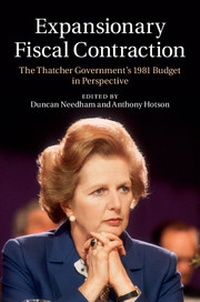
Expansionary Fiscal Contraction
The Thatcher Government's 1981 Budget in Perspective
1st Edition
Published on 27. August 2014
272 pages
978-1-139-99043-1 (ISBN)
Description

In its 1981 Budget, the Thatcher government discarded Keynesian counter-cyclical policies and cut Britain's public sector deficit in the depths of the worst UK recession since the 1930s. Controversially, the government argued that fiscal contraction would produce economic growth. In this specially commissioned volume, contributors examine recently released archives alongside firsthand accounts from key players within No. 10 Downing Street, HM Treasury and the Bank of England, to provide the first comprehensive treatment of this critical event in British economic history. They assess the empirical and theoretical basis for expansionary fiscal contraction, drawing clear parallels with contemporary debates on austerity in Europe, USA and Japan in the wake of the recent global financial crisis. This timely and thoughtful book will have broad appeal among economists, political scientists, historians and policy makers.
Reviews / Votes
'The arduous process of economic policy-making on the run is wonderfully exposed in this volume on the famous 1981 Budget. The reader is taken into the corridors of Great George Street and into the Faculties of Economics and should come away realising just how hard it is to do this stuff right.' Jagjit Chadha, University of Kent 'Budgets have redefined the economic policy of Britain: Gladstone's in 1853, Lloyd George's in 1909 - and Howe's in 1981. This excellent collection offers a sophisticated appreciation of the ideological divisions and political tensions of 1981 that brings together participants with a study of the archives. It is a major contribution to understanding the economic policies of our own time.' Martin Daunton, University of Cambridge 'Geoffrey Howe's highly controversial anti-Keynesian 1981 Budget, which significantly reduced the Government's fiscal deficit at the depth of a recession, was one of the more important turning points of the Thatcher era. A number of chapters in this book, in particular those by Sir Tim Lankester, the Treasury private secretary at Number 10 at the time, and Christopher Collins, the Director of the Margaret Thatcher Foundation, add usefully to our knowledge of how this historic event occurred.' Lord Lawson, former Chancellor of the Exchequer 'A rich collection of perspectives on a key and controversial turning point in Britain's modern economic management and performance. Brimming with insights and lessons for policy-makers, commentators and scholars.' Richard Roberts, Director of the Institute of Contemporary British History, King's College London 'This book makes an invaluable - indeed unique - contribution to the appraisal, not just of the 1981 Budget, which is its purpose, but of the whole edifice of thinking and analysis which underlay it. Indeed it raises in a fundamental form the question of what today the basis of macro-economic policy should be, if in fact there is any such thing. It is written by a variety of authorities - academics, journalists and former civil servants - and each brings to the discussion a perspective and insight which it would be difficult to match; and their conclusions, though by no means unanimous, are rigorously argued and well presented. This is a book not just for the academic specialist but for the general public as it struggles to understand how governments today make economic policy.' Sir Douglas Wass, former Permanent Secretary to the TreasuryMore details
Language
English
Place of publication
Cambridge
United Kingdom
Publishing group
Cambridge University Press
Target group
Professional and scholarly
Illustrations
10 Tables, black and white; 9 Line drawings, unspecified
File size
2,42 MB
ISBN-13
978-1-139-99043-1 (9781139990431)
Copyright in bibliographic data and cover images is held by Nielsen Book Services Limited or by the publishers or by their respective licensors: all rights reserved.
Schweitzer Classification
Other editions
Additional editions
Duncan Needham | Anthony Hotson
Expansionary Fiscal Contraction
The Thatcher Government's 1981 Budget in Perspective
Book
09/2014
Cambridge University Press
€132.50
No shipping information available
Persons
Duncan Needham is a Research Fellow at Darwin College, Cambridge and Associate Director of the Centre for Financial History at Newnham College, Cambridge where he works on contemporary UK economic history. Before returning to academia, he worked as a credit trader at JP Morgan and then as a structured credit portfolio manager at Cairn Capital. Dr Needham lectures in Economic History and teaches undergraduate and graduate courses in history, economics and politics. Anthony Hotson is an associate member of the History Faculty at the University of Oxford, and a research associate of the Centre for Financial History at the University of Cambridge. He worked at the Bank of England during the 1980s, including a year on secondment as assistant commissioner at the newly formed Building Societies Commission. He also worked at McKinsey and Company before joining S. G. Warburg, where he was a corporate financier and director during the 1990s. Thereafter, he served as a non-executive director on a number of company boards in the insurance, fund management and banking sectors, as well as pursuing his academic interests. More recently, Dr Hotson has been a research fellow at the Winton Institute for Monetary History at the University of Oxford. He teaches macroeconomics and financial history, and has recently co-edited a book on the economic policies of the Thatcher government, and another on British financial crises since the nineteenth century. He is a non-executive director of Cenkos Securities plc and chairman of a charity, the Wadenhoe Trust.
Content
Foreword Geoffrey Howe; 1. The 1981 statement by 364 economists Robert Neild; 2. The 1981 Budget: how did it come about? Tim Lankester; 3. The London Business School and the 1981 Budget Alan Budd; 4. The 1981 Budget: a view from the cockpit Adam Ridley; 5. The Bank of England and the 1981 Budget Charles Goodhart; 6. 1981 and all that William Keegan; 7. The origins of the Budget in 1980 Christopher Collins; 8. The 1981 Budget and its impact on the conduct of economic policy: was it a monetarist revolution? Anthony Hotson; 9. The 1981 Budget: 'a Dunkirk, not an Alamein' Duncan Needham; 10. Macro-economic policy and the 1981 Budget: changing the trend Ray Barrell; 11. The Keynesian twin deficits in an inflationary context Robert Z. Aliber; 12. The long road to 1981: British money supply targets from DCE to the MTFS Michael J. Oliver; List of names; Chronology of events; Official sources; Bibliography of secondary sources; Index.
