

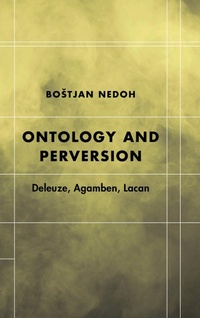
Ontology and Perversion
Deleuze, Agamben, Lacan
1st Edition
Published on 4. June 2019
214 pages
979-8-8818-5778-3 (ISBN)
Description

This book examines the philosophical and political relevance of perversion in the works of three key representatives of contemporary philosophy and psychoanalysis: Gilles Deleuze, Giorgio Agamben and Jacques Lacan.
Perversion is often understood simply in terms of cultural or sexual phenomena. By contrast, BoStjan Nedoh places perversion at the heart of philosophical, ontological and political issues in the works of Deleuze, Agamben and Lacan. He examines the relevance of their discussions of perversion for their respective critical ontological projects. By tracing the differences between these thinkers' understanding of perversion, the book finally draws lines of delimitation between the vitalist and the structuralist or psychoanalytic philosophical positions in contemporary philosophy.
Perversion is often understood simply in terms of cultural or sexual phenomena. By contrast, BoStjan Nedoh places perversion at the heart of philosophical, ontological and political issues in the works of Deleuze, Agamben and Lacan. He examines the relevance of their discussions of perversion for their respective critical ontological projects. By tracing the differences between these thinkers' understanding of perversion, the book finally draws lines of delimitation between the vitalist and the structuralist or psychoanalytic philosophical positions in contemporary philosophy.
More details
Series
Edition
1. Auflage
Language
English
Place of publication
United States
Publishing group
Bloomsbury Publishing Plc
ISBN-13
979-8-8818-5778-3 (9798881857783)
Copyright in bibliographic data and cover images is held by Nielsen Book Services Limited or by the publishers or by their respective licensors: all rights reserved.
Schweitzer Classification
Other editions
Additional editions
Book
06/2019
Rowman & Littlefield International
€157.40
Shipment within 3-4 weeks
Person
BoStjan Nedoh is a Research Fellow at the Research Centre of the Slovenian Academy of Sciences and Arts, Institute of Philosophy, Ljubljana.
Content
Acknowledgments
Preface
Part I: Introductory: Perversion as a Theatre of Being
1 Perversions and Critical Ontologies: Ontologysing Perversion, Perverting Ontology in Deleuze, Agamben, and Lacan
Part II: Perversion between Deleuze's Transcendental Empiricism and the Ontology of Immanence Theatrum Philosophicum
2 Deleuze's Transcendental Empiricism: Simulacrum, Divergence and the Ontology of Difference
3 Masoch as a Name-of-Being
4 From Masoch to Tao: The Revision of Masochism in Late Deleuze
Part III: Beyond Metaphysics? Perversion in Agamben's Philosophy of Language and Political Philosophy Theatrum Politicum
5 Perverse Sphinx Against Oedipal Metaphysics: (Anti-)Metaphysics of Perversion in Agamben's Critique of Derrida and Freud
6 Messianism between Religion and Post-Religion: On the Perverse Structure of the Messianic Time
7 State of Exception and Sade's Biopolitical Manifesto
Part IV: Not Without the Other: Ontology and Perversion in Lacanian Psychoanalysis Theatrum Analiticum
8 Why Perversi
Preface
Part I: Introductory: Perversion as a Theatre of Being
1 Perversions and Critical Ontologies: Ontologysing Perversion, Perverting Ontology in Deleuze, Agamben, and Lacan
Part II: Perversion between Deleuze's Transcendental Empiricism and the Ontology of Immanence Theatrum Philosophicum
2 Deleuze's Transcendental Empiricism: Simulacrum, Divergence and the Ontology of Difference
3 Masoch as a Name-of-Being
4 From Masoch to Tao: The Revision of Masochism in Late Deleuze
Part III: Beyond Metaphysics? Perversion in Agamben's Philosophy of Language and Political Philosophy Theatrum Politicum
5 Perverse Sphinx Against Oedipal Metaphysics: (Anti-)Metaphysics of Perversion in Agamben's Critique of Derrida and Freud
6 Messianism between Religion and Post-Religion: On the Perverse Structure of the Messianic Time
7 State of Exception and Sade's Biopolitical Manifesto
Part IV: Not Without the Other: Ontology and Perversion in Lacanian Psychoanalysis Theatrum Analiticum
8 Why Perversi
