

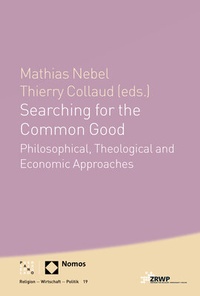
Searching for the Common Good
Philosophical, Theological and Economical Approaches
1st Edition
Published on 28. June 2018
232 pages
978-3-8452-8301-2 (ISBN)
Description

This book addresses the heated debate on whether politics has to care only about the question of justice, rights and tolerance or open up to a teleological concept like the common good. Long considered the central feature of the public sphere, the common good was progressively sidelined during the 20th century. But amid ambiguous globalisation and the limits of political liberalism, the common good is returning to the fore.
This volume gathers together theologians, economists and philosophers in order to investigate this concept's relevance in meeting the challenges of our time. It argues in different ways and from different disciplines that the common good is what shapes the public sphere most profoundly. It is not a closed concept, but rather a dia-lectic that drives societies and humanity towards more human integration. As such, the common good is a form of hope, hope that what is good for me and what is good for others are not ultimately at odds but actually enrich and extend each other.
More details
Other editions
Additional editions
Thierry Collaud / Mathias Nebel
Searching for the Common Good
Philosophical, Theological and Economical Approaches
Book
05/2018
Nomos
€32.00
Shipment within 5-7 days
Nomos Verlagsgesellschaft | Mathias Nebel | Thierry Collaud
Searching for the Common Good
Philosophical, Theological and Economical Approaches
Book
04/2018
Theologischer Verlag Zürich
€32.00
Shipment within 5-7 days
Persons
Content
- Cover
- Introduction
- Boundaries
- From the particular to the universal: common goods
- The common good and political philosophy
- Historic overview. Recalling the richness and complexity of a notion and its selective transmission to modernity
- The Language of the Common Good in Scholastic Political Thought
- Politics Pointing beyond the Polis and the Politeia: Aquinas on Natural Law and the Common Good
- I. Natural Right and Natural Law: Aquinas's "Tendentious Glosses" on Nicomachean Ethics V.7
- II. Natural Law and the Problem of Regime-Relative Political Virtue
- III. Natural Law, Magnanimity cum Humility, and Contemporary Politics
- The common good: still pertinent today? The Economy
- Building the common good and making it grow
- I. The diagnosis: denial or (ideological) blindness, and systemic transformation
- II. The common good: an ideal orientation for action
- III. Directions of actions aimed at the common good
- IV. Systemic dynamics geared to the common good
- The Common Good and the Civil Economy
- Introduction
- What is civil economy?
- The common good as a category of economic thinking
- The return of the 'common good' category
- Prospects for action, and a concluding note
- Defining the common good in terms of capabilities
- Definitions
- Real versus formal freedom
- Freedom of choice and reason to value
- Conclusion
- The common good: Still pertinent today? Theological and political philosophy
- Searching for the common good
- Introduction
- Part 1: Why the notion was rejected
- 1. The operational need for the common good
- 2. Liberal criticism and its inconsistencies
- 2.1 The totalitarian nature of the notion of the common good and the retreat on the question of justice
- 2.2 Rawls's use of the notion of the common good
- 2.3 The contractualist inversion of eschatology and protology
- 2.4 A critical review of Rawls's use of the 'political good'
- 2.5 The usefulness of the social contract myths
- Part 2: The fundamentals of a reinterpretation of the notion of the common good
- 1. The common good belongs to the sphere of action
- 1.1 The notion of the common good is implicit in all public action
- 1.2 The need to act in common, and the community created by common action
- 1.3 The elements of common action
- 2. The vocabulary of the common good
- 2.1 The social good and the shared value of the common benefit
- 2.2 The good of order and the common rationality it creates
- 2.3 The specific common good
- 2.4 The common good as a nexus of relationships between specific common goods: the universal common good (the horizon of the common good)
- 3. Aiming at the common good in politics
- 3.1 The Living together bears the hope of a conjunction between the personal good and the good of the community - it shelters the liberating power of a transcendent hope.
- 4. Aiming at the common good as the dialectic of politics
- 4.1 The conjunction of the good of the individual and the good of the community
- 4.2 Wanting the common good
- 4.3 The dialectical dynamic of the common good
- Conclusion
- The common good: historical roots in the Greek patristic texts and modern foundations
- Introduction
- The common good in the span of today's Christian Ethics: the Roman Catholic and the Orthodox theological traditions
- From ancient Greek philosophy to Christian Theology
- Situating the common good in Greek patristic texts and the paradigm of St Basil: Revisiting the missing bond
- In Search of the common good on a windy trail
- The names that theology gives to the common good
- The common good as salvation
- Hermeneutics of coexistenceThe human community between war and peace
- The community as a living body
- The violence that threatens the common good
- The common good as a resolution of the tension between war and peace
- Hermeneutics of transcendence love that builds
- The common good as desire
- The common good as relationship
- The common good as blessing
- The common good as a life unfolding its fruitfulness
- The common good as community under grace
- The common good as recognised and accepted brotherhood
- The common good as body of Christ
- Conclusion
- The common good tested against the option for the poor: a perspective for the Church's social commitment
- Introduction
- When the disadvantaged are excluded
- An appeal to respect human dignity
- From 'listening to the poor' to an 'option for the poor'
- Human rights as a lever for action
- The personal is political
- Pastoral perspectives
- A Theological Conclusion
- The closure of the commons and the dynamic of the common good
- Allegiance to the commons: social habitus and shared virtues
- Global common goods and governance for the common good
- Authors
