

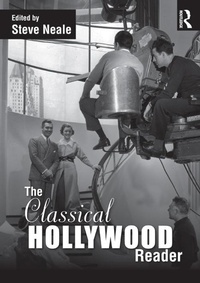
The Classical Hollywood Reader
1st Edition
Published on 12. November 2012
496 pages
978-1-135-72000-1 (ISBN)
Description

The Classical Hollywood Reader brings together essential readings to provide a history of Hollywood from the 1910s to the mid 1960s.
Following on from a Prologue that discusses the aesthetic characteristics of Classical Hollywood films, Part 1 covers the period between the 1910s and the mid-to-late 1920s. It deals with the advent of feature-length films in the US and the growing national and international dominance of the companies responsible for their production, distribution and exhibition. In doing so, it also deals with film making practices, aspects of style, the changing roles played by women in an increasingly business-oriented environment, and the different audiences in the US for which Hollywood sought to cater.
Part 2 covers the period between the coming of sound in the mid 1920s and the beginnings of the demise of the `studio system` in late 1940s. In doing so it deals with the impact of sound on films and film production in the US and Europe, the subsequent impact of the Depression and World War II on the industry and its audiences, the growth of unions, and the roles played by production managers and film stars at the height of the studio era.
Part 3 deals with aspects of style, censorship, technology, and film production. It includes articles on the Production Code, music and sound, cinematography, and the often neglected topic of animation.
Part 4 covers the period between 1946 and 1966. It deals with the demise of the studio system and the advent of independent production. In an era of demographic and social change, it looks at the growth of drive-in theatres, the impact of television, the advent of new technologies, the increasing importance of international markets, the Hollywood blacklist, the rise in art house imports and in overseas production, and the eventual demise of the Production Code.
Designed especially for courses on Hollywood Cinema, the Reader includes a number of newly researched and written chapters and a series of introductions to each of its parts. It concludes with an epilogue, a list of resources for further research, and an extensive bibliography.
Following on from a Prologue that discusses the aesthetic characteristics of Classical Hollywood films, Part 1 covers the period between the 1910s and the mid-to-late 1920s. It deals with the advent of feature-length films in the US and the growing national and international dominance of the companies responsible for their production, distribution and exhibition. In doing so, it also deals with film making practices, aspects of style, the changing roles played by women in an increasingly business-oriented environment, and the different audiences in the US for which Hollywood sought to cater.
Part 2 covers the period between the coming of sound in the mid 1920s and the beginnings of the demise of the `studio system` in late 1940s. In doing so it deals with the impact of sound on films and film production in the US and Europe, the subsequent impact of the Depression and World War II on the industry and its audiences, the growth of unions, and the roles played by production managers and film stars at the height of the studio era.
Part 3 deals with aspects of style, censorship, technology, and film production. It includes articles on the Production Code, music and sound, cinematography, and the often neglected topic of animation.
Part 4 covers the period between 1946 and 1966. It deals with the demise of the studio system and the advent of independent production. In an era of demographic and social change, it looks at the growth of drive-in theatres, the impact of television, the advent of new technologies, the increasing importance of international markets, the Hollywood blacklist, the rise in art house imports and in overseas production, and the eventual demise of the Production Code.
Designed especially for courses on Hollywood Cinema, the Reader includes a number of newly researched and written chapters and a series of introductions to each of its parts. It concludes with an epilogue, a list of resources for further research, and an extensive bibliography.
More details
Language
English
Place of publication
London
United Kingdom
Publishing group
Taylor & Francis Ltd
Target group
College/higher education
Illustrations
13 s/w Tabellen
13 Tables, black and white
File size
6,72 MB
ISBN-13
978-1-135-72000-1 (9781135720001)
Copyright in bibliographic data and cover images is held by Nielsen Book Services Limited or by the publishers or by their respective licensors: all rights reserved.
Schweitzer Classification
Other editions
Additional editions
Steve Neale
The Classical Hollywood Reader
Book
04/2012
1st Edition
Routledge
€215.41
Shipment within 15-20 days
Steve Neale
The Classical Hollywood Reader
Book
04/2012
1st Edition
Routledge
€86.30
Shipment within 15-20 days
Person
Steve Neale is Professor and Chair in Film Studies, in the School of English at Exeter University, where he teaches Introduction to Film, Hollywood and Europe, Comedy, Comedians and Romance, and Film Noir. He is an internationally renowned film studies scholar. His research focuses principally on history and theory of Hollywood cinema and he has published several publications in these areas.
Since 2004, Professor Neale has been the Academic Director for the Bill Douglas Centre for the History of Cinema and Popular Culture.
Since 2004, Professor Neale has been the Academic Director for the Bill Douglas Centre for the History of Cinema and Popular Culture.
Content
Introduction; 1: Prologue: Emotional Curves and Linear Narratives; I: Feature Films, Hollywood and the Advent of the Studio System, 1912-26; 2: The Quality Race: Feature Films and Market Dominance in the US and Europe in the 1910s; 3: Making Movies, 1915-28; 4: The Limits of Experimentation in Hollywood; 5: "Doing a 'Man's Work' ": The Rise of the Studio System and the Remasculinization of Filmmaking; 6: Hollywood's Conception of Its Audience in the 1920s; II: Sound and the Studio System, 1926-46; 7: The Coming of Sound: Technological Change in the American Film Industry; 8: Hollywood Babel: the Coming of Sound and the Multiple Language Version; 9: Organization; 10: Hollywood: The Triumph of the Studio System; 11: Cinemagoing in the United States in the Mid-1930s: A Study Based on the Variety Dataset; 12: Selling Stars: The Economic Imperative; III: Representation, Technology, Production and Style, 1926-46; 13: The Production Code and the Mythologies of 'Pre-Code' Hollywood; 14: Commanding the Sounds of the Universe: Classical Hollywood Sound in the 1930s and Early 1940s; 15: The Classical Hollywood Film Score; 16: Shooting for Selznick: Craft and Collaboration in Hollywood Cinematography; 17: Order and Plenitude: Technicolor Aesthetics in the Classical Era; 18: The Disney-Fleischer Dilemma: Product Differentiation and Technological Innovation; IV: Postwar Hollywood and the End of the Studio System, 1946-66; 19: Individualism Versus Collectivism: The Shift to Independent Production in the US Film Industry; 20: Ozoners, Roadshows and Blitz Exhibitionism: Postwar Developments in Distribution and Exhibition; 21: Glorious Technicolor, Breathtaking Cinemascope and Stereophonic Sound; 22: Hollywood and Television in the 1950s: The Roots of Diversification; 23: Hollywood and Politics in the 1940s and 1950s; 24: Arties and Imports, Exports and Runaways, Adult Films and Exploitation 1
