

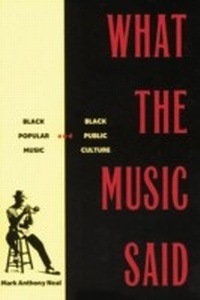
What the Music Said
Black Popular Music and Black Public Culture
1st Edition
Published on 13. September 2013
215 pages
978-1-135-20463-1 (ISBN)
Description

First Published in 1999. In What the Music Said, Mark Anthony Neal provides a timely study of from be-bop to Hip Hop. This book looks at the last fifty years of black popular music and provides an intriguing portrait of the existential and social forces that drove black communities to make music in protest, reaction and to fulfil their material and spiritual needs.
Reviews / Votes
"...validates Neal's intellectual and practical contribution to the fields of popular culture and Black cultural studies." -- Deborah Elizabeth Whaley, AmericanStudies"...carves out a well-defined intellectual and theoretical space for the post-soul generation--the soul babies of history." -- Deborah Elizabeth Whaley, American Studies
"Neal's cogent, coherent, and comprehensive What the MusicSaid is arguably the definitive study of the relationship between 20th-century black American music and black American society as a whole." -- Bill Piekarski, LibraryJournal
"Neal's grasp of the sociology of urban development is impressive, as is his familiarity with African-American studies scholarship and his knowledge of black popular music. Neal has undertaken to achieve a grand synthesis of popular culture and social research about the post-World War II black diaspora. Neal possesses encyclopedic knowledge of the music he surveys, while his pronouncements about its significance are incisive and insightful. [S]cholars interested in music, urban sociology, African-American studies, and cultural history will find What the Music Said to be wide-ranging in scope and penetrating in analysis. Indeed, since. Neal. undertake[s] to explore the ability of popular music to define community values, critique injustice, and inspire individuals to struggle for a more just society, perhaps [his book] should be considered appropriate reading for us all." -- History of Education Quarterly
"What the Music Said is a passionately written book. It provides expert analysis for those interested in the history of black arts, music and culture...What the MusicSaid hammers home the point that black music is the spiritual and political connection to our communal souls." -- Trent Fitzgerald, QBR
"Neal's book chronicles the development of various forms of black music from bebop to hip-hop with the meticulous care of a critic-historian and the zeal of a fan..In addition, What the Music Said does an excellent job of giving the reader a clear understanding of how music industry politics and current technology such as sampling help to shape the sound and texture of black popular music, particularly rap and R&B. The book is an impressive work of cultural criticism, one that both scholars and fans of popular music will learn from or argue with for decades to come." -- Washington DC Post
"In this deftly written study, Neal persuasively demonstrates that, from the spiritiuals sung by slaves to 20th-century blues, jazz, be-bop and soul, music has provided important 'aural space' in which African-American communities have been able to share and evaluate their collective experiences." -- Publisher'sWeekly
"Neal's book chronicles the development of various forms of black music from bebop to hip-hop with the meticulous care of a critic-historian and the zeal of a fan...The book is an impressive work of cultural criticism, one that both scholars and fans of popular music will learn from or argue with for decades to come." -- ChicagoHerald
"Neal manages to keep it real, while breaking off a little something for the homies in the academy." -- Todd Boyd, author of Am I Black Enough For You?
"Neal considers how structural transformations within the black community changed black music genres. The list of factors that Neal considers in tracing these structural changes and their musical consequences is ambtiously thorough, namely "migration patterns, dearth or abundance of public venues, national and local polotical movements, black religious institutions, black youth cutlure, the corporate annexation of black popular culture, crack cocaine, class stratification within the black community, gender relations, police brutality, and the structural and economic transformation of urban spaces." Neal's grasp of the sociology of urban development is impressive, as is his familiarity with African-American studies scholarship and his knowledge of black popular music." -- Goeffrey G. Tegnell, History of EducationQuarterly
"Neal has undertaken to achieve a grand synthesis of popular culture and social research about the post-World-War II black diaspora. Neal possesses encyclopedic knowledge of the music he surveys. While his pronouncements about its significance are incisive and insightful. Nevertheless, scholars interested in music, urban sociology, African-American studies, and cultural history will find What the Music Said to be wide-ranging in scope and penetrating in analysis. [This book] chould be considered appropriate reading for us all." -- Geoffrey G. Tegnell, History of Education Quarterly
More details
Language
English
Place of publication
London
United Kingdom
Publishing group
Taylor & Francis Ltd
Target group
College/higher education
File size
3,75 MB
ISBN-13
978-1-135-20463-1 (9781135204631)
Copyright in bibliographic data and cover images is held by Nielsen Book Services Limited or by the publishers or by their respective licensors: all rights reserved.
Schweitzer Classification
Other editions
Additional editions
Book
12/1998
1st Edition
Routledge
€60.10
Shipment within 15-20 days

Book
12/1998
1st Edition
Routledge
€206.20
Shipment within 15-20 days
Person
Mark Anthony Neal is Associate Professor of Black Popular Culture in the Program in African and African-American Studies at Duke University. Neal is the author of What the Music Said, Soul Babies and Songs in the Key of Black Life, all published by Routledge.
Content
Introduction; Chapter 1 Legislating Freedom, Commodifying Struggle; Chapter 2 From Protest to Climax; Chapter 3 Soul for Sale; Chapter 4 Soul for Real; Chapter 5 Postindustrial Soul; Chapter 6 Postindustrial Postscript;
