

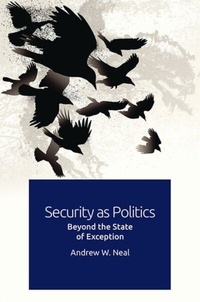
Security as Politics
Beyond the State of Exception
1st Edition
Published on 21. March 2019
288 pages
978-1-4744-5094-2 (ISBN)
Description

Andrew W. Neal argues that while 'security' was once an anti-political 'exception' in liberal democracies - a black box of secret intelligence and military decision-making at the dark heart of the state - it has now become normalised in professional political life. This represents a direct challenge to critical security studies debates and their core assumption that security is a kind of illiberal and undemocratic 'anti-politics'. Using archival research and interviews with politicians, Neal investigates security politics from the 1980s to the present day to show how its meaning and practice have changed over time. In doing so, he develops an original reassessment of the security/politics relationship.
More details
Other editions
Additional editions
Book
03/2019
Edinburgh University Press
€130.50
Shipment within 15-20 days
Content
- Intro
- Acknowledgements
- 1. In Defence of Politics against Security?
- Security as a threat to politics
- The growth of security and the Hobbesian trap
- In defence of politics
- Normative politics against security: From extraordinary politics to normal politics
- From Hobbes to Machiavelli: From state survival to political survival
- From Schmitt to Weber: From sovereign exception to the profession and vocation of politics
- The UK example
- Notes
- 2. How Do We Know Security When We See It? Problematisation as Method
- The 'everything becomes security' trap
- The problem with 'strictly defined criteria' of security
- Contextual security
- Foucault's historical empiricism: Dispensing with definitions
- Problematising security
- History as war?
- Foucault contra Foucaultians
- From governmentality to politics
- Notes
- 3. Securitisation and Politicisation
- Critique of the norm/exception binary
- Spheres and activities of politics
- The politicisation/depoliticisation debate
- Politicisation and arena migrations
- The UK example
- Conclusion
- Notes
- 4. Politicians, Security Politics and the Political Game
- Understanding the political game
- Political sociology: Discourses, norms, structures
- Unequal parliamentary power relationships
- The power relationships and norms of security politics
- The dilemma of bad faith
- Habitus and the House of Lords
- The breakdown of trust and deference
- Notes
- 5. Can One Person Make a Difference? Fearless Speech vs. Security Politics
- Parresia and its problematisations
- The problematisation of truth in security politics
- Parresia as a rejection of the rules of the game
- Conclusion: 'Nevertheless, in spite of everything'
- Notes
- 6. Security as Normal Politics: The Rise of Security in Parliamentary Committees
- The stakes of committee politics: Democratic legitimacy and executive oversight
- The 1980s as 'traditional' security politics and the beginnings of change
- The 1990s: Intelligence oversight and post-Cold War security issues
- The 2000s: Post-9/11 politicisation
- 2010 onwards
- Conclusion: The migration of security into the political arena
- Notes
- 7. Security as a Whole-of-Government Project: Risk, Economy, Politics
- Osborne goes to China: The NSC, risk assessment and balance
- Threat and risk in the National Security Strategy
- Risk as depoliticisation?
- Security as not Blair: Security from the joined-up centre
- Security, risk and political economy
- Conclusion: Security as economy, security as politics
- Notes
- Conclusion: More Security, More Politics
- Notes
- Bibliography
- Index
