

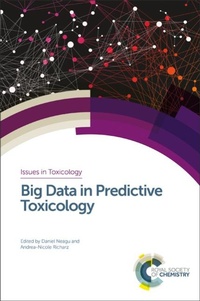
Big Data in Predictive Toxicology
1st Edition
Published on 4. December 2019
394 pages
978-1-78262-365-6 (ISBN)
Description

The rate at which toxicological data is generated is continually becoming more rapid and the volume of data generated is growing dramatically. This is due in part to advances in software solutions and cheminformatics approaches which increase the availability of open data from chemical, biological and toxicological and high throughput screening resources. However, the amplified pace and capacity of data generation achieved by these novel techniques presents challenges for organising and analysing data output.
Big Data in Predictive Toxicology discusses these challenges as well as the opportunities of new techniques encountered in data science. It addresses the nature of toxicological big data, their storage, analysis and interpretation. It also details how these data can be applied in toxicity prediction, modelling and risk assessment.
This title is of particular relevance to researchers and postgraduates working and studying in the fields of computational methods, applied and physical chemistry, cheminformatics, biological sciences, predictive toxicology and safety and hazard assessment.
Big Data in Predictive Toxicology discusses these challenges as well as the opportunities of new techniques encountered in data science. It addresses the nature of toxicological big data, their storage, analysis and interpretation. It also details how these data can be applied in toxicity prediction, modelling and risk assessment.
This title is of particular relevance to researchers and postgraduates working and studying in the fields of computational methods, applied and physical chemistry, cheminformatics, biological sciences, predictive toxicology and safety and hazard assessment.
More details
Series
Language
English
Place of publication
Cambridge
United Kingdom
Target group
Professional and scholarly
ISBN-13
978-1-78262-365-6 (9781782623656)
Copyright in bibliographic data and cover images is held by Nielsen Book Services Limited or by the publishers or by their respective licensors: all rights reserved.
Schweitzer Classification
Other editions
Additional editions
Daniel Neagu | Andrea-Nicole Richarz
Big Data in Predictive Toxicology
Book
12/2019
Royal Society of Chemistry
€229.50
Shipment within 3-4 weeks
Daniel Neagu | Andrea-Nicole Richarz
Big Data in Predictive Toxicology
E-Book
12/2019
1st Edition
Royal Society of Chemistry
€245.99
Available for download
Persons
Daniel Neagu is Professor of Computing with the University of Bradford, where he leads the Artificial Intelligence Research Group. Daniel is Fellow of the Higher Education Academy, and also member of the Institute of Electrical and Electronics Engineers: Computer Society and Computational Intelligence Society, the Association for Computing Machinery and the British Computer Society. Daniel Neagu studies the integration of explicit and implicit knowledge with means of computational intelligence. Daniel Neagu's research on machine learning, data mining, data quality and applications to product safety, predictive toxicology and engineering analytics has been published in more than 100 peer-reviewed conferences and journals, and funded by national and international research councils, organisations and industry.
Dr Andrea Richarz holds a diploma and PhD in Chemistry from the Technical University Berlin. She has managed two large international EU research projects in the area of computational toxicology and new approaches for chemical safety assessment, related to REACH chemicals and cosmetics substances, and was also involved in nanosafety project research. As Scientific Officer at the European Commission Joint Research Centre in Ispra, Italy she worked in the area of predictive toxicology, in silico methods and read-across, with special interest in integrated chemical safety assessment approaches as well as combined exposure to chemicals, including uncertainties of and confidence in the approaches in view of their regulatory acceptance. She has recently joined the European Chemicals Agency in Helsinki.
Dr Andrea Richarz holds a diploma and PhD in Chemistry from the Technical University Berlin. She has managed two large international EU research projects in the area of computational toxicology and new approaches for chemical safety assessment, related to REACH chemicals and cosmetics substances, and was also involved in nanosafety project research. As Scientific Officer at the European Commission Joint Research Centre in Ispra, Italy she worked in the area of predictive toxicology, in silico methods and read-across, with special interest in integrated chemical safety assessment approaches as well as combined exposure to chemicals, including uncertainties of and confidence in the approaches in view of their regulatory acceptance. She has recently joined the European Chemicals Agency in Helsinki.
Content
Big Data in Predictive Toxicology - Challenges, Opportunities and Perspectives;
Biological Data in the Light of Toxicological Risk Assessment;
Chemoinformatics Representation of Chemical Structures - A Milestone for Successful Big Data Modelling in Predictive Toxicology;
Organisation of Toxicological Data in Databases;
Making Big Data Available: Integrating Technologies for Toxicology Applications;
Storing and Using Qualitative and Quantitative Structure-Activity Relationships in the Era of Toxicological and Chemical Data Expansion;
Toxicogenomics and Toxicoinformatics: Supporting Systems Biology in the Big Data Era;
Profiling the Tox21 Chemical Library for Environmental Hazards: Applications in Prioritisation, Predictive Modelling, and Mechanism of Toxicity Characterisation;
Big Data Integration and Inference;
Chemometrical Analysis of Proteomics Data;
Big Data and Biokinetics;
Role of Toxicological Big Data to Support Read-Across for the Assessment of Chemicals
Biological Data in the Light of Toxicological Risk Assessment;
Chemoinformatics Representation of Chemical Structures - A Milestone for Successful Big Data Modelling in Predictive Toxicology;
Organisation of Toxicological Data in Databases;
Making Big Data Available: Integrating Technologies for Toxicology Applications;
Storing and Using Qualitative and Quantitative Structure-Activity Relationships in the Era of Toxicological and Chemical Data Expansion;
Toxicogenomics and Toxicoinformatics: Supporting Systems Biology in the Big Data Era;
Profiling the Tox21 Chemical Library for Environmental Hazards: Applications in Prioritisation, Predictive Modelling, and Mechanism of Toxicity Characterisation;
Big Data Integration and Inference;
Chemometrical Analysis of Proteomics Data;
Big Data and Biokinetics;
Role of Toxicological Big Data to Support Read-Across for the Assessment of Chemicals
