

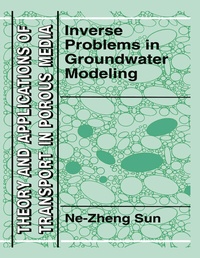
Inverse Problems in Groundwater Modeling
Published on 17. April 2013
XIV, 338 pages
978-94-017-1970-4 (ISBN)
Description

... A diskette with the updated programme of Appendix C and examples
is available through the author at a small fee.
email: nezheng@ucla.edu
fax: 1--310--825--5435 ...
This book systematically discusses basic concepts, theory, solution methods and applications of inverse problems in groundwater modeling. It is the first book devoted to this subject.
The inverse problem is defined and solved in both deterministic and statistic frameworks. Various direct and indirect methods are discussed and compared. As a useful tool, the adjoint state method and its applications are given in detail. For a stochastic field, the maximum likelihood estimation and co-kriging techniques are used to estimate unknown parameters. The ill-posed problem of inverse solution is highlighted through the whole book. The importance of data collection strategy is specially emphasized. Besides the classical design criteria, the relationships between decision making, prediction, parameter identification and experimental design are considered from the point of view of extended identifiabilities. The problem of model structure identification is also considered.
This book can be used as a textbook for graduate students majoring in hydrogeology or related subjects. It is also a reference book for hydrogeologists, petroleum engineers, environmental engineers, mining engineers and applied mathematicians.
email: nezheng@ucla.edu
fax: 1--310--825--5435 ...
This book systematically discusses basic concepts, theory, solution methods and applications of inverse problems in groundwater modeling. It is the first book devoted to this subject.
The inverse problem is defined and solved in both deterministic and statistic frameworks. Various direct and indirect methods are discussed and compared. As a useful tool, the adjoint state method and its applications are given in detail. For a stochastic field, the maximum likelihood estimation and co-kriging techniques are used to estimate unknown parameters. The ill-posed problem of inverse solution is highlighted through the whole book. The importance of data collection strategy is specially emphasized. Besides the classical design criteria, the relationships between decision making, prediction, parameter identification and experimental design are considered from the point of view of extended identifiabilities. The problem of model structure identification is also considered.
This book can be used as a textbook for graduate students majoring in hydrogeology or related subjects. It is also a reference book for hydrogeologists, petroleum engineers, environmental engineers, mining engineers and applied mathematicians.
More details
Other editions
Additional editions
Ne-Zheng Sun
Inverse Problems in Groundwater Modeling
Book
12/2010
Springer
€235.39
Shipment within 15-20 days
Ne-Zheng Sun
Inverse Problems in Groundwater Modeling
Book
07/1994
Kluwer Academic Publishers
€235.39
Shipment within 15-20 days
Content
1 Forward Problems in Groundwater Modeling.- 2 An Introduction to Inverse Problems.- 3 Classical Definition of Inverse Problems.- 4 Indirect Methods for the Solution of Inverse Problems.- 5 Direct Methods for the Solution of Inverse Problems.- 6 The Adjoint State Method.- 7 The Stochastic Method for Solving Inverse Problems.- 8 Experimental Design, Extended Identifiabilities and Model Structure Identification.- Conclusion.- Appendix A Mapping, Space and Norm.- Appendix B Probabilities and Random Fields.- Appendix C A Fortran Program.- References.
