

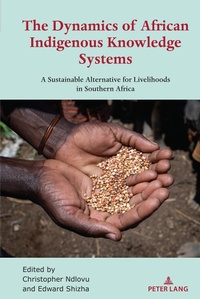
The Dynamics of African Indigenous Knowledge Systems
Description

This book discusses the pivotal role of African indigenous knowledge systems (AIKS) in promoting, enhancing, and sustaining livelihoods in Africa. The authors argue that AIKS are of central importance in the development of sustainable livelihoods, particularly in rural communities. In their analysis, they draw on interdisciplinary research in the fields of agriculture, cultural and indigenous studies, development studies, education, geography, political science, and sociology. The objective is to make AIKS more applicable to mainstream educational and development agendas in Africa, a pressing issue in areas where Eurocentric scientific practices are cost prohibitive.
The Dynamic of African Indigenous Knowledge Systems will be of interest to development professionals, policy makers, academics, students, and anyone interested in the field of AIKS and sustainable development in rural communities.
More details
Other editions
Additional editions
Persons
Christopher Ndlovu has a PhD in Science Education from the University of KwaZulu-Natal and is currently a Senior Lecturer and Chairperson in the Department of Educational Foundations at Lupane State University in Zimbabwe. He has published 9 research papers and a book chapter.
Edward Shizha has a PhD in Sociology of Education from the University of Alberta in Canada and is a Professor at Wilfrid Laurier University in Canada. He has published 12 books and several chapters and articles on indigenous knowledges and their incorporation in education in Africa.
Content
Preface - Acknowledgements - List of Abbreviations - Edward Shizha/Christopher Ndlovu: Introduction: The Dynamics of Indigenous Knowledges and Sustainable Livelihoods in Africa - Edward Shizha: Mainstreaming and Investing in Indigenous Knowledge Epistemologies for Sustainable Livelihoods - Shepherd Ndondo/Christopher Ndlovu: Buttressing Sustainable Security Systems through African Indigenous Epistemologies - Mandlenkosi Ndlovu: Harnessing Indigenous Conflict Resolution Processes in Building Sustainable Communities - Roland Moyo/ Christopher Ndlovu/Edward Shizha: Participation of Diasporas in Building Sustainable Communities in Zimbabwe: Implementation of Ubuntu Philosophy - Tinashe Pikirai: The Role of African Indigenous Knowledge Systems in Sustainable Adaptation to Climate Change - Keith Phiri: Understanding Climate Change Adaptation for Increased Productivity and Sustainability in Southern African Communities: A Review - Emily Mangwaya/Ezron Mangwaya: Implementing Indigenous Knowledge Systems for Sustainable Learning in African Primary Schools - Nhlanhla Mkwelie/Ntandoyenkosi Satamwe/Edward Shizha: Integration of Indigenous Mathematical Knowledge into the Mathematics Education for Sustainable Learning - Mlungisi Moyo: Embedding Sustainability and Ubuntu Philosophy in the Learning of Learners with Disruptive Behaviours - Otildah S. Ndlovu/Nathan Moyo: Language of Instruction Imbroglio in the Post- colonial School Curriculum (Zimbabwe Curriculum Framework, 2015- 2020): The Obstacle to Sustainable Learning - Christopher Ndlovu/Mgcini Moyo: Indigenous Knowledge Systems and the Agricultural Curriculum for Sustainable Development in Zimbabwe - Contributors.
