

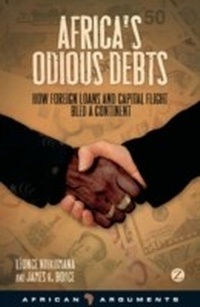
Africa's Odious Debts
How Foreign Loans and Capital Flight Bled a Continent
1st Edition
Published on 13. October 2011
152 pages
978-1-84813-460-7 (ISBN)
Description

In Africa's Odious Debts, Boyce and Ndikumana reveal the shocking fact that, contrary to the popular perception of Africa being a drain on the financial resources of the West, the continent is actually a net creditor to the rest of the world. The extent of capital flight from sub-Saharan Africa is remarkable: more than $700 billion in the past four decades. But Africa's foreign assets remain private and hidden, while its foreign debts are public, owed by the people of Africa through their governments.
Leonce Ndikumana and James K. Boyce reveal the intimate links between foreign loans and capital flight. Of the money borrowed by African governments in recent decades, more than half departed in the same year, with a significant portion of it winding up in private accounts at the very banks that provided the loans in the first place. Meanwhile, debt-service payments continue to drain scarce resources from Africa, cutting into funds available for public health and other needs. Controversially, the authors argue that African governments should repudiate these 'odious debts' from which their people derived no benefit, and that the international community should assist in this effort.
A vital book for anyone interested in Africa, its future and its relationship with the West.
Leonce Ndikumana and James K. Boyce reveal the intimate links between foreign loans and capital flight. Of the money borrowed by African governments in recent decades, more than half departed in the same year, with a significant portion of it winding up in private accounts at the very banks that provided the loans in the first place. Meanwhile, debt-service payments continue to drain scarce resources from Africa, cutting into funds available for public health and other needs. Controversially, the authors argue that African governments should repudiate these 'odious debts' from which their people derived no benefit, and that the international community should assist in this effort.
A vital book for anyone interested in Africa, its future and its relationship with the West.
Reviews / Votes
Africa's Odious Debts is a path-breaking book that should be read by every student, professional and policymaker concerned with the causes of the region's underdevelopment. In a masterful, easily comprehendible and professionally thorough manner, the authors demolish the myth that African countries have received large net capital flows. In a detailed empirical presentation, they show quite the contrary: capital outflow from the poorest countries in the world, to the richest. This book should radically alter thinking and policy. * John Weeks, Professor Emeritus, School of Oriental and African Studies, University of London * Africa's Odious Debts: How Foreign Loans and Capital Flight Bled a Continent offers a compelling account of how loans and capital flight through illegitimate means, often aided and abetted by foreign banks, led to the large accumulation of external wealth by corrupt African leaders and their private associates. This book is a "must reading material" for anybody who wants to understand how African got into the debt crisis, how to avoid its repetition, and probably reverse the debt overhang. Ndikumana and Boyce have hit a "home run" with this book. Students of economic development will certainly benefit from the book. I highly recommend it to all interested in African development and development studies generally. * Kwabena Gyimah-Brempong, Professor and Chair, Department of Economics, University of South Florida * Ndikumana and Boyce present a coruscating analysis of the deleterious impact of crushing debt and capital flight on poor African countries that are ironically among the largest recipients of foreign aid. Eminently readable, it is a fascinating study on how absolute power corrupts absolutely beyond the tethers of human conscience. * Dev Kar, Lead Economist, Global Financial Integrity * This is probably the most important book on Africa in recent years; it is vital reading for everyone with an interest in African affairs. The story of Africa's revolving door of inflowing debts and outflowing capital is one with catastrophic consequences for the ordinary people of Africa. Leonce Ndikumana and James Boyce have put in many years of legwork to explore the dimensions of this scandal, and the data they marshal shows, conclusively, how Africa has become a net creditor to the rest of the world, while remaining shackled to poverty by outstanding odious debts. Much can be done to free African countries from this appalling burden, and the authors are right to identify strengthening transparency, curtailing money laundering, repudiating odious debt and recovering stolen wealth as top priorities. Enraging, enlightening and encouraging in equal measure, this book combines passion and research excellence: a genuine tour de force. * John Christensen, Director, Tax Justice Network * With this remarkable book Ndikumana and Boyce continue their path-breaking analysis of one of the most important, but under-researched, reasons for Africa's continuing poverty. Combining political analysis and historical research with convincing economic modelling, they present a compelling case for overhauling a financial system that has acted as a barrier to progress for too long. Crucially for a short book of this nature, it is a rattling read, full of anecdotes and explanations that make quite a complex subject understandable to everyone. * Jonathan Glennie, ODI research fellow and author of 'The Trouble with Aid' * African governments borrow money from abroad, the incoming cash fuels capital flight, and capital flight leaves death and deprivation in its wake for millions of people across the continent. This basic equation is brilliantly and wrenchingly elucidated by Boyce and Ndikumana. The truth will out and the remedy is at hand. Bravo for an important, timely, and influential work! * Raymond Baker, Director, Global Financial Integrity *More details
Series
Edition
1. Auflage
Language
English
Place of publication
London
United Kingdom
Publishing group
Bloomsbury Publishing PLC
Target group
College/higher education
ISBN-13
978-1-84813-460-7 (9781848134607)
Copyright in bibliographic data and cover images is held by Nielsen Book Services Limited or by the publishers or by their respective licensors: all rights reserved.
Schweitzer Classification
Other editions
Additional editions
Leonce Ndikumana | James K. Boyce
Africa's Odious Debts
How Foreign Loans and Capital Flight Bled a Continent
Book
10/2011
Zed Books Ltd
€28.40
Shipment within 3-4 weeks
Leonce Ndikumana | James K. Boyce
Africa's Odious Debts
How Foreign Loans and Capital Flight Bled a Continent
Book
10/2011
Zed Books Ltd
€117.20
Shipment within 3-4 weeks
Persons
James K. Boyce is professor of economics at the University of Massachusetts, Amherst, where he directs the program on development, peacebuilding and the environment at the Political Economy Research Institute. His previous books include Peace and the Public Purse: Economic Policies for Postwar Statebuilding (co-edited with Madalene O'Donnell); Investing in Peace: Aid and Conditionality after Civil Wars; and A Quiet Violence: View from a Bangladesh Village (co-authored with Betsy Hartmann.) He is a graduate of Yale University and received his doctorate from Oxford University.
Leonce Ndikumana is Professor of economics at the University of Massachusetts, Amherst. He served as Director of Operational Policies and Director of Research at the African Development Bank, and Chief of Macroeconomic Analysis at the United Nations Economic Commission for Africa (UNECA). He has contributed to various areas of research and policy analysis on African countries, including the issues of external debt and capital flight, financial markets and growth, macroeconomic policies for growth and employment, and the economics of conflict and civil wars in Africa. He is a graduate of the University of Burundi and received his doctorate from Washington University in St. Louis, Missouri.
Leonce Ndikumana is Professor of economics at the University of Massachusetts, Amherst. He served as Director of Operational Policies and Director of Research at the African Development Bank, and Chief of Macroeconomic Analysis at the United Nations Economic Commission for Africa (UNECA). He has contributed to various areas of research and policy analysis on African countries, including the issues of external debt and capital flight, financial markets and growth, macroeconomic policies for growth and employment, and the economics of conflict and civil wars in Africa. He is a graduate of the University of Burundi and received his doctorate from Washington University in St. Louis, Missouri.
Content
Introduction
1. Tales from the Shadows of International Finance
2. Measuring African Capital Flight
3. The Revolving Door
4. The Human Costs
5. The Way Forward
Appendix 1: Tables
Appendix 2: Summary Outcome and Policy Recommendations from the Senior Policy Seminar on Capital Flight in Sub-Saharan Africa, held in Pretoria, South Africa, November 2007.
Notes
References
1. Tales from the Shadows of International Finance
2. Measuring African Capital Flight
3. The Revolving Door
4. The Human Costs
5. The Way Forward
Appendix 1: Tables
Appendix 2: Summary Outcome and Policy Recommendations from the Senior Policy Seminar on Capital Flight in Sub-Saharan Africa, held in Pretoria, South Africa, November 2007.
Notes
References
