

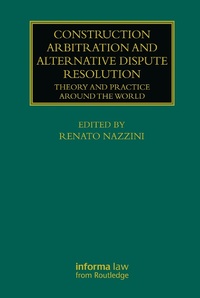
Construction Arbitration and Alternative Dispute Resolution
Theory and Practice around the World
1st Edition
Published on 21. October 2021
456 pages
978-1-000-44866-5 (ISBN)
Description

This book provides comprehensive, rigorous and up-to-date coverage of key issues that have emerged in the first quarter of the 21st Century in transnational construction arbitration and alternative dispute resolution (ADR).
Covering four general themes, this book discusses:
the increasing internationalisation of dispute resolution in construction law;
the increasing reliance on technology in the management of construction projects and construction arbitration/ADR;
the increasing prominence of collaborative contracting in construction and infrastructure projects;
the increasing importance of contractual adjudication such as dispute boards in construction and infrastructure projects;
the increasing prevalence of statutory adjudication mechanisms across the world; and
the greater incidence of investment disputes and disputes against States and State entities over construction and infrastructure concessions and agreements.
Tapping on their substantial expertise in practice and in research, the contributor team of senior practitioners and academics in the area of construction law and dispute resolution provide readers with information that balances an intellectually rigorous academic contribution against the backdrop of real concerns raised in practice.
Construction Arbitration and Alternative Dispute Resolution is an invaluable resource for practitioners in the field, academics in arbitration and construction law, and post-graduate students in construction law and dispute resolution.
Covering four general themes, this book discusses:
the increasing internationalisation of dispute resolution in construction law;
the increasing reliance on technology in the management of construction projects and construction arbitration/ADR;
the increasing prominence of collaborative contracting in construction and infrastructure projects;
the increasing importance of contractual adjudication such as dispute boards in construction and infrastructure projects;
the increasing prevalence of statutory adjudication mechanisms across the world; and
the greater incidence of investment disputes and disputes against States and State entities over construction and infrastructure concessions and agreements.
Tapping on their substantial expertise in practice and in research, the contributor team of senior practitioners and academics in the area of construction law and dispute resolution provide readers with information that balances an intellectually rigorous academic contribution against the backdrop of real concerns raised in practice.
Construction Arbitration and Alternative Dispute Resolution is an invaluable resource for practitioners in the field, academics in arbitration and construction law, and post-graduate students in construction law and dispute resolution.
More details
Series
Edition
1. Auflage
Language
English
Place of publication
London
United Kingdom
Publishing group
Taylor & Francis Ltd
Target group
Professional and scholarly
College/higher education
ISBN-13
978-1-000-44866-5 (9781000448665)
Copyright in bibliographic data and cover images is held by Nielsen Book Services Limited or by the publishers or by their respective licensors: all rights reserved.
Schweitzer Classification
Other editions
Additional editions
Renato Nazzini
Construction Arbitration and Alternative Dispute Resolution
Theory and Practice around the World
Book
01/2024
1st Edition
Routledge
€55.50
Shipment within 15-20 days
Renato Nazzini
Construction Arbitration and Alternative Dispute Resolution
Theory and Practice around the World
Book
10/2021
1st Edition
CRC Press
€359.02
Shipment within 15-20 days
Construction Arbitration and Alternative Dispute Resolution
Theory and Practice Around the World
Book
10/2021
Routledge
Unfortunately, price unknown
Available (delivery time upon request)
Person
Renato Nazzini is Professor of Law and Director of the Centre of Construction Law and Dispute Resolution at King's College London and partner at LMS Legal LLP, London. He is an international arbitrator, counsel and construction specialist with experience in common law and civil law jurisdictions in Europe, Asia, Africa and America and has acted, as arbitrator or counsel, under most international rules, including the ICC, the LCIA, the UNCITRAL and the Milan Chamber of Commerce (CAM) Rules. He is a member of the ICC Arbitration and ADR Commission, Italy, a member of the ICC Task Force on Dealing with Corruption Issues in International Arbitration and a member of the Board of the International Construction Law Association and of Africa Construction Law.
Content
Chapter 1: Introduction Renato Nazzini;
Part I: The Internationalisation of Construction Dispute Resolution;
Chapter 2: The Problem of the Law Governing the Arbitration Clause between National Rules and Transational Solutions Renato Nazzini;
Chapter 3: The Singapore Convention on Mediation: Its Impact on International Construction Disputes Shouyu Chong;
Part II: Artificial Intelligence: A Game Changer?;
Chapter 4: The Relevance of Artificial Intelligence for Construction Disputes Erik Schaefer;
Chapter 5: Administering AI in Arbitration Maud Piers and Christian Aschauer;
Part III: Good Faith and Collaborative Dispute Resolution;
Chapter 6: The Relevance of Good Faith in Transnational Construction Contracts: A Civil Law Perspective Olivier Caprasse and Maxime Tecmenne;
Chapter 7: Searching for Convergence between the Common Law and Civil Law Traditions on Good Faith through International Arbitration David Arias and James Doe;
Chapter 8: Collaborative Dispute Resolution Shy Jackson;
Part IV: Contractual Adjudication: Dispute Boards in International Construction Disputes;
Chapter 9: Dispute Boards: Trends, Observations, Developments and Procedures Nicholas Gould and Robbie McCrea;
Chapter 10: Enforcement of DAB Decisions Under the FIDIC Forms of Contract Taner Dedezade;
Chapter 11: Emergency Arbitration and the Interplay with other Pre-Arbitral Mechanisms Patricia Shaughnessy;
Part V: Statutory Construction Adjudication: A Global Perspective;
Chapter 12: Statutory Adjudication in the United Kingdom James Pickavance;
Chapter 13: Statutory Adjudication in Canada Duncan W Glaholt;
Chapter 14: Statutory Adjudication in Singapore Toh Chen Han;
Chapter 15: Statutory Adjudication in Australia Sean Kelly, Julian Bailey and Matthew Bell;
Part VI: Contracting with the State in the 21st Century;
Chapter 16: Achmea: From the Judgment to the Plurilateral Agreement, towards the Disappearance of Intra-EU Bilateral Investment Protection Treaties Malik Laazouzi;
Chapter 17: State immunity and its implications when resolving disputes with - and enforcing outcomes against - states Michael Cottrell
Part I: The Internationalisation of Construction Dispute Resolution;
Chapter 2: The Problem of the Law Governing the Arbitration Clause between National Rules and Transational Solutions Renato Nazzini;
Chapter 3: The Singapore Convention on Mediation: Its Impact on International Construction Disputes Shouyu Chong;
Part II: Artificial Intelligence: A Game Changer?;
Chapter 4: The Relevance of Artificial Intelligence for Construction Disputes Erik Schaefer;
Chapter 5: Administering AI in Arbitration Maud Piers and Christian Aschauer;
Part III: Good Faith and Collaborative Dispute Resolution;
Chapter 6: The Relevance of Good Faith in Transnational Construction Contracts: A Civil Law Perspective Olivier Caprasse and Maxime Tecmenne;
Chapter 7: Searching for Convergence between the Common Law and Civil Law Traditions on Good Faith through International Arbitration David Arias and James Doe;
Chapter 8: Collaborative Dispute Resolution Shy Jackson;
Part IV: Contractual Adjudication: Dispute Boards in International Construction Disputes;
Chapter 9: Dispute Boards: Trends, Observations, Developments and Procedures Nicholas Gould and Robbie McCrea;
Chapter 10: Enforcement of DAB Decisions Under the FIDIC Forms of Contract Taner Dedezade;
Chapter 11: Emergency Arbitration and the Interplay with other Pre-Arbitral Mechanisms Patricia Shaughnessy;
Part V: Statutory Construction Adjudication: A Global Perspective;
Chapter 12: Statutory Adjudication in the United Kingdom James Pickavance;
Chapter 13: Statutory Adjudication in Canada Duncan W Glaholt;
Chapter 14: Statutory Adjudication in Singapore Toh Chen Han;
Chapter 15: Statutory Adjudication in Australia Sean Kelly, Julian Bailey and Matthew Bell;
Part VI: Contracting with the State in the 21st Century;
Chapter 16: Achmea: From the Judgment to the Plurilateral Agreement, towards the Disappearance of Intra-EU Bilateral Investment Protection Treaties Malik Laazouzi;
Chapter 17: State immunity and its implications when resolving disputes with - and enforcing outcomes against - states Michael Cottrell
