

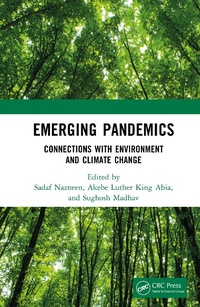
Emerging Pandemics
Connections with Environment and Climate Change
1st Edition
Published on 4. July 2023
180 pages
978-1-000-88978-9 (ISBN)
Description

Pandemics are often associated with viruses and bacteria occurring in wildlife in natural environments. Thus, diseases of epidemic and pandemic scale are mostly zoonotic, some of which include AIDS, Zika virus, severe acute respiratory syndrome (SARS), and COVID-19. The book seeks to explore the documented history of pandemics and various epidemics that have the potential of turning into pandemics with the warming climate, pollution, and environmental destruction.
The book covers some of the most essential elements of the diseases of pandemic nature and their relationship with the environment:
Environment as a reservoir of human diseases
Climate change: emerging driver of infectious diseases
Occurrence and environmental dimensions of specific pandemics and epidemics
Pandemics, environment, and globalisation: understanding the interlinkage in the context of COVID-19
Climate change and zoonotic diseases: malaria, plague, dengue, encephalitis
Tuberculosis: an old enemy of mankind and possible next pandemic
Lassa fever in Nigeria: case fatality ratio, social consequences, and prevention
There are cases where scientists fear that many epidemics have the potential of turning into pandemics, if we do not pay attention to them, and measures are not being taken to control these occurrences. This book attempts to provide integrated risk assessment on pandemics like COVID-19. It covers fundamental factors of global disease outbreaks through the complexity and severity of consequences. The information collated in this book will help in the design of mitigation measures, including behavioral changes that could prevent the emergence of such pandemics, thus protecting human life and minimising losses incurred due to diseases of such magnitude.
The book covers some of the most essential elements of the diseases of pandemic nature and their relationship with the environment:
Environment as a reservoir of human diseases
Climate change: emerging driver of infectious diseases
Occurrence and environmental dimensions of specific pandemics and epidemics
Pandemics, environment, and globalisation: understanding the interlinkage in the context of COVID-19
Climate change and zoonotic diseases: malaria, plague, dengue, encephalitis
Tuberculosis: an old enemy of mankind and possible next pandemic
Lassa fever in Nigeria: case fatality ratio, social consequences, and prevention
There are cases where scientists fear that many epidemics have the potential of turning into pandemics, if we do not pay attention to them, and measures are not being taken to control these occurrences. This book attempts to provide integrated risk assessment on pandemics like COVID-19. It covers fundamental factors of global disease outbreaks through the complexity and severity of consequences. The information collated in this book will help in the design of mitigation measures, including behavioral changes that could prevent the emergence of such pandemics, thus protecting human life and minimising losses incurred due to diseases of such magnitude.
More details
Edition
1. Auflage
Language
English
Place of publication
London
United Kingdom
Publishing group
Taylor & Francis Ltd
Target group
College/higher education
Professional and scholarly
Illustrations
4 Tables, black and white; 16 Line drawings, black and white; 16 Illustrations, black and white
ISBN-13
978-1-000-88978-9 (9781000889789)
Copyright in bibliographic data and cover images is held by Nielsen Book Services Limited or by the publishers or by their respective licensors: all rights reserved.
Schweitzer Classification
Other editions
Additional editions
Sadaf Nazneen | Akebe Luther King Abia | Sughosh Madhav
Emerging Pandemics
Connections with Environment and Climate Change
Book
07/2023
1st Edition
CRC Press
€144.60
Shipment within 10-20 days
Persons
Dr. Sadaf Nazneen is a PhD in Environmental Sciences from School of Environmental Sciences (SES), Jawaharlal Nehru University (JNU), New Delhi, India. She works on the interface of Environmental Chemistry and Biology. Dr. Nazneen has over 10 years of experience in various fields related to environmental pollution, nutrient cycling, carbon sequestration and climate change. Dr. Nazneen has a M.Sc degree in Biosciences and has sound knowledge of Biological and Environmental subjects. Currently, she is Dr D. S. Kothari Postdoctoral fellow at Department of Civil Engineering, Jamia Millia Islamia. Her area of research is Coastal Biogeochemistry and Ecology. For her PhD, she has worked on Chilika Lagoon, Asia's largest lagoon and a Ramsar Site. She has published several papers, book chapters and conference papers out of her PhD work. She is also actively involved in teaching Civil and Environmental Engineering students in her department.
Dr. Luther King Abia is a Professor of Applied and Environmental Microbiologist at the University of KwaZulu-Natal. He is also the Founder and CEO of the Environmental Research Foundation (ERF). His research focuses on but is not limited to, antimicrobial resistance in the environment and how this relates to humans and animals through the One Health approach, using culture and molecular techniques, including metagenomics and whole-genome sequencing. He has over 20 years of experience as a microbiologist and is involved in many projects, including monitoring water and soil for human pathogens, especially antibiotic-resistant ones, under changing climates. He has published over 80 journal articles, six chapters, and one book. He has also graduated several PhD and MSc students.
Dr. Sughosh Madhav is presently working as Dr. D. S. Kothari Postdoctoral Fellow (DSKPDF) in the Department of Civil Engineering, Jamia Millia Islamia, New Delhi, India. He obtained his master's degree from the Department of Environmental Science, Banaras Hindu University, Varanasi, India. He earned his doctorate from Jawaharlal Nehru University, New Delhi. The area of his doctoral research is the environmental impact of industrial effluents on groundwater and soil quality. He has published various research papers and book chapters in the field of environmental geochemistry, water pollution, wastewater remediation, and climate change. He also edited seven books in Wiley, Springer, and Elsevier publications on various environmental issues.
Dr. Luther King Abia is a Professor of Applied and Environmental Microbiologist at the University of KwaZulu-Natal. He is also the Founder and CEO of the Environmental Research Foundation (ERF). His research focuses on but is not limited to, antimicrobial resistance in the environment and how this relates to humans and animals through the One Health approach, using culture and molecular techniques, including metagenomics and whole-genome sequencing. He has over 20 years of experience as a microbiologist and is involved in many projects, including monitoring water and soil for human pathogens, especially antibiotic-resistant ones, under changing climates. He has published over 80 journal articles, six chapters, and one book. He has also graduated several PhD and MSc students.
Dr. Sughosh Madhav is presently working as Dr. D. S. Kothari Postdoctoral Fellow (DSKPDF) in the Department of Civil Engineering, Jamia Millia Islamia, New Delhi, India. He obtained his master's degree from the Department of Environmental Science, Banaras Hindu University, Varanasi, India. He earned his doctorate from Jawaharlal Nehru University, New Delhi. The area of his doctoral research is the environmental impact of industrial effluents on groundwater and soil quality. He has published various research papers and book chapters in the field of environmental geochemistry, water pollution, wastewater remediation, and climate change. He also edited seven books in Wiley, Springer, and Elsevier publications on various environmental issues.
Content
Chapter 1 Occurrence and Environmental Dimensions of Specific Pandemics and Epidemics
Chapter 2 Climate Change: Emerging Driver of Infectious Diseases
Chapter 3 Economic Outcomes of Emerging Pandemics and its Implications on the Environment
Chapter 4 Tuberculosis: An old enemy of mankind and way to next pandemic
Chapter 5 Pandemics, Environment, and Globalisation: Understanding the Interlinkage in the Context of COVID-19
Chapter 6 Climate Change and Zoonotic Diseases: Malaria, Plague, Dengue, Encephalitis
Chapter 7 Environmental dimensions of Zika Virus triggered outbreak and its association with neurological complications like Guillain-Barresyndrome and microcephaly
Chapter 8 Emerging contaminants in the environment and their linkage with COVID-19
Chapter 9 Lassa fever in Nigeria: case fatality ratio, social consequences and prevention
Chapter 10 Contribution of anthropogenic factors in the global advancement of Zika virus
Chapter 2 Climate Change: Emerging Driver of Infectious Diseases
Chapter 3 Economic Outcomes of Emerging Pandemics and its Implications on the Environment
Chapter 4 Tuberculosis: An old enemy of mankind and way to next pandemic
Chapter 5 Pandemics, Environment, and Globalisation: Understanding the Interlinkage in the Context of COVID-19
Chapter 6 Climate Change and Zoonotic Diseases: Malaria, Plague, Dengue, Encephalitis
Chapter 7 Environmental dimensions of Zika Virus triggered outbreak and its association with neurological complications like Guillain-Barresyndrome and microcephaly
Chapter 8 Emerging contaminants in the environment and their linkage with COVID-19
Chapter 9 Lassa fever in Nigeria: case fatality ratio, social consequences and prevention
Chapter 10 Contribution of anthropogenic factors in the global advancement of Zika virus
