

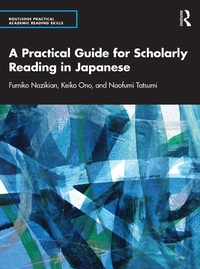
A Practical Guide for Scholarly Reading in Japanese
1st Edition
Published on 31. March 2023
280 pages
978-1-000-80421-8 (ISBN)
Description

A Practical Guide for Scholarly Reading in Japanese is an innovative textbook for students specializing in scholarly Japanese for Asian studies. This book is aimed at scholars in any Asian Studies field in which Japanese scholarship is extremely important.
The book can be used as a textbook or self-study guide for scholars of Asian studies, as well as students who need to learn to read scholarly Japanese.
The book contains concise descriptions of grammar points essential for reading scholarly writings in Japanese and exercises based on excerpts taken from prominent Japanese scholarly texts. Each exercise reading provides a list of vocabulary and explanations of expressions. The reading materials provided mainly cover Chinese history, comparative literature, religion, and culture.
The book can be used as a textbook or self-study guide for scholars of Asian studies, as well as students who have completed two years of basic language learning and need to learn to read scholarly Japanese.
The book can be used as a textbook or self-study guide for scholars of Asian studies, as well as students who need to learn to read scholarly Japanese.
The book contains concise descriptions of grammar points essential for reading scholarly writings in Japanese and exercises based on excerpts taken from prominent Japanese scholarly texts. Each exercise reading provides a list of vocabulary and explanations of expressions. The reading materials provided mainly cover Chinese history, comparative literature, religion, and culture.
The book can be used as a textbook or self-study guide for scholars of Asian studies, as well as students who have completed two years of basic language learning and need to learn to read scholarly Japanese.
More details
Series
Edition
1. Auflage
Language
English
Place of publication
London
United Kingdom
Publishing group
Taylor & Francis Ltd
Target group
College/higher education
Product notice
Reflowable
Illustrations
3 Line drawings, black and white; 10 Halftones, black and white; 13 Illustrations, black and white
ISBN-13
978-1-000-80421-8 (9781000804218)
Copyright in bibliographic data and cover images is held by Nielsen Book Services Limited or by the publishers or by their respective licensors: all rights reserved.
Schweitzer Classification
Other editions
Additional editions
Fumiko Nazikian | Keiko Ono | Naofumi Tatsumi
A Practical Guide for Scholarly Reading in Japanese
Book
03/2023
1st Edition
Routledge
€53.80
Shipment within 10-20 days
Fumiko Nazikian | Keiko Ono | Naofumi Tatsumi
A Practical Guide for Scholarly Reading in Japanese
Book
03/2023
1st Edition
Routledge
€193.45
Shipment within 10-20 days
Persons
Fumiko Nazikian is a senior lecturer in Japanese at Columbia University, USA. Among her recent publications are Social Networking Approach to Japanese Language Teaching: The Intersection of Language and Culture in the Digital Age (co-editor, Routledge, 2021), Modern Japanese Grammar: A Practical Guide & Modern Japanese Workbook (co-author, Routledge, 2014), and Hiyaku (coauthor, Routledge, 2011).
Keiko Ono is a lecturer in Japanese and classical language specialist at Princeton University, USA. Prior to joining Princeton University in 2000, she taught at Columbia University, the University of Cologne, Germany, and Bukkyo University, Japan. Her current research interests and article publications lie in the teaching of both classical and academic Japanese for non-native speakers.
Naofumi Tatsumi is a visiting lecturer of Japanese at Brown University, USA. Prior to joining Brown in 2021, he taught at Illinois Wesleyan University and Columbia University. He has recently been writing a textbook in English collaboratively with four professors from other institutions to broaden cultural awareness of Japan.
Keiko Ono is a lecturer in Japanese and classical language specialist at Princeton University, USA. Prior to joining Princeton University in 2000, she taught at Columbia University, the University of Cologne, Germany, and Bukkyo University, Japan. Her current research interests and article publications lie in the teaching of both classical and academic Japanese for non-native speakers.
Naofumi Tatsumi is a visiting lecturer of Japanese at Brown University, USA. Prior to joining Brown in 2021, he taught at Illinois Wesleyan University and Columbia University. He has recently been writing a textbook in English collaboratively with four professors from other institutions to broaden cultural awareness of Japan.
Content
Contents
Preface
To the Reader
List of Abbreviations
Acknowledgements
Chapter 1: "Toolbox": Essential Grammar for Scholarly Reading 1
1. Understanding Written Style
2. Finding the Predicate and the Subject
2.1 Finding the Predicate: The Ending of a Sentence
2.2 Finding the Subject
2.2.1 When the Particle ? Marks the Subject
2.2.2 When the Particle ? Marks the Subject
2.2.3 When the Particle ? Marks the Subject
2.2.4 When the Particle ? Marks the Subject
2.2.5 Other Particles That Mark the Subject
2.2.6 Cases in Which the Subject is Omitted
3. Separating Sentences Based on Meaning (Chunking)
3.1 Compound Sentences: Listing with the ?-Form
3.1.1 Connecting Verbs
3.1.2 Connecting I-adjectives
3.1.3 Connecting Na-adjectives
3.1.4 Connecting Nouns
3.2 The Suspended Form Method (???????????????)
3.2.1 Verbs
3.2.2 I-adjectives
3.3 ?? 'what's more; not only ~ but also.'
3.4 X ??? Y 'Y called X'
3.4.1 X (Clause) ??? Y (Noun)
3.4.2 X (Noun) ??? Y (Noun)
3.5 S1 ??S2 'S1, but / and S2'
3.5.1 BUT / ??????? (Concessive Connection)
3.5.2 AND / ??????? (Simple Connection)
3.6 Conditional Expressions 20
3.6.1 S ??, S / N ??, S ?, and S ? 'If / When'
3.6.2 Other Often-Used Conditional Expressions, ?????? 'in case of; in the case (of)' and ????
4. Sentence-Ending Expressions
4.1 Explaining a Circumstance ??/????/???
4.2 Rhetorical Questions ?(?)?????/????
4.3 Softening of a Claim/Conclusion
4.3.1 ??????/??????
4.3.2 ????????/????????
5. Defining Expressions X ? Y ??? 'regard X as Y'
6. Particles
6.1 Compound Particles
6.2 Particle Equivalent Phrases
7. Kanji
7.1 ????? (Kanji Made in Japan)
7.2 ?? ??? Chinese Character(s) Used for Its Phonetic Sound
7.3 ???????? Simplified Kanji
7.4 ???????????? Japanese-Chinese Homographs
7.5 ???????????? Japanese-Chinese Homophones
8. Classical Japanese Grammar
(for Reading Academic Articles from the Meiji Era Onwards)
8.1 ???????????????? Historical Kana Orthography
8.2 Inflected Forms
8.3 Verbs
8.4 ???????? Adjectives and ??????????? Adjectival Verbs
8.4.1 ???????? Adjectives (i-adjectives)
8.4.2 ??????????? Adjectival Verbs (na-adjectives)
8.5 ???????? Auxiliary Verbs
8.5.1 ? Negative
8.5.2 ? and ?? Recollective
8.5.3 ?? and ?? Copular/Declarative
8.5.4 ??, ?, and ? Perfective
8.5.5 ?? Advice, Appropriateness, Potential, Intentional, Speculative, and Command
8.5.6 ? and ?? Passive, Potential, Honorific, and Spontaneous
8.5.7 ??? Comparative
8.5.8 ?? Causative
8.5.9 ? Speculative, Intentional, and Circumlocution
8.5.10 ?? Negative Speculative and Negative Intentional
8.6 Conjunctive Particles
8.6.1 ? Hypothetical / Logical Connections
8.6.2 ??, ?, ??, and ? Concessive Connections
8.6.3 ? and ? Causal, Concessive, and Simple Connections
8.6.4 ?? Causal, Concessive, and Simple Connections
8.7 ????????? Attributive Form + Particle
9. The Influence of Chinese Texts in Japanese
9.1 Expressions Used for Japanese Readings
9.1.1 Causative Expressions
9.1.2 ????
9.2 ????? Verbification, Adjectivization, and Adverbization
Chapter 2 Section 1: What Are Modifiers?
(Mechanisms of Modifying Sentences in Japanese)
1.1 Modifying Nouns
1.2 The Particle ?
1.3 The ?-Form as a Conjunction
1.4 Subordinate Clauses: Clauses with Conjunctive Particles
1.4.1 Concessive ??
1.4.2 Reason Clause ??
1.4.3 Conjunctive Particle ? '(and) what is more'
2. Summary
3. Exercises
Chapter 2 Section 2: ?????????????????????????
Chapter 2 Section 3: ????????????????????????
Chapter 2 Section 4: ?????????
Chapter 2 Section 5: ????????
Chapter 2 Section 6: ???????????????
Chapter 2 Section 7: ?????
Chapter 2 Section 8: ??????
?????? Answers
Bibliography
Index Chapter 1
Index (Expressions)
Auxiliary Verb Conjugations
Preface
To the Reader
List of Abbreviations
Acknowledgements
Chapter 1: "Toolbox": Essential Grammar for Scholarly Reading 1
1. Understanding Written Style
2. Finding the Predicate and the Subject
2.1 Finding the Predicate: The Ending of a Sentence
2.2 Finding the Subject
2.2.1 When the Particle ? Marks the Subject
2.2.2 When the Particle ? Marks the Subject
2.2.3 When the Particle ? Marks the Subject
2.2.4 When the Particle ? Marks the Subject
2.2.5 Other Particles That Mark the Subject
2.2.6 Cases in Which the Subject is Omitted
3. Separating Sentences Based on Meaning (Chunking)
3.1 Compound Sentences: Listing with the ?-Form
3.1.1 Connecting Verbs
3.1.2 Connecting I-adjectives
3.1.3 Connecting Na-adjectives
3.1.4 Connecting Nouns
3.2 The Suspended Form Method (???????????????)
3.2.1 Verbs
3.2.2 I-adjectives
3.3 ?? 'what's more; not only ~ but also.'
3.4 X ??? Y 'Y called X'
3.4.1 X (Clause) ??? Y (Noun)
3.4.2 X (Noun) ??? Y (Noun)
3.5 S1 ??S2 'S1, but / and S2'
3.5.1 BUT / ??????? (Concessive Connection)
3.5.2 AND / ??????? (Simple Connection)
3.6 Conditional Expressions 20
3.6.1 S ??, S / N ??, S ?, and S ? 'If / When'
3.6.2 Other Often-Used Conditional Expressions, ?????? 'in case of; in the case (of)' and ????
4. Sentence-Ending Expressions
4.1 Explaining a Circumstance ??/????/???
4.2 Rhetorical Questions ?(?)?????/????
4.3 Softening of a Claim/Conclusion
4.3.1 ??????/??????
4.3.2 ????????/????????
5. Defining Expressions X ? Y ??? 'regard X as Y'
6. Particles
6.1 Compound Particles
6.2 Particle Equivalent Phrases
7. Kanji
7.1 ????? (Kanji Made in Japan)
7.2 ?? ??? Chinese Character(s) Used for Its Phonetic Sound
7.3 ???????? Simplified Kanji
7.4 ???????????? Japanese-Chinese Homographs
7.5 ???????????? Japanese-Chinese Homophones
8. Classical Japanese Grammar
(for Reading Academic Articles from the Meiji Era Onwards)
8.1 ???????????????? Historical Kana Orthography
8.2 Inflected Forms
8.3 Verbs
8.4 ???????? Adjectives and ??????????? Adjectival Verbs
8.4.1 ???????? Adjectives (i-adjectives)
8.4.2 ??????????? Adjectival Verbs (na-adjectives)
8.5 ???????? Auxiliary Verbs
8.5.1 ? Negative
8.5.2 ? and ?? Recollective
8.5.3 ?? and ?? Copular/Declarative
8.5.4 ??, ?, and ? Perfective
8.5.5 ?? Advice, Appropriateness, Potential, Intentional, Speculative, and Command
8.5.6 ? and ?? Passive, Potential, Honorific, and Spontaneous
8.5.7 ??? Comparative
8.5.8 ?? Causative
8.5.9 ? Speculative, Intentional, and Circumlocution
8.5.10 ?? Negative Speculative and Negative Intentional
8.6 Conjunctive Particles
8.6.1 ? Hypothetical / Logical Connections
8.6.2 ??, ?, ??, and ? Concessive Connections
8.6.3 ? and ? Causal, Concessive, and Simple Connections
8.6.4 ?? Causal, Concessive, and Simple Connections
8.7 ????????? Attributive Form + Particle
9. The Influence of Chinese Texts in Japanese
9.1 Expressions Used for Japanese Readings
9.1.1 Causative Expressions
9.1.2 ????
9.2 ????? Verbification, Adjectivization, and Adverbization
Chapter 2 Section 1: What Are Modifiers?
(Mechanisms of Modifying Sentences in Japanese)
1.1 Modifying Nouns
1.2 The Particle ?
1.3 The ?-Form as a Conjunction
1.4 Subordinate Clauses: Clauses with Conjunctive Particles
1.4.1 Concessive ??
1.4.2 Reason Clause ??
1.4.3 Conjunctive Particle ? '(and) what is more'
2. Summary
3. Exercises
Chapter 2 Section 2: ?????????????????????????
Chapter 2 Section 3: ????????????????????????
Chapter 2 Section 4: ?????????
Chapter 2 Section 5: ????????
Chapter 2 Section 6: ???????????????
Chapter 2 Section 7: ?????
Chapter 2 Section 8: ??????
?????? Answers
Bibliography
Index Chapter 1
Index (Expressions)
Auxiliary Verb Conjugations
