

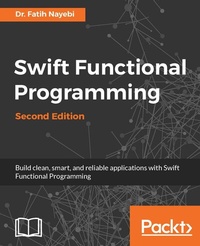
Swift Functional Programming
Ease the creation, testing, and maintenance of Swift codes
2nd Edition
Published on 8. July 2025
316 pages
978-1-78728-345-9 (ISBN)
Description

Bring the power of functional programming to Swift to develop clean, smart, scalable and reliable applications.
Key Features
[*]Written for the latest version of Swift, this is a comprehensive guide that introduces iOS, Web and macOS developers to the all-new world of functional programming that has so far been alien to them
[*]Get familiar with using functional programming alongside existing OOP techniques so you can get the best of both worlds and develop clean, robust, and scalable code
[*]Develop a case study on example backend API with Swift and Vapor Framework and an iOS application with Functional Programming, Protocol-Oriented Programming, Functional Reactive Programming, and Object-Oriented Programming techniques
Book DescriptionSwift is a multi-paradigm programming language enabling you to tackle different problems in various ways. Understanding each paradigm and knowing when and how to utilize and combine them can lead to a better code base. Functional programming (FP) is an important paradigm that empowers us with declarative development and makes applications more suitable for testing, as well as performant and elegant. This book aims to simplify the FP paradigms, making them easily understandable and usable, by showing you how to solve many of your day-to-day development problems using Swift FP. It starts with the basics of FP, and you will go through all the core concepts of Swift and the building blocks of FP. You will also go through important aspects, such as function composition and currying, custom operator definition, monads, functors, applicative functors,memoization, lenses, algebraic data types, type erasure, functional data structures, functional reactive programming (FRP), and protocol-oriented programming(POP). You will then learn to combine those techniques to develop a fully functional iOS application from scratchWhat you will learn
[*]Understand what functional programming is and why it matters
[*]Understand custom operators, function composition, currying, recursion, and memoization
[*] Explore algebraic data types, pattern matching, generics, associated type protocols, and type erasure
[*] Get acquainted with higher-kinded types and higher-order functions using practical examples
[*]Get familiar with functional and non-functional ways to deal with optionals
[*]Make use of functional data structures such as semigroup, monoid, binary search tree, linked list, stack, and lazy list
[*]Understand the importance of immutability, copy constructors, and lenses
[*] Develop a backend API with Vapor
[*]Create an iOS app by combining FP, OOP, FRP, and POP paradigms
Who this book is forMeant for a reader who knows object-oriented programming, has some experience with Objective-C/Swift programming languages and wants to further enhance his skills with functional programming techniques with Swift 3.x.
Key Features
[*]Written for the latest version of Swift, this is a comprehensive guide that introduces iOS, Web and macOS developers to the all-new world of functional programming that has so far been alien to them
[*]Get familiar with using functional programming alongside existing OOP techniques so you can get the best of both worlds and develop clean, robust, and scalable code
[*]Develop a case study on example backend API with Swift and Vapor Framework and an iOS application with Functional Programming, Protocol-Oriented Programming, Functional Reactive Programming, and Object-Oriented Programming techniques
Book DescriptionSwift is a multi-paradigm programming language enabling you to tackle different problems in various ways. Understanding each paradigm and knowing when and how to utilize and combine them can lead to a better code base. Functional programming (FP) is an important paradigm that empowers us with declarative development and makes applications more suitable for testing, as well as performant and elegant. This book aims to simplify the FP paradigms, making them easily understandable and usable, by showing you how to solve many of your day-to-day development problems using Swift FP. It starts with the basics of FP, and you will go through all the core concepts of Swift and the building blocks of FP. You will also go through important aspects, such as function composition and currying, custom operator definition, monads, functors, applicative functors,memoization, lenses, algebraic data types, type erasure, functional data structures, functional reactive programming (FRP), and protocol-oriented programming(POP). You will then learn to combine those techniques to develop a fully functional iOS application from scratchWhat you will learn
[*]Understand what functional programming is and why it matters
[*]Understand custom operators, function composition, currying, recursion, and memoization
[*] Explore algebraic data types, pattern matching, generics, associated type protocols, and type erasure
[*] Get acquainted with higher-kinded types and higher-order functions using practical examples
[*]Get familiar with functional and non-functional ways to deal with optionals
[*]Make use of functional data structures such as semigroup, monoid, binary search tree, linked list, stack, and lazy list
[*]Understand the importance of immutability, copy constructors, and lenses
[*] Develop a backend API with Vapor
[*]Create an iOS app by combining FP, OOP, FRP, and POP paradigms
Who this book is forMeant for a reader who knows object-oriented programming, has some experience with Objective-C/Swift programming languages and wants to further enhance his skills with functional programming techniques with Swift 3.x.
All prices
More details
Edition
2nd Revised edition
Language
English
Place of publication
Birmingham
United Kingdom
Target group
Professional and scholarly
US School Grade: College Graduate Student
Edition type
Revised edition
File size
2,26 MB
ISBN-13
978-1-78728-345-9 (9781787283459)
Copyright in bibliographic data and cover images is held by Nielsen Book Services Limited or by the publishers or by their respective licensors: all rights reserved.
Schweitzer Classification
Other editions
Additional editions
Fatih Nayebi
Swift Functional Programming
Book
04/2017
Packt Publishing
€56.10
Shipment within 3-4 weeks
Person
Nayebi Dr. Fatih :
Dr. Fatih Nayebi has more than 15 years of industry experience in software engineering and architecture in various fields. He has developed numerous applications with Visual Basic, C++, C#, Java, MATLAB, Python, Objective-C, and Swift. He has been designing and developing enterprise and consumer iOS applications since the release of first iOS SDK. He is also an enthusiastic Node, Scala, and Haskell developer. Aside from industry, Fatih earned his Ph.D. degree in software engineering from cole de technologie suprieure, Universit du Qubec by researching on Mobile Human-Computer Interaction, Software Engineering, and Machine Learning. His specialties include applied predictive and optimization models, human-computer interaction, functional programming, machine learning, and mobile application architecture and development. Fatih currently works as a Director, Consulting at CGI Group Inc, Montreal, and continues to his academic research and publications as a postdoctoral researcher at cole de technologie suprieure. You can find him talking on Swift and Functional Programming at meetups such as http://www.meetup.com/swift-mtl/, on GitHub at https://github.com/conqueror, on Twitter as @thefatih, and on Instagram as @thefatih.
Dr. Fatih Nayebi has more than 15 years of industry experience in software engineering and architecture in various fields. He has developed numerous applications with Visual Basic, C++, C#, Java, MATLAB, Python, Objective-C, and Swift. He has been designing and developing enterprise and consumer iOS applications since the release of first iOS SDK. He is also an enthusiastic Node, Scala, and Haskell developer. Aside from industry, Fatih earned his Ph.D. degree in software engineering from cole de technologie suprieure, Universit du Qubec by researching on Mobile Human-Computer Interaction, Software Engineering, and Machine Learning. His specialties include applied predictive and optimization models, human-computer interaction, functional programming, machine learning, and mobile application architecture and development. Fatih currently works as a Director, Consulting at CGI Group Inc, Montreal, and continues to his academic research and publications as a postdoctoral researcher at cole de technologie suprieure. You can find him talking on Swift and Functional Programming at meetups such as http://www.meetup.com/swift-mtl/, on GitHub at https://github.com/conqueror, on Twitter as @thefatih, and on Instagram as @thefatih.
Content
Table of Contents
Getting started with functional programming in Swift
Defining and using functions
Importance of immutability
Defining and using Enumerations
Defining and using Types, Type Inferences and Pattern Matching
Defining and using functional data structures
Defining and Using Generics
Map, Filter and Reduce for Declarative Programming
Dealing with Optionals
Best of both worlds, combining FP paradigms with OOP
Case Study: Developing an iOS application with FP and OOP paradigms
Getting started with functional programming in Swift
Defining and using functions
Importance of immutability
Defining and using Enumerations
Defining and using Types, Type Inferences and Pattern Matching
Defining and using functional data structures
Defining and Using Generics
Map, Filter and Reduce for Declarative Programming
Dealing with Optionals
Best of both worlds, combining FP paradigms with OOP
Case Study: Developing an iOS application with FP and OOP paradigms

