

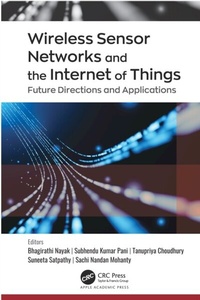
Wireless Sensor Networks and the Internet of Things
Future Directions and Applications
1st Edition
Published on 30. September 2021
380 pages
978-1-000-29333-3 (ISBN)
Description

Wireless Sensor Networks and the Internet of Things: Future Directions and Applications explores a wide range of important and real-time issues and applications in this ever-advancing field. Different types of WSN and IoT technologies are discussed in order to provide a strong framework of reference, and the volume places an emphasis on solutions to the challenges of protection, conservation, evaluation, and implementation of WSN and IoT that lead to low-cost products, energy savings, low carbon usage, higher quality, and global competitiveness.
The volume is divided into four sections that cover:
Wireless sensor networks and their relevant applications
Smart monitoring and control systems with the Internet of Things
Attacks, threats, vulnerabilities, and defensive measures for smart systems
Research challenges and opportunities
This collection of chapters on an important and diverse range of issues presents case studies and applications of cutting-edge technologies of WSN and IoT that will be valuable for academic communities in computer science, information technology, and electronics, including cyber security, monitoring, and data collection. The informative material presented here can be applied to many sectors, including agriculture, energy and power, resource management, biomedical and health care, business management, and others.
The volume is divided into four sections that cover:
Wireless sensor networks and their relevant applications
Smart monitoring and control systems with the Internet of Things
Attacks, threats, vulnerabilities, and defensive measures for smart systems
Research challenges and opportunities
This collection of chapters on an important and diverse range of issues presents case studies and applications of cutting-edge technologies of WSN and IoT that will be valuable for academic communities in computer science, information technology, and electronics, including cyber security, monitoring, and data collection. The informative material presented here can be applied to many sectors, including agriculture, energy and power, resource management, biomedical and health care, business management, and others.
More details
Edition
1. Auflage
Language
English
Place of publication
London
United Kingdom
Publishing group
Taylor & Francis Ltd
Target group
College/higher education
Professional and scholarly
Product notice
Reflowable
Illustrations
24 Tables, black and white; 18 Illustrations, color; 100 Illustrations, black and white
ISBN-13
978-1-000-29333-3 (9781000293333)
Copyright in bibliographic data and cover images is held by Nielsen Book Services Limited or by the publishers or by their respective licensors: all rights reserved.
Schweitzer Classification
Other editions
Additional editions
Bhagirathi Nayak | Subhendu Kumar Pani | Tanupriya Choudhury
Wireless Sensor Networks and the Internet of Things
Future Directions and Applications
Book
09/2023
1st Edition
Apple Academic Press Inc.
€100.50
Shipment within 3-4 weeks
Bhagirathi Nayak | Subhendu Kumar Pani | Tanupriya Choudhury
Wireless Sensor Networks and the Internet of Things
Future Directions and Applications
Book
09/2021
1st Edition
Apple Academic Press Inc.
€218.30
Shipment within 3-4 weeks

Wireless Sensor Networks and the Internet of Things
Future Directions and Applications
Book
05/2021
Apple Academic Press Inc.
Unfortunately, price unknown
Available (delivery time upon request)
Persons
Bhagirathi Nayak, PhD, is a highly results-oriented professional with experience of 25 years from IIT Kharagpur, India, in the areas of computer science and engineering, academics, administration, database design and development, and pedagogical activities. He is presently associated with Sri Sri University, Cuttack, India, as Head of the Department of Information and Communication Technology and Professor in-charge of the Enterprise Resource Planning (ERP) System. To date he has published more than 40 articles in reputed international journals and has written four books. He has holds five patents in the area of computer science and engineering. Dr. Nayak won the prestigious Dr. A. P. J. Abdul Kalam Professional Excellence Award in Data Science from the Dr. A.P. J. Abdul Kalam Research Centre. He was also honored with the Best Professor of Data Science in Odisha, India Education Award 2019 at Bangalore. For his significant contribution to the field of data science, he awarded a Best Researcher Award by the Technological Conclave 2019, Bhubaneswar, Odisha, India. He also received the Research and Innovation Award of the Year on the occasion of the National Summit 2020 on 17th January 2020 at New Delhi in the august presence of Shri Nitin Jairam Gadkari (Honorable Minister of MSME). Four PhD scholars have been awarded and presently six PhD scholars are working under him. He did many more projects in the works, such as on bioinformatics with the Department of Biotechnology, Government of India, MSME & Paradip Port, Odisha, India.
Subhendu Kumar Pani, PhD, is a Professor in the Department of Computer Science and Engineering and also Research Coordinator at Orissa Engineering College (OEC) Bhubaneswar, India. He has more than 15 years of teaching and research experience. His research interests include data mining, big data analysis, web data analytics, fuzzy decision-making, and computational intelligence. He is the recipient of five researcher awards. In addition to research, he has guided two PhD students and 31 MTech students. He has published over 50 international journal papers (25 Scopus indexed). His professional activities include roles as associate editor, editorial board member, and/or reviewer of various international journals. He is associated with a number of conferences and societies. He has more than 100 international publications, five authored books, two edited books, and ten book chapters to his credit. He is a fellow in Scientific Society of Advance Research and Social Change and a life member in many other professional organizations.
Tanupriya Choudhury, PhD, is an Associate Professor in the Department of Computer Science and Engineering at UPES Dehradun, India. Recently he has received the Global Outreach Education Award for Excellence and Best Young Researcher Award at the Global Outreach Education Conference and Awards 2018. His areas of interests include human computing, soft computing, cloud computing, data mining, etc. He has filed 14 patents to date and received 16 copyrights from the Indian Ministry of Human Resource Development for his own software. He has been associated with many conferences in India and abroad. He has authored more than 85 research papers and has delivered invited talks and guest lectures at several universities in India and elsewhere. He has been associated with many conferences throughout India as TPC member and session chair, etc. He is a lifetime member of IETA, member of IEEE, and member of IET (UK) and other renowned technical societies. He is associated with corporate, and he is Technical Adviser of DeetyaSoft Pvt. Ltd. Noida, IVRGURU, and Mydigital360, etc.
Suneeta Satpathy, PhD, is an Associate Professor in the Department of Computer Science and Engineering at the College of Engineering Bhubaneswar (CoEB), Bhubaneswar, India. Her research interests include computer forensics, cyber security, data fusion, data mining, big data analysis, and decision mining. In addition to research, she has guided many postgraduate and graduate students. She has published papers in many international journals and conferences in repute. She has two Indian patents in her credit. She is an editorial board member and/or reviewer of the Journal of Engineering Science, Advancement of Computer Technology and Applications, Robotics and Autonomous Systems, and Computational and Structural Biotechnology Journal. She is a member of CSI, ISTE, OITS, ACM, and IE.
Sachi Nandan Mohanty, PhD, is an Associate Professor in the Department of Computer Science and Engineering at the ICFAI Foundation for Higher Education Hyderabad, India. He has published 20 journal papers and has edited four books. He is actively involved as a fellow of the Indian Society Technical Education, the Institute of Engineering and Technology, the Computer Society of India, and as member of the Institute of Engineers and IEEE Computer Society. He is currently a reviewer of many journals, including Robotics and Autonomous Systems, Computational and Structural Biotechnology, Artificial Intelligence Review, and Spatial Information Research. He has been awarded a Best Researcher Award from Biju Pattnaik University of Technology in 2019, Best Thesis Award (first prize) from the Computer Society of India in 2015, and an Outstanding Faculty in Engineering Award from the Dept. of Higher Education, Government of Odisha in 2020. He has also received international travel funds from SERB, Dept. of Science and Technology, Govt. of India, for chairing several sessions at international conferences (USA in 2020). Dr. Mohanty received several best paper awards during his PhD at IIT Kharagpur from the International Conference at Bejing, China, and the International Conference on Soft Computing Applications, organized by IIT Rookee, India, in 2013. Prof. Mohanty's research areas include data mining, big data analysis, cognitive science, fuzzy decision-making, brain-computer interface, and computational intelligence.
Subhendu Kumar Pani, PhD, is a Professor in the Department of Computer Science and Engineering and also Research Coordinator at Orissa Engineering College (OEC) Bhubaneswar, India. He has more than 15 years of teaching and research experience. His research interests include data mining, big data analysis, web data analytics, fuzzy decision-making, and computational intelligence. He is the recipient of five researcher awards. In addition to research, he has guided two PhD students and 31 MTech students. He has published over 50 international journal papers (25 Scopus indexed). His professional activities include roles as associate editor, editorial board member, and/or reviewer of various international journals. He is associated with a number of conferences and societies. He has more than 100 international publications, five authored books, two edited books, and ten book chapters to his credit. He is a fellow in Scientific Society of Advance Research and Social Change and a life member in many other professional organizations.
Tanupriya Choudhury, PhD, is an Associate Professor in the Department of Computer Science and Engineering at UPES Dehradun, India. Recently he has received the Global Outreach Education Award for Excellence and Best Young Researcher Award at the Global Outreach Education Conference and Awards 2018. His areas of interests include human computing, soft computing, cloud computing, data mining, etc. He has filed 14 patents to date and received 16 copyrights from the Indian Ministry of Human Resource Development for his own software. He has been associated with many conferences in India and abroad. He has authored more than 85 research papers and has delivered invited talks and guest lectures at several universities in India and elsewhere. He has been associated with many conferences throughout India as TPC member and session chair, etc. He is a lifetime member of IETA, member of IEEE, and member of IET (UK) and other renowned technical societies. He is associated with corporate, and he is Technical Adviser of DeetyaSoft Pvt. Ltd. Noida, IVRGURU, and Mydigital360, etc.
Suneeta Satpathy, PhD, is an Associate Professor in the Department of Computer Science and Engineering at the College of Engineering Bhubaneswar (CoEB), Bhubaneswar, India. Her research interests include computer forensics, cyber security, data fusion, data mining, big data analysis, and decision mining. In addition to research, she has guided many postgraduate and graduate students. She has published papers in many international journals and conferences in repute. She has two Indian patents in her credit. She is an editorial board member and/or reviewer of the Journal of Engineering Science, Advancement of Computer Technology and Applications, Robotics and Autonomous Systems, and Computational and Structural Biotechnology Journal. She is a member of CSI, ISTE, OITS, ACM, and IE.
Sachi Nandan Mohanty, PhD, is an Associate Professor in the Department of Computer Science and Engineering at the ICFAI Foundation for Higher Education Hyderabad, India. He has published 20 journal papers and has edited four books. He is actively involved as a fellow of the Indian Society Technical Education, the Institute of Engineering and Technology, the Computer Society of India, and as member of the Institute of Engineers and IEEE Computer Society. He is currently a reviewer of many journals, including Robotics and Autonomous Systems, Computational and Structural Biotechnology, Artificial Intelligence Review, and Spatial Information Research. He has been awarded a Best Researcher Award from Biju Pattnaik University of Technology in 2019, Best Thesis Award (first prize) from the Computer Society of India in 2015, and an Outstanding Faculty in Engineering Award from the Dept. of Higher Education, Government of Odisha in 2020. He has also received international travel funds from SERB, Dept. of Science and Technology, Govt. of India, for chairing several sessions at international conferences (USA in 2020). Dr. Mohanty received several best paper awards during his PhD at IIT Kharagpur from the International Conference at Bejing, China, and the International Conference on Soft Computing Applications, organized by IIT Rookee, India, in 2013. Prof. Mohanty's research areas include data mining, big data analysis, cognitive science, fuzzy decision-making, brain-computer interface, and computational intelligence.
Content
PART I: WIRELESS SENSOR NETWORK AND THEIR RELEVANCE APPLICATIONS 1. Intelligent 5G Networks: Challenges, Realization, and Insights 2. Energy Harvesting Implementation for Wireless Sensor Networks 3. An Approach to Enhance the Wireless Sensor Network Efficiency through Coverage and Energy Utilization Technique 4. A Modified Track Sector Clustering Scheme for Energy Efficiency in Wireless Sensor Networks 5. A Comprehensive Survey of RFID-Based Localization Techniques for Wireless Networks 6. Survey of Collision Control Strategies over Multi-Hop Wireless Ad Hoc Networks PART II: SMART MONITORING AND CONTROL SYSTEM WITH THE INTERNET OF THINGS 7. Internet of Things and Smart Homes: A Review 8. Employment of IoT towards Energy Efficient Home Automation: State-of-the-Art 9. IoT-Based Home Electronic Appliances Control System with Voice Control 10. Real-Time Data Communication with IoT Sensors and ThingSpeak Cloud 11. Value Creation Model for Waste Management in Smart Cities' Ecosystems 12. Safeguarding Location Privacy in Internet of Things 13. IoT-RFID Sensing System for Monitoring Corrosion 14. Blockchain in IoT: Use-Case and Challenges 15. Participation of 5G with Wireless Sensor Networks in the Internet-Of-Things Application PART III: ATTACKS, THREATS, VULNERABILITIES, AND DEFENSIVE MEASURES FOR SMART SYSTEMS AND RESEARCH CHALLENGES 16. Internet of Things (IoT): Vulnerability, Attacks, and Security 17. Latest Trend of IoT Threats and Defense 18. Latest Techniques Used to Detect Botnets 19. SDN-Enabled IoT Management Architectures and Security Solutions: A Review 20. ID-Based Security Mechanism for Data Transmission in MANET 21. A Survey of DDoS Defense Mechanisms in Software-Defined Networks (SDN) 22. Internet of Things: Challenges and Research Opportunities
