

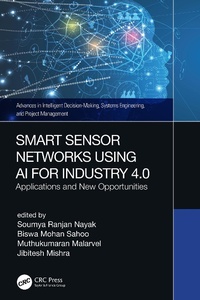
Smart Sensor Networks Using AI for Industry 4.0
Applications and New Opportunities
1st Edition
Published on 10. October 2021
262 pages
978-1-000-45851-0 (ISBN)
Description

Smart Sensor Networks (WSNs) using AI have left a mark on the lives of all by aiding in various sectors, such as manufacturing, education, healthcare, and monitoring of the environment and industries. This book covers recent AI applications and explores aspects of modern sensor technologies and the systems needed to operate them.
The book reviews the fundamental concepts of gathering, processing, and analyzing different AI-based models and methods. It covers recent WSN techniques for the purpose of effective network management on par with the standards laid out by international organizations in related fields and focuses on both core concepts along with major applicational areas.
The book will be used by technical developers, academicians, data sciences, industrial professionals, researchers, and students interested in the latest innovations on problem-oriented processing techniques in sensor networks using IoT and evolutionary computer applications for Industry 4.0.
The book reviews the fundamental concepts of gathering, processing, and analyzing different AI-based models and methods. It covers recent WSN techniques for the purpose of effective network management on par with the standards laid out by international organizations in related fields and focuses on both core concepts along with major applicational areas.
The book will be used by technical developers, academicians, data sciences, industrial professionals, researchers, and students interested in the latest innovations on problem-oriented processing techniques in sensor networks using IoT and evolutionary computer applications for Industry 4.0.
More details
Series
Edition
1. Auflage
Language
English
Place of publication
London
United Kingdom
Publishing group
Taylor & Francis Ltd
Target group
College/higher education
Professional and scholarly
Illustrations
22 Tables, black and white; 101 Line drawings, black and white; 11 Halftones, black and white; 112 Illustrations, black and white
ISBN-13
978-1-000-45851-0 (9781000458510)
Copyright in bibliographic data and cover images is held by Nielsen Book Services Limited or by the publishers or by their respective licensors: all rights reserved.
Schweitzer Classification
Other editions
Additional editions

Soumya Ranjan Nayak | Biswa Mohan Sahoo | Muthukumaran Malarvel
Smart Sensor Networks Using AI for Industry 4.0
Applications and New Opportunities
Book
10/2024
1st Edition
CRC Press
€70.90
Shipment within 15-20 days
Soumya Ranjan Nayak | Biswa Mohan Sahoo | Muthukumaran Malarvel
Smart Sensor Networks Using AI for Industry 4.0
Applications and New Opportunities
Book
10/2021
1st Edition
CRC Press
€170.40
Shipment within 15-20 days
Persons
Soumya Ranjan Nayak is an Assistant Professor at Amity School of Engineering and Technology, Amity University, Noida, India. He received his Ph.D. degree in Computer Science and Engineering under MHRD Govt. of India fellowship from CET, BPUT Rourkela, India; with preceded degree of M. Tech and B. Tech degree in Computer Science and Engineering. He has published over seventy articles in peer-reviewed journals and conferences of international repute like Elsevier, Springer, World Scientific, IOS Press, Taylor & Francis, Inderscience, IGI Global, etc.. Apart from that, 12 Book Chapter, 6 Books and three Indian patent (One granted), and two international Patents under his credit. His current research interests include medical image analysis and classification, machine learning, deep learning, pattern recognition, fractal graphics and computer vision. His publications have more than 400 citations, of h index of 12, and i10 index of 15 (Google Scholar). He serves as a reviewer of many peer-reviewed journals such as IEEE Journal of Biomedical and Health Informatics, Applied Mathematics and Computation, Journal of Applied Remote Sensing, Mathematical Problems in Engineering, International Journal of Light and Electron optics, Journal of Intelligent and Fuzzy Systems, Future Generation Computer Systems, Pattern Recognition Letters, etc. He has also served as Technical Program Committee Member of several conferences of international repute.
Biswa Mohan Sahoo is a Senior IEEE member and received his B.Tech and M.Tech degree in computer science and engineering from Biju Patnaik University of Technology, Odisha, India and PhD degree in computer science and engineering from Indian Institute of Technology (ISM), Dhanbad, India. He is currently working as an Assistant Professor at Amity University, Uttar Pradesh, India. He has published more than 15 articles in prestigious international peer review journals and conferences in the area of Wireless Sensor Networks, Swarm Intelligence and Image Processing. His currently focus on artificial intelligence approaches on sensor networks. His research interest area is wireless sensor network with Evolutionary Algorithm and Artificial intelligence.
Muthukumaran Malarvel is a researcher and academician working as an Associate Professor in the Centre for Research and Innovation Network (CURIN), Institute of Engineering and Technology, CHITKARA University, Punjab, India. He is Having 17+ years of experience it includes information technology industry, teaching and rich research experience. He has Received doctoral degree in computer science and engineering and awarded Senior Research Fellowship (SRF) under the funded project of Board of Research in Nuclear Sciences (BRNS), Government of India. He published more than 20 research articles indexed in SCI, SCIE and SCOPUS journals and conferences. He is an Editor and reviewer of reputed journals also edited 3 books in reputed publisher. He has Filed 4 patents in Intellectual property India and received one patent grant. His research interests are digital image processing, pattern recognition, quantum image processing and machine learning techniques.
Jibitesh Mishra has interests in Research, Consultancy, Working on new technologies, Projects. He has continuously worked for his College i.e College of Engineering & Technology since 1994. After doing his Ph.D in the year 2001, he has completed projects like Orissa Tourism Information Systems. One of his paper "On calculation of fractal dimension of images" is being cited by many researchers. His first book "Design of Information Systems: A Modern Approach" was widely published in China as well. He had worked in Function Point Metrics in association with Infosys Ltd. He has written a book L-systems Fractal published by Elsevier. He started introducing the concept of Web Engineering in India in 2006 after organizing the International Conference on Web Engineering & Applications (ICWA2006). In the social front, he coordinated the training program for SC & ST graduate engineers in the year 2008. He was on Sabbatical leave during 2008 to 2010 at King Khalid University, Abha, Saudi Arabia. He wrote a book on E-commerce published by Macmillan during that period which later on was purchased by Laxmi Publisher. Currently he is head of the Dept of Computer Science & Application in CET. His current research initiatives are in the area of Data Analytics, Engineering the Mobile Apps and Ontology Engineering.
Biswa Mohan Sahoo is a Senior IEEE member and received his B.Tech and M.Tech degree in computer science and engineering from Biju Patnaik University of Technology, Odisha, India and PhD degree in computer science and engineering from Indian Institute of Technology (ISM), Dhanbad, India. He is currently working as an Assistant Professor at Amity University, Uttar Pradesh, India. He has published more than 15 articles in prestigious international peer review journals and conferences in the area of Wireless Sensor Networks, Swarm Intelligence and Image Processing. His currently focus on artificial intelligence approaches on sensor networks. His research interest area is wireless sensor network with Evolutionary Algorithm and Artificial intelligence.
Muthukumaran Malarvel is a researcher and academician working as an Associate Professor in the Centre for Research and Innovation Network (CURIN), Institute of Engineering and Technology, CHITKARA University, Punjab, India. He is Having 17+ years of experience it includes information technology industry, teaching and rich research experience. He has Received doctoral degree in computer science and engineering and awarded Senior Research Fellowship (SRF) under the funded project of Board of Research in Nuclear Sciences (BRNS), Government of India. He published more than 20 research articles indexed in SCI, SCIE and SCOPUS journals and conferences. He is an Editor and reviewer of reputed journals also edited 3 books in reputed publisher. He has Filed 4 patents in Intellectual property India and received one patent grant. His research interests are digital image processing, pattern recognition, quantum image processing and machine learning techniques.
Jibitesh Mishra has interests in Research, Consultancy, Working on new technologies, Projects. He has continuously worked for his College i.e College of Engineering & Technology since 1994. After doing his Ph.D in the year 2001, he has completed projects like Orissa Tourism Information Systems. One of his paper "On calculation of fractal dimension of images" is being cited by many researchers. His first book "Design of Information Systems: A Modern Approach" was widely published in China as well. He had worked in Function Point Metrics in association with Infosys Ltd. He has written a book L-systems Fractal published by Elsevier. He started introducing the concept of Web Engineering in India in 2006 after organizing the International Conference on Web Engineering & Applications (ICWA2006). In the social front, he coordinated the training program for SC & ST graduate engineers in the year 2008. He was on Sabbatical leave during 2008 to 2010 at King Khalid University, Abha, Saudi Arabia. He wrote a book on E-commerce published by Macmillan during that period which later on was purchased by Laxmi Publisher. Currently he is head of the Dept of Computer Science & Application in CET. His current research initiatives are in the area of Data Analytics, Engineering the Mobile Apps and Ontology Engineering.
Content
Chapter 1 Optimization of Wireless Sensor Networks using Bio-Inspired Algorithm
Ayusee Swain, K. P. Swain, G. Palai, and Soumya Ranjan Nayak
Chapter 2 An Improved Genetic Algorithm with Haar Lifting for Optimal Sensor Deployment in Target Covers Based Wireless Sensor Networks
T. Ganesan and Pothuraju Rajarajeswari
Chapter 3 Lifetime Enhancement of Wireless Sensor Network Using Artificial Intelligence Techniques
Jayashree Dev and Jibitesh Mishra
Chapter 4 Research Issues of Information Security Using Blockchain Technique in Multiple Media WSNs: A Communication Technique Perceptive
Nihar Ranjan Pradhan and Akhilendra Pratap Singh
Chapter 5 Modified Artificial Fish Swarm Optimization Based Clustering in Wireless Sensor Network
Biswa Mohan Sahoo, Ramesh Chandra Sahoo, Nabanita Paul, Abhinav Tomar, and Ranjeet Kumar Rout
Chapter 6 Survey: Data Prediction Model in Wireless Sensor Networks Using Machine Learning and Optimization Methods
S. Ramalingam, K. Baskaran, and Umashankar Subramaniam
Chapter 7 Strategic Sink Mobility Based on Particle Swarm Optimization in Wireless Sensor Network
Ramandeep Kaur and Roop Lal Sharma
Chapter 8 A Study on Outlier Detection Techniques for Wireless Sensor Network with CNN Approach
Biswaranjan Sarangi and Biswajit Tripathy
Chapter 9 NEECH: A Novel Energy-Efficient Cluster Head Selecting Protocol in a Wireless Sensor Network
Shelly Bhardwaj and Gurpreet Singh Saini
Chapter 10 An Efficient Model for Toxic Gas Detection and Monitoring Using Cloud and Sensor Network
A. M. Senthil Kumar, Yamini Pemmasani, Haritha Venkata Naga Siva Sruthi Addanki, Vasantha Sravani, and Dama Srinu
Chapter 11 Particle swarm Intelligence-Based Localization Algorithms in Wireless Sensor Networks
Ravichander Janapati, Ravi Kumar Jatoth, A. Brahmananda Reddy, and Ch. Balaswamy
Chapter 12 A Review on Defense Strategy Security Mechanism for Sensor Network
Amara SA L G Gopala Gupta and G. Syam Prasad
Chapter 13 Securing Wireless Multimedia Objects through Machine Learning Techniques in Wireless Sensor Networks
Rakesh Ahuja, Purnima, Ambuj Kumar Agarwal, Saira Bano, and Manish Sharma
Chapter 14 Low Power Communication in Wireless Sensor Networks and IoT
Pawan Kumar Sharma, Jaspreet Singh, Yogita, and Vipin Pal
Chapter 15 Localization Using Bat Algorithm in Wireless Sensor Network
Ramandeep Kaur and Gurpreet Singh Saini
Ayusee Swain, K. P. Swain, G. Palai, and Soumya Ranjan Nayak
Chapter 2 An Improved Genetic Algorithm with Haar Lifting for Optimal Sensor Deployment in Target Covers Based Wireless Sensor Networks
T. Ganesan and Pothuraju Rajarajeswari
Chapter 3 Lifetime Enhancement of Wireless Sensor Network Using Artificial Intelligence Techniques
Jayashree Dev and Jibitesh Mishra
Chapter 4 Research Issues of Information Security Using Blockchain Technique in Multiple Media WSNs: A Communication Technique Perceptive
Nihar Ranjan Pradhan and Akhilendra Pratap Singh
Chapter 5 Modified Artificial Fish Swarm Optimization Based Clustering in Wireless Sensor Network
Biswa Mohan Sahoo, Ramesh Chandra Sahoo, Nabanita Paul, Abhinav Tomar, and Ranjeet Kumar Rout
Chapter 6 Survey: Data Prediction Model in Wireless Sensor Networks Using Machine Learning and Optimization Methods
S. Ramalingam, K. Baskaran, and Umashankar Subramaniam
Chapter 7 Strategic Sink Mobility Based on Particle Swarm Optimization in Wireless Sensor Network
Ramandeep Kaur and Roop Lal Sharma
Chapter 8 A Study on Outlier Detection Techniques for Wireless Sensor Network with CNN Approach
Biswaranjan Sarangi and Biswajit Tripathy
Chapter 9 NEECH: A Novel Energy-Efficient Cluster Head Selecting Protocol in a Wireless Sensor Network
Shelly Bhardwaj and Gurpreet Singh Saini
Chapter 10 An Efficient Model for Toxic Gas Detection and Monitoring Using Cloud and Sensor Network
A. M. Senthil Kumar, Yamini Pemmasani, Haritha Venkata Naga Siva Sruthi Addanki, Vasantha Sravani, and Dama Srinu
Chapter 11 Particle swarm Intelligence-Based Localization Algorithms in Wireless Sensor Networks
Ravichander Janapati, Ravi Kumar Jatoth, A. Brahmananda Reddy, and Ch. Balaswamy
Chapter 12 A Review on Defense Strategy Security Mechanism for Sensor Network
Amara SA L G Gopala Gupta and G. Syam Prasad
Chapter 13 Securing Wireless Multimedia Objects through Machine Learning Techniques in Wireless Sensor Networks
Rakesh Ahuja, Purnima, Ambuj Kumar Agarwal, Saira Bano, and Manish Sharma
Chapter 14 Low Power Communication in Wireless Sensor Networks and IoT
Pawan Kumar Sharma, Jaspreet Singh, Yogita, and Vipin Pal
Chapter 15 Localization Using Bat Algorithm in Wireless Sensor Network
Ramandeep Kaur and Gurpreet Singh Saini
