

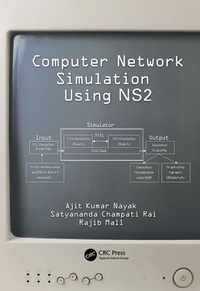
Computer Network Simulation Using NS2
1st Edition
Published on 19. August 2016
325 pages
978-1-4987-6856-6 (ISBN)
Description

Computer Network Simulations Using NS2 provides a solid foundation of computer networking knowledge and skills, covering everything from simple operating system commands to the analysis of complex network performance metrics.
The book begins with a discussion of the evolution of data communication techniques and the fundamental issues associated with performance evaluation. After presenting a preliminary overview of simulation and other performance evaluation techniques, the authors:
Describe a number of computer network protocols and TCP/IP and OSI models, highlighting the networking devices used
Explain a socket and its use in network programming, fostering the development of network applications using C and socket API
Introduce the NS2 network simulator, exhibiting its internal architecture, constituent software packages, and installation in different operating systems
Delve into simulation using NS2, elaborating on the use of Tcl and OTcl scripts as well as AWK scripting and plotting with Gnuplot
Show how to simulate wired and wireless network protocols step by step, layer by layer
Explore the idea of simulating very large networks, identifying the challenges associated with measuring and graphing the various network parameters
Include nearly 90 example programs, scripts, and outputs, along with several exercises requiring application of the theory and programming
Computer Network Simulations Using NS2 emphasizes the implementation and simulation of real-world computer network protocols, affording readers with valuable opportunities for hands-on practice while instilling a deeper understanding of how computer network protocols work.
The book begins with a discussion of the evolution of data communication techniques and the fundamental issues associated with performance evaluation. After presenting a preliminary overview of simulation and other performance evaluation techniques, the authors:
Describe a number of computer network protocols and TCP/IP and OSI models, highlighting the networking devices used
Explain a socket and its use in network programming, fostering the development of network applications using C and socket API
Introduce the NS2 network simulator, exhibiting its internal architecture, constituent software packages, and installation in different operating systems
Delve into simulation using NS2, elaborating on the use of Tcl and OTcl scripts as well as AWK scripting and plotting with Gnuplot
Show how to simulate wired and wireless network protocols step by step, layer by layer
Explore the idea of simulating very large networks, identifying the challenges associated with measuring and graphing the various network parameters
Include nearly 90 example programs, scripts, and outputs, along with several exercises requiring application of the theory and programming
Computer Network Simulations Using NS2 emphasizes the implementation and simulation of real-world computer network protocols, affording readers with valuable opportunities for hands-on practice while instilling a deeper understanding of how computer network protocols work.
More details
Edition
1. Auflage
Language
English
Place of publication
London
United Kingdom
Publishing group
Taylor & Francis Ltd
Target group
Professional and scholarly
College/higher education
Illustrations
18 s/w Tabellen, 121 s/w Abbildungen
18 Tables, black and white; 121 Illustrations, black and white
File size
19,92 MB
ISBN-13
978-1-4987-6856-6 (9781498768566)
Copyright in bibliographic data and cover images is held by Nielsen Book Services Limited or by the publishers or by their respective licensors: all rights reserved.
Schweitzer Classification
Other editions
Additional editions
Ajit Kumar Nayak | Satyananda Champati Rai | Rajib Mall
Computer Network Simulation Using NS2
Book
06/2020
1st Edition
CRC Press
€75.40
Shipment within 15-20 days
Ajit Kumar Nayak | Satyananda Champati Rai | Rajib Mall
Computer Network Simulation Using NS2
Book
08/2016
1st Edition
CRC Press
€170.84
Article not available at the moment
Persons
Ajit Kumar Nayak is professor and head of the Department of Computer Science and Information Technology in the Institute of Technical Education and Research at Siksha 'O' Anusandhan University, Bhubaneswar. He earned his M. Tech. and Ph.D. in computer science at Utkal University in 2001 and 2010, respectively. He has published more than 20 research articles in conference proceedings and journals. He is a member of the IEEE and IET and a life member of the Orissa Information Technology Society (OITS). He has guided more than 15 M. Tech. students, and five research students are currently pursuing their Ph.D. under his guidance. His current research interests include mobile ad hoc networks, wireless sensor networks, and language computing.
Satyananda Champati Rai is currently working as an associate professor and head of the Department of Information Technology at the Silicon Institute of Technology, Bhubaneswar. He earned his M. Tech. and Ph.D. in computer science from Utkal University in 2001 and 2012, respectively. He has published 20 research articles in national and international conference proceedings and journals and has written a monograph titled QoS Provisioning in Mobile Ad Hoc Networks: Principles, Practices and Models. He is a member of the IEEE and a life member of the ISTE and Orissa Information Technology Society (OITS). He has guided 22 M. Tech. students and served as program committee member in several international conferences. His current research interests include mobile ad hoc networks, wireless sensor networks, and mobile cloud computing related to quality of service and performance analysis.
Rajib Mall earned his B.E., M.E., and Ph.D. from the Indian Institute of Science, Bangalore. He worked for nearly three years for Motorola India Ltd. before he joined the Department of Computer Science and Engineering (CSE) at the Indian Institute of Technology, Kharagpur, in 1994, as a faculty member. He is currently a professor and the head of the Department of CSE and the School of Information Technology at the Indian Institute of Technology, Kharagpur. His current research interests include program testing and software engineering issues in large systems and those in real-time embedded systems. He has published approximately 200 research papers and refereed international journals and conference proceedings and has carried out a number of sponsored projects in the areas of program analysis and program testing. He is a senior member of the IEEE (USA).
Satyananda Champati Rai is currently working as an associate professor and head of the Department of Information Technology at the Silicon Institute of Technology, Bhubaneswar. He earned his M. Tech. and Ph.D. in computer science from Utkal University in 2001 and 2012, respectively. He has published 20 research articles in national and international conference proceedings and journals and has written a monograph titled QoS Provisioning in Mobile Ad Hoc Networks: Principles, Practices and Models. He is a member of the IEEE and a life member of the ISTE and Orissa Information Technology Society (OITS). He has guided 22 M. Tech. students and served as program committee member in several international conferences. His current research interests include mobile ad hoc networks, wireless sensor networks, and mobile cloud computing related to quality of service and performance analysis.
Rajib Mall earned his B.E., M.E., and Ph.D. from the Indian Institute of Science, Bangalore. He worked for nearly three years for Motorola India Ltd. before he joined the Department of Computer Science and Engineering (CSE) at the Indian Institute of Technology, Kharagpur, in 1994, as a faculty member. He is currently a professor and the head of the Department of CSE and the School of Information Technology at the Indian Institute of Technology, Kharagpur. His current research interests include program testing and software engineering issues in large systems and those in real-time embedded systems. He has published approximately 200 research papers and refereed international journals and conference proceedings and has carried out a number of sponsored projects in the areas of program analysis and program testing. He is a senior member of the IEEE (USA).
Content
Introduction. Network Protocols. Network Programming Using Socket API. Introduction to NS2. Basics of Protocol Simulation Using NS2. Wired Network Simulation. Wireless Network Simulation.
