

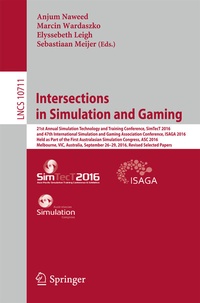
Intersections in Simulation and Gaming
Description

This book constitutes the refereed post-conference proceedings of the 21st Annual Simulation
Technology and Training Conference, SimTecT 2016, and the 47th International Simulation and
Gaming Association Conference, ISAGA 2016, Held as Part of the First Australasian Simulation
Congress, ASC 2016, held in Melbourne, VIC, Australia, in September 2016.
The 28 revised full papers included in the volume were carefully reviewed and selected from 55 submissions. They are organized in the following topical sections: Making the grade; Come to think of it; From here to fidelity; The name of the game; and Ahead of the game.
More details
Other editions
Additional editions
Content
- Intro
- Preface
- Organization
- Contents
- Making the Grade
- From Recreational to Clinical Approaches: The Use of the Cuatro Tribus Game-Based Workshop as a Comp ...
- Abstract
- 1 Introduction
- 2 Description of the Cuatro Tribus Workshops
- 2.1 Introduction and Objectives
- 2.2 Cognitive Development
- 2.3 Behavior Analysis and Modification
- 2.4 Context and Characteristics of Participants
- 3 Program at Juvenile Detention Center (CIEPA)
- 3.1 Methodology
- 3.2 Observation Guidelines
- 4 Results
- 4.1 Behavior and Cognitive Development
- 4.2 Behavior and Criminological Dynamics
- 5 Clinical Interventions
- 5.1 Examples of Interventions
- 6 Clinical Considerations
- 7 Discussions
- References
- Constructing Safe Containers for Effective Learning: Vignettes of Breakdown in Psychological Safety ...
- Abstract
- 1 Introduction
- 1.1 Physical and Psychological Safety
- 1.2 Aims and Objectives
- 2 Vignettes of Breakdown in Psychological Safety During Simulated Scenarios
- 2.1 Transport (Rail)
- 2.2 Health (Anesthesiology)
- 2.3 Business (Management/Social Education)
- 2.4 Drama (Theatre)
- 2.5 First Aid Training
- 2.6 Navy (Maritime Engineering)
- 2.7 Construction (Management)
- 2.8 Summary of Hazards
- 3 Discussion
- Acknowledgements
- References
- Leading from the Engine Room
- Abstract
- 1 Introduction
- 2 Background
- 3 Culture of Collaboration
- 3.1 Fear as Inhibitor to Collaboration
- 4 Assumptions and Beliefs as Barriers to Understanding
- 4.1 Costs as Drivers or Dividers
- 5 Case Studies - Matching Needs and Sharing Meaning
- 5.1 Case 1 - an OH&S Game
- 5.2 Case 2 - Storytelling Site for Teaching Culture
- 5.3 Case 3 - Simulation-Based Classroom
- 5.4 Case 4 - Contract for a Learning Game
- 6 Discussion
- 6.1 Technology Reuse
- 6.2 Social and Cultural Issues
- 6.3 Leadership Issues
- 6.4 Management of Product
- 7 Stereotypes and Team Processes - a Simulation Scenario
- 7.1 Team Processes
- 7.2 Forming
- 7.3 Storming
- 7.4 Norming
- 8 Conclusion
- References
- A Management Model for Effective Team Communication in Business Simulation Games
- Abstract
- 1 Introduction
- 2 Communication
- 2.1 Communication in Group Processes
- 2.2 Communication in Experiential Learning
- 2.3 Transactional Model of Communication
- 2.4 Communicative Interactions Research Method
- 2.5 Process- and Outcome-Oriented Research Approach
- 3 Research Method
- 4 Procedure
- 4.1 Subjects
- 4.2 Researching Procedure
- 4.3 Qualitative Data Analysis Procedure
- 5 Results
- 6 Modelled Approach
- 7 Limitations and Discussion
- References
- Artillery Simulation as a Pedagogical Tool in Military Education
- Abstract
- 1 Introduction
- 2 Simulator Description
- 3 Game Description
- 4 Description of the Investigation
- 5 Results
- 6 Discussion
- 7 Conclusions
- 8 Future Research
- References
- Come to Think of it
- Soft Overcomes Hard: Simulation Leadership as Mediation of Choice Architectures
- Abstract
- 1 Introduction
- 2 Soft Overcomes Hard
- 2.1 Hard and Soft Control
- 3 Enter the Nudge
- 3.1 Humans as Error-Prone Processors
- 3.2 Choice Architecture to Mediate Leadership
- 4 The Machinations of Manipulators
- 4.1 With Great Power Comes Great Responsibility
- 5 Simu-Leaders as Choice Architects
- 5.1 Considerations for Teachers Using Choice Architectures
- 5.2 Nudges in Action
- 6 Conclusion
- References
- Building Strategies for Organizational Development with Simulation Games
- Abstract
- 1 Introduction
- 2 Effective Use of Simulation Games in Organizations
- 3 Designing Simulation Games for Organizational Development
- 4 Simulation Games for Organization Development
- 5 Simulation Gaming Model
- 5.1 Example 1
- 5.2 Example 2
- 6 Discussion
- References
- Pitfalls for Debriefing Games and Simulations: Theory and Practice
- Abstract
- 1 Introduction
- 2 Background Work
- 3 Research Approach and Methodology
- 4 Results
- 4.1 Pitfall 1: The Debriefers' Level of Involvement and Style is not Appropriate
- 4.2 Pitfall 2: Debriefers Have Lack of Understanding of the Debriefing Process
- 4.3 Pitfall 3: Lack of Plan and/or Rules
- 4.4 Pitfall 4: The Allocated Time for the Debriefing is Short
- 4.5 Pitfall 5: Ineffective Use of Audiovisual (A-V) Material
- 4.6 Pitfall 6: Lack of Emotional Safety of the Participants
- 4.7 Pitfall 7: Factors Related with the Actual Physical Environment, Where the Debriefing Takes Place
- 4.8 Pitfall 8: Choosing the Appropriate Structure for Debriefing
- 4.9 Pitfall 9: The Tendency of the Participants to Assign Blame and Antagonize Each Other
- 4.10 Pitfall 10: Lack of Trust of the Participants Towards the Debriefer
- 4.11 Pitfall 11: The Simulation is not Organized in a Personal Basis
- 4.12 Pitfall 12: Inappropriate Timing/Scheduling of the Debriefing
- 5 Conclusion and Future Work
- References
- Assessment and Evaluation of Learning via Simulation
- Abstract
- 1 Introduction
- 2 Project
- 3 Simulation in Use
- 4 Selecting a Beginning Point
- 4.1 What is 'Simulation'?
- 5 Simulation as 'Trickery'
- 6 Beginning a Dialogue
- 6.1 Differing Perspectives
- 6.2 Indeterminacy and Chaos
- 6.3 'Open' and 'Closed' Simulation
- 6.4 Boundaries in Simulation
- 6.5 Patterns of Action in Simulation
- 6.6 Revisiting Questions of Assessment
- 6.7 Revisiting the Nature of Simulation
- 6.8 Chaos/Complexity Theory and Simulation
- 6.9 Assessment Strategies
- 6.10 Agency and Structure
- 6.11 Multiplying the Questions
- 6.12 What to Measure? and How?
- 6.13 Simulation and Paradigm Shifts
- 7 Conclusions and Next Steps
- References
- A Katana Design Experience
- Abstract
- 1 Introduction
- 2 Simulating a New Design Experience
- 2.1 Theory
- 2.2 Process
- 2.3 Tools
- 2.4 Systems
- 3 Method
- 3.1 Step 1: Identify a Bank of Appropriate Gestures
- 3.2 Step 2: Map the Morphogenetic Behaviours to the Katana Gestures
- 3.3 Step 3: Refine the Prototype
- 4 Discussion
- 5 Conclusions
- Acknowledgements
- References
- "Polyphonic Games" for Leadership Training
- Abstract
- 1 Introduction
- 2 Games for Leadership Development
- 3 Bakhtin's Theory: Polyphonic and Ventriloquistic Games
- 3.1 The Role of Game Facilitator
- 3.2 Dialogism
- 3.3 Transgression
- 4 Conclusion
- References
- Swarm Mechanism for "Hedgehog" Asteroid Rover, Using Netlogo Simulations
- Abstract
- 1 Introduction
- 2 Localization and Data Transmission
- 3 Simulations
- 3.1 Environment
- 3.2 Swarming Rules
- 3.3 Results
- 4 Discussion
- References
- From Here to Fidelity
- Rail Simulation and Training: A Socio-Cultural and Technical Orchestration
- Abstract
- 1 Introduction
- 2 Workplace Learning and Organisational Culture
- 3 Simulation Success Factors
- 3.1 Fidelity
- 3.2 Domain Specificity
- 3.3 Skilled Facilitation
- 3.4 Integration with Curriculum
- 3.5 Availability
- 3.6 Reliability
- 3.7 Stakeholder Engagement
- 4 Seeing into the Rail Driver's Head
- 5 Conclusion
- Acknowledgements
- References
- A Qualitative Evaluation of the Role of Virtual Reality as a Safety Training Tool for the Mining Ind ...
- Abstract
- 1 Introduction
- 2 Virtual Reality as a Training Tool
- 2.1 VR-Based Training for Rescue Brigades in Coal Services Pty. Ltd.
- 3 Coal Services Pty. Ltd. VR Training Center
- 4 Methodology
- 4.1 Actual Training Needs
- 4.2 Real World Training Constraints
- 4.3 VR Capabilities
- 4.4 VR Utilization
- 5 Participants
- 6 Results
- 6.1 Actual Training Needs
- 6.2 Real-World's Training Constraints
- 6.3 VR-Based Training Capabilities
- 6.4 VR-Based Training Utilization from Various Point of Views
- 7 Conclusion
- References
- Exploring Avatar Facial Fidelity and Emotional Expressions on Observer Perception of the Uncanny Valley
- Abstract
- 1 Introduction
- 1.1 Avatar-Human Interaction
- 1.2 Avatar Facial Emotional Expression
- 1.3 Avatar Fidelity and Realism
- 1.4 The Uncanny Valley
- 1.5 Measurement of Emotional Reactions
- 1.6 Tools for Measuring Responses to Avatars
- 2 Method
- 2.1 Participants
- 2.2 Experiment
- 2.3 Data Preparation and Analysis
- 3 Results
- 3.1 Participants
- 3.2 EMG Startle Results
- 3.3 Godspeed Results
- 3.4 Gender Differences
- 3.5 Correlations
- 4 Discussion and Conclusion
- Acknowledgements
- References
- Making Virtual Sense: Display Type and Narrative Medium Influence Sensemaking in Virtual Environments
- Abstract
- 1 Introduction
- 1.1 Virtual Environments
- 1.2 Narrative
- 1.3 Sensemaking
- 1.4 Research Objective
- 2 Methodology
- 2.1 Participants
- 2.2 Equipment, Materials and Measures
- 2.3 Tasks
- 2.4 Procedure
- 2.5 Data Analysis
- 3 Results
- 3.1 Report on Return Debriefing
- 3.2 Sensemaking
- 4 Discussion
- 4.1 Display Type and Sensemaking
- 4.2 Narrative Medium and Sensemaking
- 4.3 Interaction Effect on Sensemaking
- 4.4 Limitations and Future Research
- 4.5 Practical Applications of Research Findings
- 5 Conclusion
- Acknowledgements
- References
- The Name of the Game
- Supporting Energy Efficient Train Operation by Using Gamification to Motivate Train Drivers
- Abstract
- 1 Eco Driving
- 1.1 Principles and Strategies of Eco Driving
- 1.2 Eco Driving Approach in Road Transport
- 1.3 Eco Driving Approaches in Railways
- 2 Motivation
- 2.1 Behaviorist and Cognitivist Approaches
- 2.2 Self-Determination Theory Premises
- 2.3 Basic Human Needs in SDT
- 3 Gamification
- 3.1 Definition
- 3.2 Gamification Mechanics and Components
- 3.3 SDT in Accordance to Gamification
- 4 Gamification Framework Designed for a Polish Regional Railway Carrier
- 4.1 Phase 1: Feedback
- 4.2 Phase 2: Comparison
- 4.3 Phase 3: Cooperation and Group Competition
- 4.4 Phase 4: Society and Mastery
- 5 Conclusions
- References
- Addressing Challenges of Planning in Multimodal Transportation Nodes with Simulation Games
- Abstract
- 1 Introduction
- 1.1 Background
- 1.2 Motivation
- 1.3 Structure
- 2 The Use of Simulation Games as Design Tool for Complex Systems
- 3 The Multiplayer Game Decisions Based on Collaborative Interactions in TEams (D-CITE)
- 3.1 General Information
- 3.2 Study
- 3.3 D-CITE as a Training Instrument
- 4 The Multiplayer Yard Crane Scheduler Game (YCS3)
- 4.1 General Information
- 4.2 Study
- 5 Discussion and Conclusion
- Acknowledgements
- References
- A Study on Gaming Simulation as a Key of Meta-Frame of Planning for Neighborhood Immigrant Integrati ...
- Abstract
- 1 Urgency in Promoting Neighborhood Diversity
- 2 Gaming Simulation as a Tool to Promote Immigrant Integration
- 3 Game Design and Mechanism
- 4 Effect of the Game on Resident Perception
- 5 Discussion and Final Remarks
- References
- Oceanic Oil Spill Simulations Provide Memorable Disaster Preparedness Training
- Abstract
- 1 Introduction
- 2 Simulation Objectives
- 2.1 Active Learning and Roleplay
- 2.2 Industry-Centered Professional Experience
- 2.3 Real-World Connectivity with Materials
- 3 Key Materials
- 3.1 Crude Oil
- 3.2 Microcosms for Experimental Containment
- 3.3 Remediation Equipment
- 4 Simulation Procedure
- 4.1 Providing Background Context
- 4.2 Choose (and Justify) Your Own Adventure
- 4.3 Laboratory Layout
- 4.4 Environmental Health and Safety (EHS) Talk
- 4.5 Commencing the Oil Spill Simulation
- 5 Post-activity Reflection
- 6 Learning Outcomes
- 6.1 Participants Reports
- 6.2 Feedback on the Simulation
- 7 Conclusions
- Acknowledgements
- References
- Milk Supply Chain Management Game for Waste Reduction
- Abstract
- 1 Introduction
- 2 Necessity of an Original Game
- 3 Japanese Milk Supply Chain
- 4 Game Scenario
- 4.1 Specified Organization
- 4.2 Milk Manufacturers
- 4.3 Supermarkets
- 4.4 Consumers
- 4.4.1 Single Men
- 4.4.2 Housewives
- 5 Conclusion
- References
- Ahead of the Game
- Challenges and Solutions for Integrating Simulation into a Transportation Device
- Abstract
- 1 Introduction
- 2 On-Board Condition Monitoring Device
- 2.1 Multi-body Simulator
- 2.2 Synchronizing the Simulator
- 3 Bench Testing by Simulation
- 3.1 Simulating GPS
- 3.2 Results
- 4 Discussion
- 4.1 Synchronization Improvements
- 4.2 Future Simulation Improvements
- 4.3 Simulation Limitations
- 5 Conclusion
- Acknowledgements
- References
- Simulation Game Impacts on Perceptions of Nuclear Energy
- Abstract
- 1 Introduction
- 2 Review of Literature
- 2.1 Learning Outcomes of Games
- 2.2 Post-Fukushima Japan
- 2.3 Prior Study
- 2.4 Attitudes and Perceptions
- 3 Method
- 3.1 Sources of Data
- 3.2 Materials
- 4 Results and Analyses
- 4.1 Quantitative Analyses
- 4.2 Qualitative Analysis
- 5 Discussion
- 6 Conclusion
- References
- Sink or SWMM: Simulating the Hydrological Effects of Retention Tanks in a Small Urban Catchment
- Abstract
- 1 Introduction
- 1.1 Rainwater Retention Tanks
- 1.2 Multiple WSUD Approaches
- 2 Study Aim and Objectives
- 3 Method
- 3.1 Selection of the Modelling Tool
- 3.2 Construction of the Runoff Model
- 3.3 Model Calibration and Validation
- 3.4 Rainfall Data
- 3.5 Development Scenarios
- 3.6 Simulation for Each Development Scenario
- 3.7 Comparison of Scenario Outcomes
- 4 Results
- 4.1 Impact of Infill Development
- 4.2 Effect of Retention Tanks Fitted to 75% of Properties in the Catchment
- 4.3 Economic Assessment
- 5 Discussion
- 5.1 Impact of Different Uptake Levels
- 5.2 Impact of Different Tank Sizes
- 5.3 Impact of Different Water Uses
- 5.4 Impact of Retention to Restore Peak Flow and Runoff Volume
- 5.5 Sources of Error in SWMM
- 5.6 Economic Assessment
- 6 Use of Simulation and Modelling
- 7 Conclusion
- 8 Recommendations
- Acknowledgements
- References
- The Effectiveness of Negotiation Games in Citizenship Education: An Examination of Diplomatic Negotiation Game INDEPENDENCE DAY in a Japanese High School
- Abstract
- 1 Introduction
- 2 INDEPENDENCE DAY
- 2.1 The Contents of INDEPENDENCE DAY
- 2.2 Situation
- 2.3 Game Flow
- 2.4 Notes
- 2.5 Debriefing
- 3 Experiment Evaluation: Methods and Results
- 3.1 Hypotheses
- 3.2 Methods
- 3.3 Results
- 4 Conclusion
- References
- Development of Business Simulation Game with Use of Design Science Research
- Abstract
- 1 Introduction
- 2 Design Science Research in Simulation Development
- 3 Foundation of the Artifact
- 4 Design and Development
- 5 Game Description
- 6 Conclusions and Future Research
- References
- Gaming Simulation as a Science of Design Approach
- Abstract
- 1 Types of Gaming Simulation Applications
- 2 Gaming Simulation as Method for Understanding and Changing Systems
- 3 Methodology of Gaming Simulation
- 3.1 Simulation and Resources
- 3.2 Roles and Actors
- 3.3 Game and Rules
- 4 Case Example SysTeamsChange® - A Game for Change Management and Leadership
- 4.1 SysTeamsChange® - Design-in-the-Small of the Game Artifact
- 4.2 SysTeamsChange® - Design-in-the-Large with the Game Artifact
- References
- A Serious Game for Eliciting Tacit Strategies for Dynamic Table Assignment in a Restaurant
- Abstract
- 1 Introduction
- 2 Table Assignment Problem
- 2.1 Basic Problem Structure
- 2.2 Dynamic Aspects of the Problem
- 2.3 Subjective Aspects of the Problem
- 3 Serious Game Development
- 3.1 Game Outline
- 3.2 Table Configurations
- 3.3 Customer Model
- 3.4 Score Design
- 3.5 Game Screen
- 3.6 Game Implementation
- 4 Application Experiments
- 4.1 Case 1: Difference Between Experienced and Inexperienced Players
- 4.2 Case 2: Characterization of Strategies of Players
- 5 Conclusions
- References
- Author Index
