

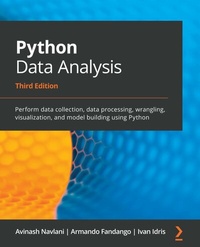
Python Data Analysis
Perform data collection, data processing, wrangling, visualization, and model building using Python
3rd Edition
Published on 23. September 2024
478 pages
978-1-78995-345-9 (ISBN)
Description

Understand data analysis pipelines using machine learning algorithms and techniques with this practical guide
Key Features
Prepare and clean your data to use it for exploratory analysis, data manipulation, and data wrangling
Discover supervised, unsupervised, probabilistic, and Bayesian machine learning methods
Get to grips with graph processing and sentiment analysis
Book DescriptionData analysis enables you to generate value from small and big data by discovering new patterns and trends, and Python is one of the most popular tools for analyzing a wide variety of data. With this book, you'll get up and running using Python for data analysis by exploring the different phases and methodologies used in data analysis and learning how to use modern libraries from the Python ecosystem to create efficient data pipelines. Starting with the essential statistical and data analysis fundamentals using Python, you'll perform complex data analysis and modeling, data manipulation, data cleaning, and data visualization using easy-to-follow examples. You'll then understand how to conduct time series analysis and signal processing using ARMA models. As you advance, you'll get to grips with smart processing and data analytics using machine learning algorithms such as regression, classification, Principal Component Analysis (PCA), and clustering. In the concluding chapters, you'll work on real-world examples to analyze textual and image data using natural language processing (NLP) and image analytics techniques, respectively. Finally, the book will demonstrate parallel computing using Dask. By the end of this data analysis book, you'll be equipped with the skills you need to prepare data for analysis and create meaningful data visualizations for forecasting values from data.What you will learn
Explore data science and its various process models
Perform data manipulation using NumPy and pandas for aggregating, cleaning, and handling missing values
Create interactive visualizations using Matplotlib, Seaborn, and Bokeh
Retrieve, process, and store data in a wide range of formats
Understand data preprocessing and feature engineering using pandas and scikit-learn
Perform time series analysis and signal processing using sunspot cycle data
Analyze textual data and image data to perform advanced analysis
Get up to speed with parallel computing using Dask
Who this book is forThis book is for data analysts, business analysts, statisticians, and data scientists looking to learn how to use Python for data analysis. Students and academic faculties will also find this book useful for learning and teaching Python data analysis using a hands-on approach. A basic understanding of math and working knowledge of the Python programming language will help you get started with this book.
Key Features
Prepare and clean your data to use it for exploratory analysis, data manipulation, and data wrangling
Discover supervised, unsupervised, probabilistic, and Bayesian machine learning methods
Get to grips with graph processing and sentiment analysis
Book DescriptionData analysis enables you to generate value from small and big data by discovering new patterns and trends, and Python is one of the most popular tools for analyzing a wide variety of data. With this book, you'll get up and running using Python for data analysis by exploring the different phases and methodologies used in data analysis and learning how to use modern libraries from the Python ecosystem to create efficient data pipelines. Starting with the essential statistical and data analysis fundamentals using Python, you'll perform complex data analysis and modeling, data manipulation, data cleaning, and data visualization using easy-to-follow examples. You'll then understand how to conduct time series analysis and signal processing using ARMA models. As you advance, you'll get to grips with smart processing and data analytics using machine learning algorithms such as regression, classification, Principal Component Analysis (PCA), and clustering. In the concluding chapters, you'll work on real-world examples to analyze textual and image data using natural language processing (NLP) and image analytics techniques, respectively. Finally, the book will demonstrate parallel computing using Dask. By the end of this data analysis book, you'll be equipped with the skills you need to prepare data for analysis and create meaningful data visualizations for forecasting values from data.What you will learn
Explore data science and its various process models
Perform data manipulation using NumPy and pandas for aggregating, cleaning, and handling missing values
Create interactive visualizations using Matplotlib, Seaborn, and Bokeh
Retrieve, process, and store data in a wide range of formats
Understand data preprocessing and feature engineering using pandas and scikit-learn
Perform time series analysis and signal processing using sunspot cycle data
Analyze textual data and image data to perform advanced analysis
Get up to speed with parallel computing using Dask
Who this book is forThis book is for data analysts, business analysts, statisticians, and data scientists looking to learn how to use Python for data analysis. Students and academic faculties will also find this book useful for learning and teaching Python data analysis using a hands-on approach. A basic understanding of math and working knowledge of the Python programming language will help you get started with this book.
All prices
More details
Edition
3rd Revised edition
Language
English
Place of publication
Birmingham
United Kingdom
Target group
Professional and scholarly
US School Grade: College Graduate Student
Edition type
Revised edition
Product notice
Reflowable
File size
14,94 MB
ISBN-13
978-1-78995-345-9 (9781789953459)
Copyright in bibliographic data and cover images is held by Nielsen Book Services Limited or by the publishers or by their respective licensors: all rights reserved.
Schweitzer Classification
Other editions
Additional editions
Avinash Navlani | Ivan Idris
Python Data Analysis
Perform data collection, data processing, wrangling, visualization, and model building using Python
Book
02/2021
3rd Edition
Packt Publishing
€47.50
Shipment within 3-4 weeks
Previous edition
Armando Fandango
Python Data Analysis, Second Edition
Data manipulation and complex data analysis with Python
E-Book
01/2025
2nd Edition
Packt Publishing Limited
€48.49
Available for download
Persons
Navlani Avinash :
Avinash Navlani has over 8 years of experience working in data science and AI. Currently, he is working as a senior data scientist, improving products and services for customers by using advanced analytics, deploying big data analytical tools, creating and maintaining models, and onboarding compelling new datasets. Previously, he was a university lecturer, where he trained and educated people in data science subjects such as Python for analytics, data mining, machine learning, database management, and NoSQL. Avinash has been involved in research activities in data science and has been a keynote speaker at many conferences in India.Idris Ivan :
Ivan Idris has an MSc in experimental physics. His graduation thesis had a strong emphasis on applied computer science. After graduating, he worked for several companies as a Java developer, data warehouse developer, and QA analyst. His main professional interests are business intelligence, big data, and cloud computing. Ivan Idris enjoys writing clean, testable code and interesting technical articles. Ivan Idris is the author of NumPy 1.5. Beginner's Guide and NumPy Cookbook by Packt Publishing.
Avinash Navlani has over 8 years of experience working in data science and AI. Currently, he is working as a senior data scientist, improving products and services for customers by using advanced analytics, deploying big data analytical tools, creating and maintaining models, and onboarding compelling new datasets. Previously, he was a university lecturer, where he trained and educated people in data science subjects such as Python for analytics, data mining, machine learning, database management, and NoSQL. Avinash has been involved in research activities in data science and has been a keynote speaker at many conferences in India.Idris Ivan :
Ivan Idris has an MSc in experimental physics. His graduation thesis had a strong emphasis on applied computer science. After graduating, he worked for several companies as a Java developer, data warehouse developer, and QA analyst. His main professional interests are business intelligence, big data, and cloud computing. Ivan Idris enjoys writing clean, testable code and interesting technical articles. Ivan Idris is the author of NumPy 1.5. Beginner's Guide and NumPy Cookbook by Packt Publishing.
Content
Table of Contents
Getting Started with Python Libraries
NumPy and Pandas
Statistics
Linear Algebra
Data Visualization
Retrieving, Processing, and Storing Data
Cleaning Messy Data
Signal Processing and Time Series
Supervised Learning
Supervised Learning
Unsupervised Learning
Analyzing Textual Data
Analyzing Image Data
Parallel Computing using Dask
Getting Started with Python Libraries
NumPy and Pandas
Statistics
Linear Algebra
Data Visualization
Retrieving, Processing, and Storing Data
Cleaning Messy Data
Signal Processing and Time Series
Supervised Learning
Supervised Learning
Unsupervised Learning
Analyzing Textual Data
Analyzing Image Data
Parallel Computing using Dask
