

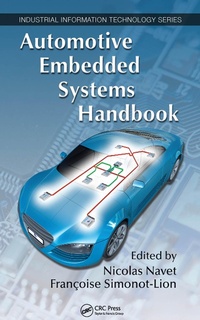
Automotive Embedded Systems Handbook
Published on 19. December 2017
488 pages
978-1-351-83819-1 (ISBN)
Description

A Clear Outline of Current Methods for Designing and Implementing Automotive Systems
Highlighting requirements, technologies, and business models, the Automotive Embedded Systems Handbook provides a comprehensive overview of existing and future automotive electronic systems. It presents state-of-the-art methodological and technical solutions in the areas of in-vehicle architectures, multipartner development processes, software engineering methods, embedded communications, and safety and dependability assessment.
Divided into four parts, the book begins with an introduction to the design constraints of automotive-embedded systems. It also examines AUTOSAR as the emerging de facto standard and looks at how key technologies, such as sensors and wireless networks, will facilitate the conception of partially and fully autonomous vehicles. The next section focuses on networks and protocols, including CAN, LIN, FlexRay, and TTCAN. The third part explores the design processes of electronic embedded systems, along with new design methodologies, such as the virtual platform. The final section presents validation and verification techniques relating to safety issues.
Providing domain-specific solutions to various technical challenges, this handbook serves as a reliable, complete, and well-documented source of information on automotive embedded systems.
Highlighting requirements, technologies, and business models, the Automotive Embedded Systems Handbook provides a comprehensive overview of existing and future automotive electronic systems. It presents state-of-the-art methodological and technical solutions in the areas of in-vehicle architectures, multipartner development processes, software engineering methods, embedded communications, and safety and dependability assessment.
Divided into four parts, the book begins with an introduction to the design constraints of automotive-embedded systems. It also examines AUTOSAR as the emerging de facto standard and looks at how key technologies, such as sensors and wireless networks, will facilitate the conception of partially and fully autonomous vehicles. The next section focuses on networks and protocols, including CAN, LIN, FlexRay, and TTCAN. The third part explores the design processes of electronic embedded systems, along with new design methodologies, such as the virtual platform. The final section presents validation and verification techniques relating to safety issues.
Providing domain-specific solutions to various technical challenges, this handbook serves as a reliable, complete, and well-documented source of information on automotive embedded systems.
Reviews / Votes
"Written for students in electrical and industrial engineering, this textbook describes the computer-based embedded systems commonly used in modern automobiles, and how AUTOSAR standards continue to evolve toward the creation of autonomous vehicles in the future. Editors Navet and Simonot-Lion have obtained information from leading experts to describe in-vehicle architectures, software engineering, embedded communications and safety assessment technologies currently being introduced to the automotive industry. These contributors also explain networks and protocols such as CAN, LIN, TTCAN and FlexRay as well as the use of virtual platforms in the design process."-Research Book News, June 2009More details
Series
Language
English
Place of publication
London
United Kingdom
Publishing group
Taylor & Francis Ltd
Target group
Professional and scholarly
Product notice
Reflowable
Illustrations
13 Tables, black and white; 159 Illustrations, black and white
File size
18,38 MB
ISBN-13
978-1-351-83819-1 (9781351838191)
Copyright in bibliographic data and cover images is held by Nielsen Book Services Limited or by the publishers or by their respective licensors: all rights reserved.
Schweitzer Classification
Other editions
Additional editions
Nicolas Navet | Francoise Simonot-Lion
Automotive Embedded Systems Handbook
Book
12/2008
1st Edition
CRC Press
€299.30
Available immediately
Persons
Navet, Nicolas; Simonot-Lion, Francoise
Content
Preface. Automotive Architectures. Embedded Communications. Embedded Software and Development Processes. Verification, Testing, and Timing Analysis. Index.
