

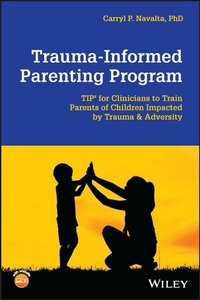
Trauma-Informed Parenting Program
Description

In Trauma-Informed Parenting Program: TIPs for Clinicians to Train Parents of Children Impacted by Trauma & Adversity, distinguished behavioral healthcare practitioner, Dr. Carryl P. Navalta, delivers a practical and hands-on guide for clinicians to assist clients, and their families with emotion regulation in the face of trauma. In the book, readers will discover how to assess, conceptualize, and treat children suffering from the effects of exposure to various forms of trauma and adversity and to provide their clients' parents with the tools neccessary to facilitate further healing in the home and beyond.
TIPs also Provides:
* A thorough introduction to trauma that describes the historical roots and prevalence of trauma as well as the impact of adverse childhood experiences on child development and emotion regulation
* A comrehensive exploration of case conceptualization and the creation of clinical formulations that identify, define, and integrate the primary problems facing the client
* A fulsome discussion of treatment planning, including goal development, objective construction, intervention creation, and diagnosis determination
* Psychologists can earn 6 continuing credits by reading the book and taking a post-test. This professional learning activity is offered by the National Prevention Science Coalition to Improve Lives
An indespensible resource for clinicians dealing with trauma-impacted children, Trauma-Informed Parenting Program will earn a plce in the libraries of mental health counselors, social works, psychologists, psychiatrists, and all the practitioners who seek to make the parents of their clients an integral and usefual part of the treatment process.
More details
Other editions
Additional editions
Person
CARRYL P. NAVALTA, PhD, is Clinical Associate Professor of Psychiatry at Boston University School of Medicine. He has devoted his nearly 30-year career to the health of children, teenagers, and their families. His work in the field of developmental adversity includes clinical research in assessment, treatment, and neurobiology; numerous articles and book chapters; and presentations to local, regional, national, and international audiences. As a core faculty member who teaches both didactic and supervision courses, Dr. Navalta educates and trains future behavioral healthcare clinicians to adopt his mantra, Assess to understand before you intervene.
Content
Foreword ix
Acknowledgements xi
About the Companion Website xiii
1 Introduction and Foundations 1
2 Clinical Assessment 22
3 Case Conceptualization 39
4 Treatment Planning 57
5 Guidelines for Clinicians 76
6 Final Thoughts . . . . and Skills 123
Appendix A Case Conceptualization Development Form 129
Appendix B Treatment Planning Form 131
Appendix C Emotion Identification Worksheet 133
Appendix D Problem-Solving Steps 135
References 137
Index 163
