

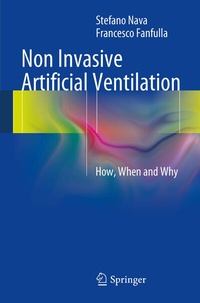
Non Invasive Artificial Ventilation
Description

Over the last two decades, the increasing use of noninvasive ventilation (NIV) has reduced the need for endotracheal ventilation, thus decreasing the rate of ventilation-induced complications. Thus, NIV has decreased both intubation rates and mortality rates in specific subsets of patients with acute respiratory failure (for example, patients with hypercapnia, cardiogenic pulmonary edema, immune deficiencies, or post-transplantation acute respiratory failure). Despite the increased use of NIV in clinical practice, there is still a need for more educational tools to improve clinicians' knowledge of the indications and contraindications for NIV, the factors that predict failure or success, and also what should be considered when starting NIV. This book has the dual function of being a "classical" text where the major findings in the literature are discussed and highlighted, as well as a practical manual on the tricks and pitfalls to consider in NIV application by both beginners and experts. For example, setting the ventilatory parameters; choosing the interfaces, circuits, and humidification systems; monitoring; and the "right" environment for the "right" patient will be discussed to help clinicians in their choices.
Reviews / Votes
From the reviews:
"This book describes the physiology and applications of mechanical ventilation without the traditional endotracheal tube. The purpose is to provide a clinical approach to noninvasive ventilation and pearls. Practitioners at all levels using noninvasive ventilation are an appropriate audience for this work . . This is an effective, conversational introduction to an important bedside technology." (David J. Dries, Doody's Book Reviews, February, 2014)More details
Other editions
Additional editions
Content
1. Why to use NIV to wean a patient.- 2. Mechanical ventilation physiology.- 3. (Almost) all you want to know about a ventilator.- 4. Interfaces for NIV.- 5. When to start (or not) a ventilator treatment.- 6. Modalities to wean a patient undergoing NIV.- 7. How to set up the ventilator.- 8. Other ventilation modalities.- 9. Why NIV is beautiful?.- 10. Myths, prejudices and real problems.- 11. Non invasive ventilotherapy in acute respiratory failure treatment: the five marvelous.- 12. Non invasive ventilotherapy in acute respiratory failure treatment: emerging indications.- 13. Non invasive ventilotherapy in acute respiratory failure treatment: controversial indications.- 14. Eight rules to remember when using NIV to wean a patient.- 15. Tricks and trips of NIV.- 16. Negative predictors.- 17. Where to wean a patient during NIV.- 18. Non invasive ventilotherapy monitoring.- 19. How to interpret curves on a ventilator screen.- 20. Chronic mechanical ventilation: does a rationale exist?.- 21. Chronic ventilation in BPCO.- 22. Ventilation in patients with restrictive diseases.- 23. Rational bases of ventilation during sleep.- 24. Night ventilation: when CPAP, when NIV.
