

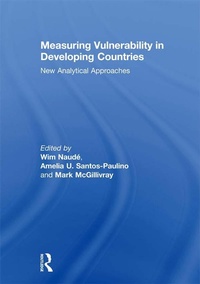
Measuring Vulnerability in Developing Countries
New Analytical Approaches
1st Edition
Published on 29. October 2014
144 pages
978-1-317-98451-1 (ISBN)
Description

In all of the major challenges facing the world currently, whether it be climate change, terrorism and conflict, or urbanization and demographic change, no progress is possible without the alleviation of poverty. New approaches in development economics have in recent years started from the premise that we cannot successfully deal with poverty unless we also deal with vulnerability-but not only vulnerability to income poverty but also vulnerability to various others hazards-such as climate, conflict, macroeconomic shocks and natural disasters.
This book provide insights into new approaches in conceptualising and measuring vulnerability. It includes chapters dealing with advanced issues such as the compilation of economic vulnerability indices (EVIs) on a macro-level, of conceptualizing and measuring local vulnerability across regions in a country, and of measuring the flip-side of vulnerability, namely resilience. The book also explores the sensitivities of the various measurements of vulnerability to vulnerability lines, poverty lines, and permanent income, with consideration to some of the most vulnerable groups in developing countries. Overall, the contributions in the book consolidate new approaches as far as the concept and measurement of vulnerability on different levels and outcomes are concerned, and note directions for future research.
This book was published as a special issue of Oxford Development Studies.
This book provide insights into new approaches in conceptualising and measuring vulnerability. It includes chapters dealing with advanced issues such as the compilation of economic vulnerability indices (EVIs) on a macro-level, of conceptualizing and measuring local vulnerability across regions in a country, and of measuring the flip-side of vulnerability, namely resilience. The book also explores the sensitivities of the various measurements of vulnerability to vulnerability lines, poverty lines, and permanent income, with consideration to some of the most vulnerable groups in developing countries. Overall, the contributions in the book consolidate new approaches as far as the concept and measurement of vulnerability on different levels and outcomes are concerned, and note directions for future research.
This book was published as a special issue of Oxford Development Studies.
More details
Edition
1. Auflage
Language
English
Place of publication
London
United Kingdom
Publishing group
Taylor & Francis Ltd
Target group
College/higher education
Illustrations
4 Line drawings, black and white; 1 Halftones, black and white
ISBN-13
978-1-317-98451-1 (9781317984511)
Copyright in bibliographic data and cover images is held by Nielsen Book Services Limited or by the publishers or by their respective licensors: all rights reserved.
Schweitzer Classification
Other editions
Additional editions
Wim Naude | Amelia Santos-Paulino | Mark McGillivray
Measuring Vulnerability in Developing Countries
New Analytical Approaches
Book
05/2013
1st Edition
Routledge
€88.08
Shipment within 15-20 days
Wim Naude | Amelia Santos-Paulino | Mark McGillivray
Measuring Vulnerability in Developing Countries
New Analytical Approaches
Book
09/2011
1st Edition
Routledge
€207.98
Shipment within 15-20 days
Persons
Wim Naude is Professor of Development Economics and Entrepreneurship at Maastricht School of Management, Maastricht, The Netherlands, and Senior Research Fellow at UNU-WIDER, Helsinki, Finland.
Amelia U. Santos-Paulino is at the Division for Africa, Least Developed Countries and Special Programmes, UNCTAD, Geneva, Switzerland. She is a former UNU-WIDER Research Fellow.
Mark McGillivray is Research Professor of International Development at Alfred Deakin Research Institute, Deakin University, Geelong, Australia. He is a former deputy-director of UNU-WIDER.
Amelia U. Santos-Paulino is at the Division for Africa, Least Developed Countries and Special Programmes, UNCTAD, Geneva, Switzerland. She is a former UNU-WIDER Research Fellow.
Mark McGillivray is Research Professor of International Development at Alfred Deakin Research Institute, Deakin University, Geelong, Australia. He is a former deputy-director of UNU-WIDER.
Content
1. Measuring Vulnerability: An Overview and Introduction Wim Naude, Amelia U. Santos-Paulino and Mark McGillivray 2. An Economic Vulnerability Index: Its Design and Use for International Development Policy Patrick Guillaumont 3. Economic Vulnerability and Resilience: Concepts and Measurements Lino Briguglio, Gordon Cordina, Nadia Farrugia and Stephanie Vella 4. Measuring the Vulnerability of Subnational Regions in South Africa Wim Naude, Mark McGillivray and Stephanie Rossouw 5. How Precisely Can We Estimate Vulnerability to Poverty? Yuan Zhang and Guanghua Wan 6. The Impact of Violent Conflicts on Households: What Do We Know and What Should We Know about War Widows? Tilman Brueck and Kati Schindler
