

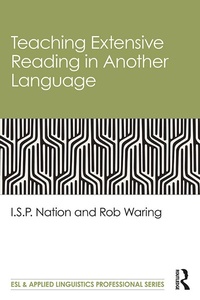
Teaching Extensive Reading in Another Language
1st Edition
Published on 20. November 2019
212 pages
978-1-000-73989-3 (ISBN)
Description

This comprehensive book by renowned scholars Paul Nation and Rob Waring accessibly covers all aspects of extensive reading in second and foreign language contexts. The book serves as a major update to the field on the topic, with current research findings on extensive reading as they relate to motivation, reading fluency, and vocabulary learning, among other topics.
Clear and straightforward, it includes case studies, strategies, and methods for implementing and assessing effective extensive reading in the classroom and provides resources and tools for preservice teachers of ESL/EFL and foreign languages.
Suitable for programs in TESOL and Applied Linguistics with courses in L2 reading, reading instruction, TESOL methods, and foreign language reading or teaching, it will appeal to students and preservice teachers as well as English language teaching professionals and EFL/ESL teachers.
Clear and straightforward, it includes case studies, strategies, and methods for implementing and assessing effective extensive reading in the classroom and provides resources and tools for preservice teachers of ESL/EFL and foreign languages.
Suitable for programs in TESOL and Applied Linguistics with courses in L2 reading, reading instruction, TESOL methods, and foreign language reading or teaching, it will appeal to students and preservice teachers as well as English language teaching professionals and EFL/ESL teachers.
Reviews / Votes
"Teaching Extensive Reading in Another Language is an invaluable addition to ER literature. While making readers aware of the complementary relationship between vocabulary learning from ER and deliberate vocabulary learning, the authors assert that ER is possibly the best remedy to problematic L2 curricula. Such a claim is assuredly justified by research and empirical findings. This book also makes ER accessible to practitioners by providing examples of ER practice, while simultaneously encouraging researchers to advance ER research by outlining methodological pitfalls. This volume can, therefore, be considered as a source of inspiration for existing and future ER proponents."-Mitsue Tabata-Sandom, Reading in a Foreign Language 32(1)
More details
Series
Edition
1. Auflage
Language
English
Place of publication
London
United Kingdom
Publishing group
Taylor & Francis Ltd
Target group
ELT/ESL
College/higher education
Product notice
Reflowable
Illustrations
16 Tables, black and white; 3 Line drawings, black and white; 3 Illustrations, black and white
ISBN-13
978-1-000-73989-3 (9781000739893)
Copyright in bibliographic data and cover images is held by Nielsen Book Services Limited or by the publishers or by their respective licensors: all rights reserved.
Schweitzer Classification
Other editions
Additional editions
I.S.P. Nation | Rob Waring
Teaching Extensive Reading in Another Language
Book
12/2019
1st Edition
Routledge
€65.10
Shipment within 15-20 days
I.S.P. Nation | Rob Waring
Teaching Extensive Reading in Another Language
Book
12/2019
1st Edition
Routledge
€185.90
Shipment within 15-20 days
Persons
Paul Nation is Professor Emeritus in Applied Linguistics at Victoria University of Wellington, New Zealand.
Rob Waring is Professor at Notre Dame Seishin University in Okayama, Japan.
Rob Waring is Professor at Notre Dame Seishin University in Okayama, Japan.
Content
Chapter 1: Keeping extensive reading simple
Chapter 2: What are graded readers?
Chapter 3: Case studies of extensive reading programs
Chapter 4: How do you set up and run an extensive reading program?
Chapter 5: How vocabulary is learned from extensive reading
Chapter 6: The most important studies on extensive reading in a foreign language
Chapter 7: Research findings: motivation and pushing learners to read
Chapter 8: Research findings: Does extensive reading result in reading fluency and comprehension improvement?
Chapter 9: Research on vocabulary learning from extensive reading
Chapter 10: Developing reading fluency
Chapter 11: Designing research into extensive reading
Chapter 12: What makes a good graded reading scheme?
Chapter 13: A way forward
References
Chapter 2: What are graded readers?
Chapter 3: Case studies of extensive reading programs
Chapter 4: How do you set up and run an extensive reading program?
Chapter 5: How vocabulary is learned from extensive reading
Chapter 6: The most important studies on extensive reading in a foreign language
Chapter 7: Research findings: motivation and pushing learners to read
Chapter 8: Research findings: Does extensive reading result in reading fluency and comprehension improvement?
Chapter 9: Research on vocabulary learning from extensive reading
Chapter 10: Developing reading fluency
Chapter 11: Designing research into extensive reading
Chapter 12: What makes a good graded reading scheme?
Chapter 13: A way forward
References
