

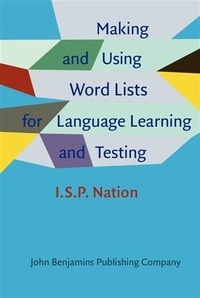
Making and Using Word Lists for Language Learning and Testing
1st Edition
Published on 8. September 2016
224 pages
978-90-272-6627-9 (ISBN)
Description

Word lists lie at the heart of good vocabulary course design, the development of graded materials for extensive listening and extensive reading, research on vocabulary load, and vocabulary test development. This book has been written for vocabulary researchers and curriculum designers to describe the factors they need to consider when they create frequency-based word lists. These include the purpose for which the word list is to be used, the design of the corpus from which the list will be made, the unit of counting, and what should and should not be counted as words. The book draws on research to show the current state of knowledge of these factors and provides very practical guidelines for making word lists for language teaching and testing. The writer is well known for his work in the teaching and learning of vocabulary and in the creation of word lists and vocabulary size tests based on word lists.
More details
Other editions
Additional editions
Book
09/2016
John Benjamins Publishing Co
€119.04
Shipment within 10-15 days
Content
- Intro
- Making and Using Word Lists for Language Learning and Testing
- Title page
- LCC data
- Dedication page
- Table of contents
- Acknowledgements
- Introduction
- Section I. The uses of word lists
- 1. Word lists
- Course design
- Language teaching and learning
- Specialized vocabulary
- Language testing
- Factors affecting the making of word lists
- Influential word lists
- Section II. Deciding what to count as words
- 2. Types, lemmas, and word families
- The unit of counting
- Types
- Lemmas
- Word families
- Lemmas versus word families
- Learners' knowledge of affixes
- The validity of the word family levels
- Note
- Recommendations
- 3. Homoforms and polysemes
- Word senses
- Recommendations
- 4. Proper nouns
- Needed research
- Recommendations
- 5. Hyphenated words and transparent compounds
- Transparent compounds
- Needed research
- Recommendations
- 6. Multiword units
- Co-occurrence and frequency
- The relationship between the meaning of the parts and the meaning of the whole
- Including multiword units in word frequency counts
- Choosing between multiword lists
- Recommendations
- 7. Marginal words and foreign words
- Foreign words
- Recommendations
- 8. Acronyms
- Needed research
- Recommendations
- 9. Function words
- Recommendations
- Cut-off points
- Section III. Choosing and preparing the corpus
- 10. Corpus selection and design
- Text types and other factors
- Geographical divisions
- Age-related material
- Language learning situation
- Corpus size
- Proportion of text types in a corpus
- How do you divide a corpus into sub-corpora?
- Recommendations
- 11. Preparation for making word lists
- Preparing the corpus
- Preparing the lists
- Preparing the program
- Recommendations
- Section IV. Making the lists
- 12. Taking account of your purpose
- Purposes
- General service vocabulary
- General academic vocabulary
- Specialized vocabulary
- The vocabulary of English course books
- The vocabulary of graded readers
- Testing
- Approaches to making lists
- Range, frequency, dispersion
- Range
- Frequency
- Dispersion
- Combined measures
- Applying the criteria
- Other criteria
- Lexical sets
- Making additions because of the age of the corpus
- West's efficiency criteria
- Taking account of user characteristics
- Evaluating a word list
- Recommendations
- 13. Critiquing a word list: the BNC/COCA lists
- Critiquing a word list
- The BNC/COCA word family lists
- The lists
- The making of the lists
- The 1st 1000 and 2nd 1000 word family lists
- The 3rd 1000 onwards
- Word families
- The nature of the families
- The validity of the BNC word family lists
- Evaluation and critique of the BNC/COCA lists
- 14. Specialized word lists
- Values of specialized word lists
- Making a specialized word list
- Using a corpus-comparison approach to make technical word lists
- Making an academic word list
- Recommendations
- 15. Making an essential word list for beginners
- Which items should be included in a word list for beginners?
- What should be the unit of counting in a wordlist created for beginners?
- Research questions
- Materials
- The master list
- The corpora
- Procedure
- Ranking the headwords in the master list
- Determining the number of EWL headwords
- Assessing the EWL
- Ranking the headwords in the master list
- Determining the number of EWL headwords
- Assessing the EWL
- Discussion
- Section V. Using the lists
- 16. Using word lists
- Course design
- Setting long-range vocabulary learning goals
- Deciding on short-term vocabulary learning goals
- Language teaching and learning
- Vocabulary lists and learning from meaning-focused input
- Vocabulary lists and learning from meaning-focused output
- Vocabulary lists and deliberate language-focused learning
- Vocabulary lists and fluency development
- Designing graded reading programs
- Analyzing the vocabulary load of texts
- Developing vocabulary tests
- Appendix 1. Proper noun tagging in the BNC
- Appendix 2. Closed lexical set headwords
- Appendix 3. The Essential Word List
- References
- Author index
- Subject index
