

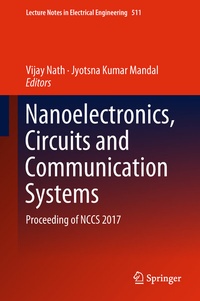
Nanoelectronics, Circuits and Communication Systems
Description

This book features selected papers presented at Third International Conference on Nanoelectronics, Circuits and Communication Systems (NCCS 2017). Covering topics such as MEMS and nanoelectronics, wireless communications, optical communication, instrumentation, signal processing, Internet of Things, image processing, bioengineering, green energy, hybrid vehicles, environmental science, weather forecasting, cloud computing, renewable energy, RFID, CMOS sensors, actuators, transducers, telemetry systems, embedded systems, and sensor network applications in mines, it is a valuable resource for young scholars, researchers, and academics.
More details
Other editions
Additional editions
Persons
Vijay Nath received his bachelor's degree in Physics and master's degree in Electronics from DDU Gorakhpur University, India in 1998 and 2001 respectively. He received PGDCN from MMM Engineering College Gorakhpur (GM) in 1999, and Ph.D. in VLSI Design & Technology from Dr. RML Avadh University, Faizabad in association with CEERI, Pilani in 2008. He served as faculty in the Department of Electronics, DDU Gorakhpur University, Gorakhpur (2002-2006). In 2006 he joined as faculty in the Department of Electronics and Communication Engineering, Birla Institute of Technology Mesra Ranchi. Currently, he is Professor In-charge of Embedded System Design Lab of Department of ECE, Member of BIT Brand Management, Assistant Examination Controller of BIT Mesra Ranchi. His research interests includes Microelectronics, Low Power VLSI Design, Temperature Sensors, ASICs Design, SoC, FPGA based wireless system design, signal conditioning, real embedded systems designs, smart cardiac pacemakers etc. He has completed 3 projects funded by DRDO, MHRD & ISRO Govt of India. He has 16yrs teaching & research experience, guided 2 PhD scholars, developed Pedagogy course on VLSI Design, edited 4 books as volume editor of Springer, published 120 research articles in international journals & conferences, and member of several respected professional and academic bodies including IETE, ISVE, and IEEE.
Jyotsna Kumar Mandal
received his M.Tech. from the Department of Computer Science, University of Calcutta, India and Ph.D. in the field of Data Compression and Error Correction Techniques from Jadavpur University. He is Professor of Computer Science and Engineering, Director of IQAC, and Former Dean of FETM, University of Kalyani. Prof. Mandal has 29 years of teaching and research experience, and is currently working in the field of network security, steganography, image processing, and wireless and sensor networks. He has guided 21 Ph.D. scholars, published six books and more than 380 papers, including 154 publications in various International journals, and edited 27 volumes as volume editor for Science Direct, Springer, CSI, etc.
