

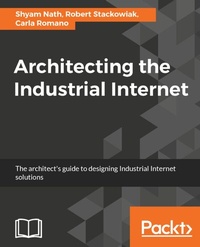
Architecting the Industrial Internet
The architect's guide to designing Industrial Internet solutions
Published on 8. July 2025
360 pages
978-1-78728-374-9 (ISBN)
Description

No detailed description available for "Architecting the Industrial Internet".
All prices
More details
Edition
Digital original
Language
English
Place of publication
Birmingham
United Kingdom
Target group
Professional and scholarly
US School Grade: College Graduate Student
Edition type
Digital original
File size
16,57 MB
ISBN-13
978-1-78728-374-9 (9781787283749)
Copyright in bibliographic data and cover images is held by Nielsen Book Services Limited or by the publishers or by their respective licensors: all rights reserved.
Schweitzer Classification
Other editions
Additional editions
Shyam Nath | Robert Stackowiak | Carla Romano
Architecting the Industrial Internet
Book
09/2017
Packt Publishing
€63.50
Shipment within 3-4 weeks
Person
Stackowiak Robert :
Robert Stackowiak is a technology business strategist at the Microsoft Technology Center in Chicago where he gathers business and technical requirements during client briefings and defines Internet of Things and analytics architecture solutions, including those that reside in the Microsoft Azure cloud. He joined Microsoft in 2016 after a 20-year stint at Oracle where he was Executive Director of Big Data in North America. Bob (his nickname) has spoken at industry conferences around the world and co-authored many books on analytics and data management including Big Data and the Internet of Things: Enterprise Architecture for A New Age, published by Apress, five editions of Oracle Essentials, published by O'Reilly Media, Oracle Big Data Handbook, published by Oracle Press, Achieving Extreme Performance with Oracle Exadata, published by Oracle Press, and Oracle Data Warehousing and Business Intelligence Solutions, published by Wiley. You can follow him on Twitter at @rstackow.Romano Carla :
Carla Romano is director of development for big data and data warehousing at Oracle, focusing on industry solutions, including the Industry Data Model suite of products for airlines and transportation, telecommunications, retail, and utilities industries. She has an extensive background in Business Intelligence and data management, and is a frequent presenter at Oracle Openworld and the BIWA-SIG conferences. She is also a member of the IIC testbeds committee. She is currently developing utilities for Oracle Big Data Cloud Service. She previously worked at Lockheed Engineering Sciences and Unisys under contracts from NASA.Varan Nath Shyam :
Specialist Leader - AI & Analytics, Deloitte
Robert Stackowiak is a technology business strategist at the Microsoft Technology Center in Chicago where he gathers business and technical requirements during client briefings and defines Internet of Things and analytics architecture solutions, including those that reside in the Microsoft Azure cloud. He joined Microsoft in 2016 after a 20-year stint at Oracle where he was Executive Director of Big Data in North America. Bob (his nickname) has spoken at industry conferences around the world and co-authored many books on analytics and data management including Big Data and the Internet of Things: Enterprise Architecture for A New Age, published by Apress, five editions of Oracle Essentials, published by O'Reilly Media, Oracle Big Data Handbook, published by Oracle Press, Achieving Extreme Performance with Oracle Exadata, published by Oracle Press, and Oracle Data Warehousing and Business Intelligence Solutions, published by Wiley. You can follow him on Twitter at @rstackow.Romano Carla :
Carla Romano is director of development for big data and data warehousing at Oracle, focusing on industry solutions, including the Industry Data Model suite of products for airlines and transportation, telecommunications, retail, and utilities industries. She has an extensive background in Business Intelligence and data management, and is a frequent presenter at Oracle Openworld and the BIWA-SIG conferences. She is also a member of the IIC testbeds committee. She is currently developing utilities for Oracle Big Data Cloud Service. She previously worked at Lockheed Engineering Sciences and Unisys under contracts from NASA.Varan Nath Shyam :
Specialist Leader - AI & Analytics, Deloitte
Content
- Cover
- Copyright
- Credits
- About the Authors
- About the Reviewers
- www.PacktPub.com
- Customer Feedback
- Table of Contents
- Preface
- Chapter 1: The Industrial Internet Revolution
- How today's Industrial Internet came about
- Earlier generations of the Industrial Revolution
- Why is it time for the Industrial Internet?
- Challenges to IIoT
- The architect's roles and skills
- Architectural approaches for success
- Reference architectures for the Industrial Internet
- The multi-tier IIoT architecture
- A security framework for the Industrial Internet
- A connectivity framework for the Industrial Internet
- The industrial data analytics framework
- Cloud and user experience considerations
- Business strategy framework for the Industrial Internet
- Summary
- Chapter 2: Architectural Approaches for Success
- Architectural framework
- Architectural viewpoints
- Business viewpoint
- Security considerations for the business viewpoint
- Usage viewpoint
- Security considerations for the usage viewpoint
- Functional viewpoint
- Control domain
- Operations domain
- Information domain
- Application domain
- Business domain
- Cross-cutting functions and system characteristics
- Computational deployment patterns
- Security considerations for the functional viewpoint
- Implementation viewpoint
- Security considerations for the implementation viewpoint
- Data and analytics
- Data management
- Analytics and advanced data processing
- Integrability, interoperability, and composability
- Connectivity
- Intelligent and resilient control
- Dynamic composition and automated interoperability
- Using PoCs to evaluate design
- Scope definition
- Business case considerations
- Solution definition
- Building the PoC
- Prototype scale
- Evaluate/modify
- Production scale
- Architecture
- Components
- Continuing engineering
- Summary
- Chapter 3: Gathering Business Requirements
- Initial business discovery
- Getting ready for business discovery
- Gathering CSFs
- Gathering KPIs
- From data sources to KPI delivery
- Prioritizing the building of solutions
- Building the business case
- Components of backend infrastructure cost models
- Smart device and networking costs
- Estimating implementation costs
- Documenting future benefits
- Financial justification of our supply chain project
- Selling the project
- Summary
- Chapter 4: Mapping Requirements to a Functional Viewpoint
- The control domain
- Basic edge device capabilities
- Smarter edge device configurations
- Selecting sensors and edge devices
- The supply chain optimization control domain
- The operations domain
- The information domain
- Solving information domain functional requirements
- A supply chain optimization information domain
- The application domain
- Assessing business analysts and user skills
- The supply chain optimization application domain
- The business domain
- DevOps and the agile movement
- Agile approaches
- Using microservices and containers to speed DevOps
- Summary
- Chapter 5: Assessing Industrial Internet Applications
- Architecture patterns for the Industrial Internet
- Build versus buy decisions
- Asset Performance Management (APM)
- Assessing the analytics applications
- Descriptive analytics
- Diagnostic analytics
- Predictive analytics
- Prescriptive analytics
- Fit gap analysis
- Brilliant Manufacturing
- Field Service Management (FSM) application
- Summary
- Chapter 6: Defining the Data and Analytics Architecture
- Data and analytics requirements and capabilities
- Data reduction and analytics
- Publish and subscribe
- Query
- Storage persistence and retrieval
- Integration
- Description and presence
- Data framework
- Rights management
- Creating business value
- Analytics functionality
- Mapping analytics architecture to reference architecture
- Advanced analytics
- The Lambda architecture and IIoT
- Analytics, machine learning, and analyst tools
- A process for advanced analytics creation
- Machine learning tools
- Other analyst tools
- Early Industrial Internet applications and historians
- The speed layer and field gateways
- The batch layer
- Data lakes and Hadoop
- Graph database
- Data warehouses, data marts, and relational databases
- Supply chain optimization in the batch layer
- Summary
- Chapter 7: Defining a Deployment Architecture
- Current state of deployment architectures for IT systems
- Hosted systems and the cloud
- Hosted services
- Single-tenant hosting
- Multi-tenancy
- Cloud computing
- Public cloud
- Private cloud
- Hybrid cloud
- Billing
- Enterprise Resource Planning (ERP)
- Considerations for SaaS cloud versus on-premises
- Customer Relationship Management (CRM)
- Human Resource Management Systems
- Data warehousing and big data
- Data warehouse and decision support
- Management considerations for data warehouse
- Big data
- Hadoop file systems
- Data lakes
- Management considerations for data lakes
- Big data analytics and data science
- Converged infrastructure and engineered systems
- Deployment considerations
- IIoT constraints
- Incremental upgrades
- On-premises versus cloud
- Consumption models
- Analytics capacity considerations
- Analytics considerations
- Key constraints in analytics architecture design
- Design for the edge tier
- Networking considerations
- Connectivity transport layer
- Network layer consideration
- Topology
- Edge connectivity
- Management and support infrastructure
- Summary
- Chapter 8: Securing the Industrial Internet
- Examples of cybersecurity attacks
- IIoT security core building blocks
- NIST cybersecurity frameworks
- IIoT security guidelines
- Securing devices and the edge to the cloud gateway
- Device considerations
- Device to gateway connections
- Securing the backend
- Data lake security
- Securing other NoSQL databases
- Data warehouse security
- Risk assessments and best security practices
- Planning for security in the supply chain example
- Summary
- Chapter 9: Governance and Assuring Compliance
- Assessing governance, risk, and compliance
- Data governance
- Assessing risk and trustworthiness
- International compliance certifications
- International consortia and emerging standards
- Government and public institution compliance
- Non-U.S. government standards and certifications
- U.S. government standards
- Industry compliance certifications
- Which guidelines apply
- GRC in the supply chain optimization example
- Summary
- Chapter 10: Industrial Internet Use Cases in Various Industries
- Use cases versus case studies
- Use cases within industry vertical
- Use cases in agribusiness
- Use cases in alternative energy and environmental control
- Use cases in construction
- Use cases in logistics and transportation
- Use cases in manufacturing and CPGs
- Use cases in oil and gas
- Use cases in pharmaceuticals, medical equipment, and healthcare
- Use cases in utility companies
- Manufacturing IIoT architectures and examples
- A manufacturing test bed
- Factory operation visibility and intelligence
- Omnichannel initiatives
- Predictive maintenance
- Airline industry background
- Airline proactive and preventive maintenance
- Preventive maintenance as a business
- Asset tracking and handling
- Baggage and cargo handling
- Expanded baggage-handling services
- Tracking tools in manufacturing and construction
- Chemical industry automated tracking and replenishment
- Environmental impact and abatement
- Summary
- Chapter 11: A Vision of the Future
- Maturing IIoT frameworks and applications
- Evolving edge devices
- The evolution of networking
- Cognitive and mixed reality HMIs and deep learning
- The impact on robotics and mobile devices
- Improved security through blockchain technology
- Quantum computing
- The Industrial Internet's impact on society
- Summary
- Appendix: Sources
- Chapter 1
- Chapter 2
- Chapter 3
- Chapter 4
- Chapter 5
- Chapter 6
- Chapter 7
- Chapter 8
- Chapter 9
- Chapter 10
- Chapter 11
- Index

