

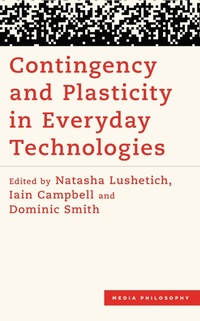
Contingency and Plasticity in Everyday Technologies
1st Edition
Published on 23. November 2022
1 pages
979-8-8818-6226-8 (ISBN)
Description

Technology is a host of social, material, and epistemic transformation techniques, tools, and methods. The common perception of digital technology today is that it is determined, even over-determined. This volume suggests a different view: the digital is indeterminate. Mobilising insights from philosophy, art and architecture theory, mathematics, computer science and anthropology, it situates digital indeterminacy within the wider context of material and immaterial processes, causations, triggerings, and their performative working.
The book's tripartite structure reflects technology's inherent capacity to transform knowledges, practices, and time. Part I: Social-Digital Technologies juxtaposes arguments for machinic indeterminacy to those of overdetermination in blockchain, cognitive augmentation, and digital ideology. Part II: Spatial, Temporal, Aural and Visual Technologies delves deeper into received ideas about technologies for building spatial structures, manufacturing instruments and constructing the visual space. Part III: Epistemic Technologies analyses the use of plasticity in cognitive science, contingency in thinking habits, ontogenesis in experimental computing, and divination techniques with an inbuilt margin of indeterminacy.
List of contributors: Franco 'Bifo' Berardi, Iain Campbell, Stephen Darren Dougherty, Aden Evens, Oswaldo Emiddio Vasquez Hadjilyra, Stavros Kousoulas, Natasha Lushetich, Peteer Müürsepp, Luciana Parisi, Andrej Radman, Alesha Serada, Dominic Smith, Sha Xin Wei, Joel White, Ashley Woodward, and David Zeitlyn.
The book's tripartite structure reflects technology's inherent capacity to transform knowledges, practices, and time. Part I: Social-Digital Technologies juxtaposes arguments for machinic indeterminacy to those of overdetermination in blockchain, cognitive augmentation, and digital ideology. Part II: Spatial, Temporal, Aural and Visual Technologies delves deeper into received ideas about technologies for building spatial structures, manufacturing instruments and constructing the visual space. Part III: Epistemic Technologies analyses the use of plasticity in cognitive science, contingency in thinking habits, ontogenesis in experimental computing, and divination techniques with an inbuilt margin of indeterminacy.
List of contributors: Franco 'Bifo' Berardi, Iain Campbell, Stephen Darren Dougherty, Aden Evens, Oswaldo Emiddio Vasquez Hadjilyra, Stavros Kousoulas, Natasha Lushetich, Peteer Müürsepp, Luciana Parisi, Andrej Radman, Alesha Serada, Dominic Smith, Sha Xin Wei, Joel White, Ashley Woodward, and David Zeitlyn.
More details
Series
Edition
1. Auflage
Language
English
Place of publication
United States
Publishing group
Bloomsbury Publishing Plc
Target group
Professional and scholarly
Illustrations
12 b/w illustrations; 2 tables;
ISBN-13
979-8-8818-6226-8 (9798881862268)
Copyright in bibliographic data and cover images is held by Nielsen Book Services Limited or by the publishers or by their respective licensors: all rights reserved.
Schweitzer Classification
Other editions
Additional editions
Natasha Lushetich | Iain Campbell | Dominic Smith
Contingency and Plasticity in Everyday Technologies
Book
11/2022
Rowman & Littlefield Publishers
€134.60
Shipment within 3-4 weeks
Persons
Natasha Lushetich is professor of contemporary art & theory at the University of Dundee and Arts and Humanities Research Council Leadership Fellow. Her research is interdisciplinary and focuses on intermedia and critical mediality; global art; the status of sensory experience in cultural knowledge; biopolitics and performativity. Her books include Fluxus: The Practice of Non-Duality (2014), Interdisciplinary Performance (2016), The Aesthetics of Necropolitics (Rowman & Littlefield 2018), Beyond Mind, Symbolism, an International Annual of Critical Aesthetics (2019), Big Data - A New Medium? (2020) and Distributed Perception: Resonances and Axiologies (co-edited with I. Campbell, 2021).
Iain Campbell is a teaching fellow in aesthetics at Edinburgh College of Art and a research associate at Duncan of Jordanstone College of Art and Design, University of Dundee, where he is working on the project The Future of Indeterminacy: Datafication, Memory, Bio-Politics. He has written on topics across philosophy, music, sound studies, and art theory for publications including parallax, Contemporary Music Review, Sound Studies, and Continental Philosophy Review. His current research focuses on experimentation and on the differences and continuities between conceptualisations of this notion in philosophy, art, music, and science. He is co-editor, with Natasha Lushetich, of Distributed Perception: Resonances and Axiologies (2021).
Dominic Smith is senior lecturer in philosophy at the University of Dundee, where he researches philosophy of technology/media. Dominic is interested in bringing the continental tradition in philosophy (e.g. phenomenology, critical theory, poststructuralism, new forms of realism and materialism) to bear on philosophy of technology and media. He is a member of the Scottish Centre for Continental Philosophy: http://scot-cont-phil.org/. Dominic's latest book is Exceptional Technologies: A Continental Philosophy of Technology. His current project involves thinking about how philosophy of technology can be broadened to speak to issues in philosophy of education, design, and creativity, with a focus on the work of Walter Benjamin.
Iain Campbell is a teaching fellow in aesthetics at Edinburgh College of Art and a research associate at Duncan of Jordanstone College of Art and Design, University of Dundee, where he is working on the project The Future of Indeterminacy: Datafication, Memory, Bio-Politics. He has written on topics across philosophy, music, sound studies, and art theory for publications including parallax, Contemporary Music Review, Sound Studies, and Continental Philosophy Review. His current research focuses on experimentation and on the differences and continuities between conceptualisations of this notion in philosophy, art, music, and science. He is co-editor, with Natasha Lushetich, of Distributed Perception: Resonances and Axiologies (2021).
Dominic Smith is senior lecturer in philosophy at the University of Dundee, where he researches philosophy of technology/media. Dominic is interested in bringing the continental tradition in philosophy (e.g. phenomenology, critical theory, poststructuralism, new forms of realism and materialism) to bear on philosophy of technology and media. He is a member of the Scottish Centre for Continental Philosophy: http://scot-cont-phil.org/. Dominic's latest book is Exceptional Technologies: A Continental Philosophy of Technology. His current project involves thinking about how philosophy of technology can be broadened to speak to issues in philosophy of education, design, and creativity, with a focus on the work of Walter Benjamin.
Content
List of Figures
Prologue: Normalising Catastrophe or Revealing Mysterious Sur-Chaotic Micro-Worlds?
Natasha Lushetich, Iain Campbell and Dominic Smith
Acknowledgments
Part I: Social-Digital Technologies
Chapter 1: Information and Alterity: From Probability to Plasticity
Ashley Woodward
Chapter 2: Transcendental Instrumentality and Incomputable Thinking
Luciana Parisi
Chapter 3: Digital Ontology and Contingency
Aden Evens
Chapter 4: Blockchain Owns You: From Cypherpunk to Self-Sovereign Identity
Alesha Serada
Chapter 5: The Double Spiral of Chaos and Automation
Franco 'Bifo' Berardi
Part II: Spatial, Temporal, Aural and Visual Technologies
Chapter 6: Allagmatics of Architecture: From Generic Structures to Genetic Operations (and Back)
Andrej Radman
Chapter 7: Computation and Material Transformations: Dematerialisation, Rematerialisation and Immaterialisation in Time-Based Media
Oswaldo Emiddio Vasquez Hadjilyra
Chapter 8: How the Performer Came to be Prepared: Three Moments in Music's Encou
Prologue: Normalising Catastrophe or Revealing Mysterious Sur-Chaotic Micro-Worlds?
Natasha Lushetich, Iain Campbell and Dominic Smith
Acknowledgments
Part I: Social-Digital Technologies
Chapter 1: Information and Alterity: From Probability to Plasticity
Ashley Woodward
Chapter 2: Transcendental Instrumentality and Incomputable Thinking
Luciana Parisi
Chapter 3: Digital Ontology and Contingency
Aden Evens
Chapter 4: Blockchain Owns You: From Cypherpunk to Self-Sovereign Identity
Alesha Serada
Chapter 5: The Double Spiral of Chaos and Automation
Franco 'Bifo' Berardi
Part II: Spatial, Temporal, Aural and Visual Technologies
Chapter 6: Allagmatics of Architecture: From Generic Structures to Genetic Operations (and Back)
Andrej Radman
Chapter 7: Computation and Material Transformations: Dematerialisation, Rematerialisation and Immaterialisation in Time-Based Media
Oswaldo Emiddio Vasquez Hadjilyra
Chapter 8: How the Performer Came to be Prepared: Three Moments in Music's Encou
