

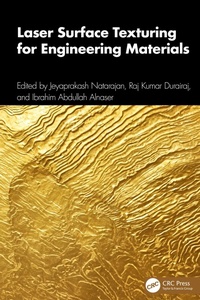
Laser Surface Texturing for Engineering Materials
1st Edition
Will be published approx. on 29. July 2026
256 pages
E-Book
978-1-040-66998-3 (ISBN)
Description

Laser surface texturing (LST) is a process that uses lasers to modify or prepare a material's surface for improved performance. This book examines laser surface texturing techniques for various materials and applications. It also explores the microstructural, tribological, anti-corrosion, and mechanical behaviors of laser-textured component surfaces to understand the mechanisms for improving lifecycle and reducing frictional losses.
This book:
* Considers LST of metals, ceramics, and polymers
* Offers a unique mix of research and commercials aspects
* Includes process parameters, mechanical properties results, and research outcomes
* Discusses adhesive strength, wettability, microstructural properties, mechanical and tribological behavior, surface roughness, coefficient of friction, and wear rate
* Features case studies
* Describes the challenges, applications, material properties, and bonding strength of various materials
Offering a concise approach to a complex technology with minimal mathematical equations, this work provides an overview of surface texturing techniques, their applications, analysis, and future advancements for materials, mechanical, and manufacturing engineers.
This book:
* Considers LST of metals, ceramics, and polymers
* Offers a unique mix of research and commercials aspects
* Includes process parameters, mechanical properties results, and research outcomes
* Discusses adhesive strength, wettability, microstructural properties, mechanical and tribological behavior, surface roughness, coefficient of friction, and wear rate
* Features case studies
* Describes the challenges, applications, material properties, and bonding strength of various materials
Offering a concise approach to a complex technology with minimal mathematical equations, this work provides an overview of surface texturing techniques, their applications, analysis, and future advancements for materials, mechanical, and manufacturing engineers.
More details
Edition
1. Auflage
Language
English
Place of publication
London
United Kingdom
Publishing group
Taylor & Francis Ltd
Target group
College/higher education
Professional and scholarly
Product notice
Reflowable
Illustrations
32 Tables, black and white; 87 Halftones, black and white; 87 Illustrations, black and white
ISBN-13
978-1-040-66998-3 (9781040669983)
Copyright in bibliographic data and cover images is held by Nielsen Book Services Limited or by the publishers or by their respective licensors: all rights reserved.
Schweitzer Classification
Other editions
Additional editions
Jeyaprakash Natarajan | Raj Kumar Durairaj | Ibrahim Abdullah Alnaser
Laser Surface Texturing for Engineering Materials
Book
approx. 07/2026
1st Edition
CRC Press
€173.50
Not yet published
Persons
Jeyaprakash Natarajan is an associate professor in the School of Mechanical and Electrical Engineering, China University of Mining and Technology. He received his Ph.D. in Production Engineering from National Institute of Technology, Tiruchirappalli, India.
Raj Kumar Durairaj is a professor in the Department of Mechanical Engineering, Sri Ramakrishna College of Engineering, Perambalur, India. He obtained his Ph.D. in Mechanical Engineering from Anna University, India.
Ibrahim Abdullah Alnaser is the director of the Center of Excellence for Research in Engineering Materials at King Saud University, Riyadh, Saudi Arabia. He earned his Ph.D. in Mechanical Engineering from the University of Tulsa, USA.
Raj Kumar Durairaj is a professor in the Department of Mechanical Engineering, Sri Ramakrishna College of Engineering, Perambalur, India. He obtained his Ph.D. in Mechanical Engineering from Anna University, India.
Ibrahim Abdullah Alnaser is the director of the Center of Excellence for Research in Engineering Materials at King Saud University, Riyadh, Saudi Arabia. He earned his Ph.D. in Mechanical Engineering from the University of Tulsa, USA.
Content
1. Introduction to Surface Texturing Techniques and Its Applications. 2. Simulation and Study of Laser Surface Texturing Parameters. 3. Analysis of Pre/During Post Treatment on Laser Surface Textured Materials. 4. Mechanical and Tribological Characteristics of Laser Surface Textured Coating. 5. Surface Heat Transfer Analysis Using Laser Surface Texturing. 6. Laser Surface Texturing on Tool Surfaces for Conventional/Unconventional Machining. 7. Mechanical and Tribological Behavior Analysis on Laser-Surface-Textured Metals/Ceramics/Polymers. 8. Hydrophobicity and Corrosion Behavior Analysis on Laser Surface Textured Materials. 9. Laser Surface Texturing on the Piston Top Surface: Enhancing Surface Modification, Reducing Residual Stresses, and Improving Surface Quality. 10. Anti-Corrosion and Biomaterial Surface Analyzed Through Laser Surface Texturing. 11. Applications of Laser Surface Texturing on Additively Manufactured Parts. 12. Laser Surface Texturing For Biomaterial Applications.
