

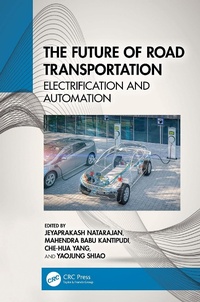
The Future of Road Transportation
Electrification and Automation
1st Edition
Published on 29. November 2023
322 pages
978-1-000-99478-0 (ISBN)
Description

The Future of Road Transportation presents rapidly growing research towards electrified and automated vehicles. It explains the workings and drawbacks of a conventional vehicle's powertrain, braking, and steering systems before exploring ADAS equipment and driverless car technologies.
Emphasizing the necessary changes in conventional transport systems towards sustainable and smart mobility, this book discusses advanced future mobility technologies and the challenges and considerations for developing sustainable vehicle designs. It overviews the construction details and the research-level contents of the power train, battery, charging infrastructure, and other control systems of the electrical vehicles.
The book is intended for automotive and electrical engineers and researchers working on electric vehicle technology, autonomous and automated vehicles, automotive sustainability. It will also be useful for mechanical and electrical engineering students taking courses in Automotive/Vehicle Engineering and Automotive Systems and Design.
Emphasizing the necessary changes in conventional transport systems towards sustainable and smart mobility, this book discusses advanced future mobility technologies and the challenges and considerations for developing sustainable vehicle designs. It overviews the construction details and the research-level contents of the power train, battery, charging infrastructure, and other control systems of the electrical vehicles.
The book is intended for automotive and electrical engineers and researchers working on electric vehicle technology, autonomous and automated vehicles, automotive sustainability. It will also be useful for mechanical and electrical engineering students taking courses in Automotive/Vehicle Engineering and Automotive Systems and Design.
More details
Edition
1. Auflage
Language
English
Place of publication
London
United Kingdom
Publishing group
Taylor & Francis Ltd
Target group
College/higher education
Professional and scholarly
Illustrations
25 Tables, black and white; 184 Line drawings, black and white; 4 Halftones, black and white; 188 Illustrations, black and white
ISBN-13
978-1-000-99478-0 (9781000994780)
Copyright in bibliographic data and cover images is held by Nielsen Book Services Limited or by the publishers or by their respective licensors: all rights reserved.
Schweitzer Classification
Other editions
Additional editions
Jeyaprakash Natarajan | Mahendra Babu Kantipudi | Che-Hua Yang
The Future of Road Transportation
Electrification and Automation
Book
12/2025
1st Edition
CRC Press
€78.70
Shipment within 10-20 days
Jeyaprakash Natarajan | Mahendra Babu Kantipudi | Che-Hua Yang
The Future of Road Transportation
Electrification and Automation
Book
11/2023
1st Edition
CRC Press
€148.20
Shipment within 10-20 days
Persons
Jeyaprakash Natarajan is an Associate Professor at the School of Mechanical and Electrical Engineering, China University of Mining and Technology, Xuzhou, China. He received his bachelor's degree in Mechanical Engineering from Anna University, Chennai, India in 2006. Dr. Jeyaprakash Natarajan received his master's degree in Manufacturing Engineering in 2009 from Anna University, Chennai, India and his PhD in Production Engineering in 2018 from the National Institute of Technology, Tiruchirappalli, India. In 2007, he was appointed to the position of Lecturer at the Department of Automobile Engineering, Thanthai Roever Institute of Polytechnic College, Perambalur, India. In 2009, he was appointed as an Assistant Professor in the Department of Mechanical Engineering at Periyar Maniammai University, Tanjore, India. In 2011, he was appointed to the position of Assistant Professor in the Department of Engineering, Hamelmalo Agricultural College, Keren, Eritrea, North East Africa. In 2013, he was appointed as Assistant Professor in the Department of Production Engineering, Defence University, Debre Zeit, Ethiopia, Africa. From 9, 2018 to 12, 2018 he was a Research Assistant in Additive Manufacturing Center for Mass Customization Production, National Taipei University of Technology, Taiwan. From 2019 to 2020, he was a Postdoctoral Research Associate in Additive Manufacturing Center for Mass Customization Production, Graduate Institute of Manufacturing Technology, National Taipei University of Technology, Taiwan. In 2021, he was promoted as Research Assistant Professor in Graduate Institute of Manufacturing Technology, National Taipei University of Technology, Taiwan. Dr. Jeyaprakash Natarajan has published more than 70 peer-reviewed research articles, book chapters, and two books titled Laser Surface Treatments for Tribological Application and Advances in Additive Manufacturing Processes in 2021. He teaches various postgraduate courses in automotive, mechanical, manufacturing and laser ultrasound, and conducts academic research and consultancy. Dr. Jeyaprakash Natarajan is serving as a reviewer for many reputed international journals. Also, Dr. Jeyaprakash Natarajan has completed four research projects in the field of additive manufacturing, surface engineering, tribology, laser cladding, corrosion, etc.
Mahendra Babu Kantipudi received his B.Tech. in Mechanical Engineering from Pondicherry University, India, in 2007 and his master's degree in Automotive Engineering from the University of Hertfordshire, England, in 2009. Then, he worked as an Assistant Professor of Mechanical Engineering at reputed engineering colleges in India for 7 years. He got his PhD from the College of Mechanical and Electrical Engineering, National Taipei University of Technology, Taiwan in 2020. Currently, he is a senior researcher in National Taipei University of Technology and has been involved in the project of the Ministry of Science and Technology, Taiwan. He is the author and co-author of several research papers in SCI-indexed journals. He has presented the paper at national and international conferences. His areas of research interest include the areas of magnetorheological fluid (MR)-based actuators, anti-lock braking systems (ABS), smart vehicle control systems, IC engine performance study, electromagnetic analysis, future mobility, thermal studies, and multi-physics analysis.
Che-Hua Yang is a Professor at the Graduate Institute of Manufacturing Technology, National Taipei University of Technology, Taiwan. He received his bachelor's degree in Mechanical Engineering from National Taiwan University, Taiwan in 1984. Prof. Che-Hua Yang received his Masters and PhD in Mechanical Engineering in 1989 and 1991, respectively, from Johns Hopkins University, USA. In 1991, he was appointed as a research associate at Johns Hopkins NDE Center, Johns Hopkins University USA, where he worked on the structural analysis and Opto-mechanical integration and implementation. In 1993, he was appointed as an Associate Professor in the Department of Mechanical Engineering at Chang Gung University, Taiwan. In 2005, he was promoted as Professor in the Department of Mechanical Engineering, Chang Gung University, Taiwan. In 2007, Prof. Che-Hua Yang was appointed as Professor in the Department of Mechanical and Electrical Engineering, National Taipei University of Technology, Taiwan and he has been the Deputy Director in National Taipei University of Technology, Taiwan, from 2007 to 2008. From 2007 to 2008, he was also an Adjust Professor at Chang Gung University, Taiwan. From 2008 to 2011, he was a Professor and Director of the Institute of Engineering, National Taipei University of Technology, Taiwan. From 2011 to 2017, he was a Professor and Dean of School of Mechanical and Electrical Engineering, National Taipei University of Technology, Taiwan. From 2017 to 2018, he was a Professor and Vice President of National Taipei University of Technology, Taiwan. From 2018 to 2021, he was a Professor and Director of Additive Manufacturing Center for Mass Customization Production, National Taipei University of Technology, Taiwan. Prof. Che-Hua Yang has published more than 120 peer-reviewed research articles, book chapters and two books titled Laser Surface Treatments for Tribological Application and Advances in Additive Manufacturing Processes in 2021. He teaches various postgraduate courses in automotive, mechanical, manufacturing and laser ultrasound, supervises Master and PhD students, and conducts academic research and consultancy. Prof. Che-Hua Yang is serving as a reviewer for many reputed international journals.
Yaojung Shiao received his bachelor's degree from the Department of Mechanical Engineering, National Cheng Kung University, Taiwan. He received his master's degree and PhD from the Department of Mechanical Engineering, University of Wisconsin, Madison, USA. He has worked as an Assistant Professor of Heat Transfer in the Mechanical Department, University of Wisconsin, Madison, USA. He worked as an Associate Professor in the Department of vehicle engineering, National Pingtung University of Science and Technology, Taiwan from 1996 to2001. He was the head of the Department of vehicle engineering at the National Taipei University of Technology, Taiwan from 2014 to 2019. He is presently a Professor in the Department of vehicle engineering, National Taipei University of Technology, Taiwan. He is the author of over 100 publications in smart material structures, actuators, intelligent control systems, connected vehicles, vehicle control systems, and gait control systems. He is working on rail vehicles, electric vehicle systems, advanced low-energy engines, road-friendly headlight systems, advanced braking systems and suspension systems, and locomotive ABS/TCS systems. His research has obtained several invention patents.
Mahendra Babu Kantipudi received his B.Tech. in Mechanical Engineering from Pondicherry University, India, in 2007 and his master's degree in Automotive Engineering from the University of Hertfordshire, England, in 2009. Then, he worked as an Assistant Professor of Mechanical Engineering at reputed engineering colleges in India for 7 years. He got his PhD from the College of Mechanical and Electrical Engineering, National Taipei University of Technology, Taiwan in 2020. Currently, he is a senior researcher in National Taipei University of Technology and has been involved in the project of the Ministry of Science and Technology, Taiwan. He is the author and co-author of several research papers in SCI-indexed journals. He has presented the paper at national and international conferences. His areas of research interest include the areas of magnetorheological fluid (MR)-based actuators, anti-lock braking systems (ABS), smart vehicle control systems, IC engine performance study, electromagnetic analysis, future mobility, thermal studies, and multi-physics analysis.
Che-Hua Yang is a Professor at the Graduate Institute of Manufacturing Technology, National Taipei University of Technology, Taiwan. He received his bachelor's degree in Mechanical Engineering from National Taiwan University, Taiwan in 1984. Prof. Che-Hua Yang received his Masters and PhD in Mechanical Engineering in 1989 and 1991, respectively, from Johns Hopkins University, USA. In 1991, he was appointed as a research associate at Johns Hopkins NDE Center, Johns Hopkins University USA, where he worked on the structural analysis and Opto-mechanical integration and implementation. In 1993, he was appointed as an Associate Professor in the Department of Mechanical Engineering at Chang Gung University, Taiwan. In 2005, he was promoted as Professor in the Department of Mechanical Engineering, Chang Gung University, Taiwan. In 2007, Prof. Che-Hua Yang was appointed as Professor in the Department of Mechanical and Electrical Engineering, National Taipei University of Technology, Taiwan and he has been the Deputy Director in National Taipei University of Technology, Taiwan, from 2007 to 2008. From 2007 to 2008, he was also an Adjust Professor at Chang Gung University, Taiwan. From 2008 to 2011, he was a Professor and Director of the Institute of Engineering, National Taipei University of Technology, Taiwan. From 2011 to 2017, he was a Professor and Dean of School of Mechanical and Electrical Engineering, National Taipei University of Technology, Taiwan. From 2017 to 2018, he was a Professor and Vice President of National Taipei University of Technology, Taiwan. From 2018 to 2021, he was a Professor and Director of Additive Manufacturing Center for Mass Customization Production, National Taipei University of Technology, Taiwan. Prof. Che-Hua Yang has published more than 120 peer-reviewed research articles, book chapters and two books titled Laser Surface Treatments for Tribological Application and Advances in Additive Manufacturing Processes in 2021. He teaches various postgraduate courses in automotive, mechanical, manufacturing and laser ultrasound, supervises Master and PhD students, and conducts academic research and consultancy. Prof. Che-Hua Yang is serving as a reviewer for many reputed international journals.
Yaojung Shiao received his bachelor's degree from the Department of Mechanical Engineering, National Cheng Kung University, Taiwan. He received his master's degree and PhD from the Department of Mechanical Engineering, University of Wisconsin, Madison, USA. He has worked as an Assistant Professor of Heat Transfer in the Mechanical Department, University of Wisconsin, Madison, USA. He worked as an Associate Professor in the Department of vehicle engineering, National Pingtung University of Science and Technology, Taiwan from 1996 to2001. He was the head of the Department of vehicle engineering at the National Taipei University of Technology, Taiwan from 2014 to 2019. He is presently a Professor in the Department of vehicle engineering, National Taipei University of Technology, Taiwan. He is the author of over 100 publications in smart material structures, actuators, intelligent control systems, connected vehicles, vehicle control systems, and gait control systems. He is working on rail vehicles, electric vehicle systems, advanced low-energy engines, road-friendly headlight systems, advanced braking systems and suspension systems, and locomotive ABS/TCS systems. His research has obtained several invention patents.
Content
1. Fundamentals and Challenges of Conventional Road Transportation. 2. Challenges of Present Transportation. 3. Alternative Propulsion Systems. 4. Recent Advancements and Challenges of Powertrain Technologies in Electric Vehicles Applications. 5. Analysis of Recent Developments in Three-Phase Transformerless Inverter Topologies for Photovoltaic and Electric Vehicle Applications. 6. Evaluation of Single-Phase Rectifier Bridge Clamping Circuit Solar Power Transformerless Inverter Topologies for Electric Vehicle Applications. 7. Battery Technology for Hybrid and Battery Vehicles. 8. Challenges and Limitations of Electric Vehicles. 9. Battery Management System for Electric Vehicles. 10. Charging Infrastructure for EVs. 11. Advanced Driver Assistance Systems. 12. An Insight Review on Cognitive Bias for Advanced Driver Assistance System. 13. The Sensors in Future Vehicles. 14. Trends in Electrical and Automated Vehicles.
