

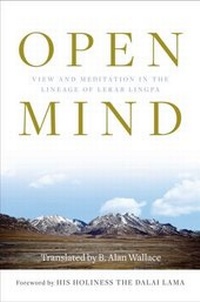
Open Mind
View and Meditation in the Lineage of Lerab Lingpa
1st Edition
Published on 6. February 2018
424 pages
978-1-61429-404-7 (ISBN)
Description

Get to know the teachings and legacy of the celebrated Lerab Lingpa, the influential confidant of the Thirteenth Dalai Lama, in this collection of practical instructions on the Great Perfection and reflections on the nonsectarian (rimé) approach to Tibetan Buddhism.
Lerab Lingpa (1856-1926), also known as Tertön Sogyal, was one of the great Dzogchen (Great Perfection) masters of the nineteenth and early-twentieth centuries and a close confidant and guru of the Thirteenth Dalai Lama. This volume contains translations by B. Alan Wallace of two works that are representative of the lineage of this great "treasure revealer," or tertön.
The first work, composed by Lerab Lingpa himself, is The Vital Essence of Primordial Consciousness. It presents pith instructions on all the stages of the Great Perfection, which is the highest form of meditation and practice in the Nyingma school of Tibetan Buddhism. In this practice, the meditator comes to see directly the ultimate nature of consciousness itself. The work guides the reader from the common preliminaries through to the highest practices of the Great Perfection-the direct crossing over and the achievement of the rainbow body.
The second work, Selected Essays on Old and New Views of the Secret Mantrayana, is a collection of seven essays by two of Lerab Lingpa's close disciples, Dharmasara and Jé Tsultrim Zangpo. Dharmasara wrote six of the essays, providing detailed, erudite explanations of the compatibility among the theories and practices of Great Perfection, Mahamudra (a parallel practice tradition found in other schools), and the Madhyamaka view, especially as these are interpreted by the Indian pandita Candrakirti, the Nyingma master Longchen Rabjam, and Tsongkhapa, founder of the Geluk school of Tibetan Buddhism. The one essay by Jé Tsultrim Zangpo (a.k.a. Tulku Tsullo), "An Ornament of the Enlightened View of Samantabhadra," contextualizes the Great Perfection within the broader framework of Mahayana and Vajrayana Buddhism and then elucidates all the stages of practice of the Great Perfection, unifying the profound path of cutting through and the vast path of the spontaneous actualization of the direct crossing over.
This volume will be of great interest for all those interested in the theory and practice of the Great Perfection and the way it relates to the wisdom teachings of Tsongkhapa and others in the new translation schools of Tibetan Buddhism.
Lerab Lingpa (1856-1926), also known as Tertön Sogyal, was one of the great Dzogchen (Great Perfection) masters of the nineteenth and early-twentieth centuries and a close confidant and guru of the Thirteenth Dalai Lama. This volume contains translations by B. Alan Wallace of two works that are representative of the lineage of this great "treasure revealer," or tertön.
The first work, composed by Lerab Lingpa himself, is The Vital Essence of Primordial Consciousness. It presents pith instructions on all the stages of the Great Perfection, which is the highest form of meditation and practice in the Nyingma school of Tibetan Buddhism. In this practice, the meditator comes to see directly the ultimate nature of consciousness itself. The work guides the reader from the common preliminaries through to the highest practices of the Great Perfection-the direct crossing over and the achievement of the rainbow body.
The second work, Selected Essays on Old and New Views of the Secret Mantrayana, is a collection of seven essays by two of Lerab Lingpa's close disciples, Dharmasara and Jé Tsultrim Zangpo. Dharmasara wrote six of the essays, providing detailed, erudite explanations of the compatibility among the theories and practices of Great Perfection, Mahamudra (a parallel practice tradition found in other schools), and the Madhyamaka view, especially as these are interpreted by the Indian pandita Candrakirti, the Nyingma master Longchen Rabjam, and Tsongkhapa, founder of the Geluk school of Tibetan Buddhism. The one essay by Jé Tsultrim Zangpo (a.k.a. Tulku Tsullo), "An Ornament of the Enlightened View of Samantabhadra," contextualizes the Great Perfection within the broader framework of Mahayana and Vajrayana Buddhism and then elucidates all the stages of practice of the Great Perfection, unifying the profound path of cutting through and the vast path of the spontaneous actualization of the direct crossing over.
This volume will be of great interest for all those interested in the theory and practice of the Great Perfection and the way it relates to the wisdom teachings of Tsongkhapa and others in the new translation schools of Tibetan Buddhism.
More details
Other editions
Additional editions
B. Alan Wallace | His Holiness the Dalai Lama
Open Mind
View and Meditation in the Lineage of Lerab Linga
Book
03/2018
Wisdom Publications,U.S.
€19.50
Article not available at the moment
Persons
Eva Natanya is a scholar of Indian and Tibetan Buddhism, Christian theology, and comparative religion, and has served in many capacities as a spiritual teacher, translator of Tibetan texts, author, and retreat leader. Following a nine-year career as a professional ballet dancer with both the New York City Ballet and the Royal Ballet of England, she earned an MA in Christian Systematic Theology at the Graduate Theological Union, and a PhD in Religious Studies from the University of Virginia. Her dissertation examined the complex interactions of Madhyamaka, Yogacara, and Abhidharma teachings as they underlie the Vajrayana philosophy of Je Tsongkhapa. She has spent more than four years in solitary meditation retreat, is the co-founder of the Center for Contemplative Research, and currently serves as resident teacher at the CCR's Miyo Samten Ling Hermitage in Crestone, Colorado, while continuing her solitary retreat practice.
His Holiness the Dalai Lama is the spiritual leader of the Tibetan people, a Nobel Peace Prize recipient, and a beacon of inspiration for Buddhists and non-Buddhists alike. He has persistently reached out across religious and political lines and has engaged in dialogue with scientists in his mission to advance peace and understanding in the world. In doing so, he embodies his motto: "My religion is kindness."
B. Alan Wallace is president of the Santa Barbara Institute for Consciousness Studies. He trained for many years as a monk in Buddhist monasteries in India and Switzerland. He has taught Buddhist theory and practice in Europe and America since 1976 and has served as interpreter for numerous Tibetan scholars and contemplatives, including H. H. the Dalai Lama. After graduating summa cum laude from Amherst College, where he studied physics and the philosophy of science, he earned his MA and PhD in religious studies at Stanford University. He has edited, translated, authored, and contributed to more than forty books on Tibetan Buddhism, medicine, language, and culture, and the interface between science and religion. Alan is also the founder of the Center for Contemplative Research (CCR), which has retreat center locations in Crestone, Colorado and Castellina Marittima, Italy and a center in New Zealand slated to open soon. The CCR is dedicated to researching the role and methods of the ancient contemplative practices of shamatha and vipashyana, and their involvement in mental health and wellbeing, as well as their role in fathoming the nature and origins of human consciousness.
His Holiness the Dalai Lama is the spiritual leader of the Tibetan people, a Nobel Peace Prize recipient, and a beacon of inspiration for Buddhists and non-Buddhists alike. He has persistently reached out across religious and political lines and has engaged in dialogue with scientists in his mission to advance peace and understanding in the world. In doing so, he embodies his motto: "My religion is kindness."
B. Alan Wallace is president of the Santa Barbara Institute for Consciousness Studies. He trained for many years as a monk in Buddhist monasteries in India and Switzerland. He has taught Buddhist theory and practice in Europe and America since 1976 and has served as interpreter for numerous Tibetan scholars and contemplatives, including H. H. the Dalai Lama. After graduating summa cum laude from Amherst College, where he studied physics and the philosophy of science, he earned his MA and PhD in religious studies at Stanford University. He has edited, translated, authored, and contributed to more than forty books on Tibetan Buddhism, medicine, language, and culture, and the interface between science and religion. Alan is also the founder of the Center for Contemplative Research (CCR), which has retreat center locations in Crestone, Colorado and Castellina Marittima, Italy and a center in New Zealand slated to open soon. The CCR is dedicated to researching the role and methods of the ancient contemplative practices of shamatha and vipashyana, and their involvement in mental health and wellbeing, as well as their role in fathoming the nature and origins of human consciousness.
Content
- Intro
- Title Page
- Contents
- Foreword by H. H. the Dalai Lama
- Preface
- Translator's Introduction
- The Vital Essence of Primordial Consciousness
- 1. The Treasure Text, Its Lineage, and Empowerment
- 2. Shared Preliminaries to Meditation
- 3. Unique Preliminaries to the Main Practice
- 4. The Generation Stage of the Guru and Cutting the Basis of Delusion
- 5. Original Purity
- 6. Spontaneous Actualization
- 7. Liberation in the Intermediate Period
- 8. Closing Advice
- Outline of The Vital Essence of Primordial Consciousness
- Selected Essays on Old and New Views of the Secret Mantrayana
- Oral Instructions of the Vidyadhara Gurus
- An Ornament of the Enlightened View of Samantabhadra
- Oral Instructions of the Wise
- Heart Essence of the Vidyadhara Elders of the Early Translation School
- A Blazing Sun of Brilliant Faith That Dispels the Darkness of Misconceptions
- A Jeweled Mirror of Pure Appearances
- An Offering Cloud of Ambrosia on the Path of Reasoning
- Glossary
- Bibliography
- Index
- About the Translator
- Take Online Courses with B. Alan Wallace
- Also by B. Alan Wallace
- About Wisdom Publications
- Copyright
