

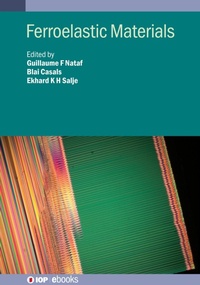
Ferroelastic Materials
Description

This book offers a comprehensive introduction to ferroelastic materials, their phase transitions and their structures. It explores how domain walls respond to electric fields, including recent research describing these movements through the concept of avalanches.
It presents new insights into the unique properties of ferroelastic domain walls, such as electrical conductivity, polarity and magnetism. These phenomena are examined from both theoretical and experimental perspectives, with a focus on how surfaces can influence their expression.
A chapter is dedicated to martensitic phase transitions and the growing interest in ferroelasticity within organic-inorganic hybrid perovskites is also examined.
This book is an essential resource for researchers and advanced students interested in the evolving science of ferroelastic materials and their role in future technologies.
Key Features:
- Offers a comprehensive overview of the field of ferroelastic materials
- Provides a recent description of the behaviour of domain walls under an applied field: avalanches
- Covers the most up to date research on functionality of domain walls in ferroelastic materials
- Provides a perspective on the importance of ferroelasticity to understand some properties of organic-inorganic hybrid perovskites
More details
Other editions
Additional editions
Persons
Guillaume F. Nataf completed his joint PhD in 2016 at the University Paris-Saclay (France) and the University of Luxembourg. In 2017 he moved to the University of Cambridge as postdoc and obtained a Research Fellowship from the Royal Commission for the Exhibition of 1851. In 2021 he became a CNRS Research Scientist at the GREMAN laboratory, Tours, France. A year later he was awarded an ERC Starting Grant to investigate thermal transport in ferroelectric and ferroelastic materials.
Ekhard K.H. Salje completed his PhD at Hannover University, Germany, in 1972 and became Head of the Institute for Crystallography and Petrology (Hannover University) in 1983. In 1985 he moved to the University of Cambridge where he became Professor of Mineral Physics (Department of Earth Sciences) in 1992. He published several key articles on ferroelastic materials, including the first publication on domain boundary engineering, which highlighted that domain walls can be used as functional interfaces.
Blai Casals is an Assistant Professor of Physics at the University of Barcelona, Spain. He obtained his PhD from the Universitat Autònoma de Barcelona in 2018. As a postdoctoral researcher he spent 2.5 years at the University of Cambridge and two years as a postdoc at the Catalan Institute of Nanoscience and Nanotechnology (ICN2).
Content
- Introduction
- Ferroelastic phase transitions-well-known results and new perspectives
- Symmetry aspects of ferroelastic domains and domain walls
- Response of ferroelastic domains to an applied field
- Avalanches in ferroelastic materials
- Functional properties of ferroelastic domain walls
- Ferroelastic domain walls at surfaces
- Martensitic materials
- Ferroelastic hybrid organic-inorganic perovskites
- Applications of ferroelastic materials: past, present and future
