

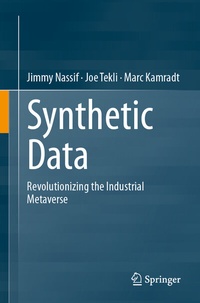
Synthetic Data
Description

The book concentrates on the impact of digitalization and digital transformation technologies on the Industry 4.0 and smart factories, how the factory of tomorrow can be designed, built, and run virtually as a digital twin likeness of its real-world counterpart, before the physical structure is actually erected.
It highlights the main digitalization technologies that have stimulated the Industry 4.0, how these technologies work and integrate with each other, and how they are shaping the industry of the future.
It examines how multimedia data and digital images in particular are being leveraged to create fully virtualized worlds in the form of digital twin factories and fully virtualized industrial assets. It uses BMW Group's latest SORDI dataset (Synthetic Object Recognition Dataset for Industry), i.e., the largest industrial images dataset to-date and its applications at BMW Group and Idealworks, as one of the main explanatory scenarios throughout the book.It discusses the need of synthetic data to train advanced deep learning computer vision models, and how such datasets will help create the "robot gym" of the future: training robots on synthetic images to prepare them to function in the real world.
More details
Other editions
Additional editions
Persons
chapter (since 2018), Associate Editor of Springer KAIS journal, and member of the US-Atlantic Council AI Connect initiative (since 2022).
Marc Kamradt is currently serving as Head of BMW Group TechOffice, Munich (since 2021). The work of the TechOffice mainly revolves around the development and integration of digitalization technologies to help build next generation smart factories, including Ominverse Artificial Intelligence (AI) pipeline, synthetic data generation, and BMW Green physics AI. M. Kamradt was previously appointed to different leadership positions within BMW Group. He served as Senior Expert Innovation, Lead BMW Innovation Lab (2016-2020), leading projects around visual object recognition, knowledge graph enabled manufacturingassistance, and chat bot production at BMW Group. He also served as Innovations Manager (2013-2016), leading projects around cognitive production control and error analysis, and knowledge graph enabled manufacturing assistance. Prior to his leadership roles, he had an extensive technical experience as Enterprise Information Technology (IT) Architect at BMW Group (2011-2012), Product and Process Planning Electonics at BMW Group (2007-2010), IT Specialist at BMW Group (2002-2007), and IT Specialist at T-Systems International GmbH (2000-2002). M. Kamradt obtained his Computer Science diploma from Carl von Ossietzky University of Oldenburg, Germany (1999).Content
Ch. 1. Welcome to the Age of Industrial Data.- Ch. 2. Industrial Evolution toward the Age of Imagination.- Ch. 3. Background and Technologies.- Ch. 4. How Visual Data is Revolutionizing the Industry World.- Ch. 5. Digital Images - the Bread and Butter of Computer Vision.- Ch. 6. Creating SORDI: the Largest Synthetic Dataset for Industries.- Ch. 7. Towards an Industrial Robot Gym.- Ch. 8. What is Next with SORDI.
