

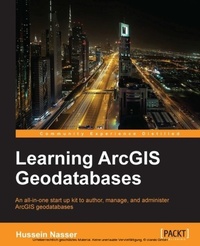
Learning ArcGIS Geodatabases
An all-in-one start up kit to author, manage, and administer ArcGIS geodatabases.
Published on 7. October 2025
158 pages
978-1-78398-865-5 (ISBN)
Description

Key Features
Book DescriptionThis is a solution-based book, showcasing the real power of ArcGIS Geodatabase by following a real-world, example-based approach. This book is aimed at geospatial developers who want to work with ArcGIS geodatabases as well as manage them. Having knowledge of building a geodatabase from scratch isn't a must; Learning ArcGIS Geodatabases is ideal for those who want to use ArcGIS geodatabase for the first time, or for those who want to migrate from their existing legacy database to a geodatabase.What you will learn
Explore the benefits of geodatabases with practical illustrations
Work with geodatabase datasets covering feature classes, tables, relationship classes, coverage, and annotations
Model your geodatabase by creating a sturdy design that can sustain large edits and decrease maintenance
Discover various tools to optimize queries and response time, which will help you to finetune your geodatabase
Utilize Python scripting to author your geodatabase programmatically
Set up and configure a fullfledged networked enterprise geodatabase using ArcSDE technology
Add programming flavors to your geodatabase using Python
Who this book is for
Book DescriptionThis is a solution-based book, showcasing the real power of ArcGIS Geodatabase by following a real-world, example-based approach. This book is aimed at geospatial developers who want to work with ArcGIS geodatabases as well as manage them. Having knowledge of building a geodatabase from scratch isn't a must; Learning ArcGIS Geodatabases is ideal for those who want to use ArcGIS geodatabase for the first time, or for those who want to migrate from their existing legacy database to a geodatabase.What you will learn
Explore the benefits of geodatabases with practical illustrations
Work with geodatabase datasets covering feature classes, tables, relationship classes, coverage, and annotations
Model your geodatabase by creating a sturdy design that can sustain large edits and decrease maintenance
Discover various tools to optimize queries and response time, which will help you to finetune your geodatabase
Utilize Python scripting to author your geodatabase programmatically
Set up and configure a fullfledged networked enterprise geodatabase using ArcSDE technology
Add programming flavors to your geodatabase using Python
Who this book is for
All prices
More details
Edition
Digital original
Language
English
Place of publication
Birmingham
United Kingdom
Target group
Professional and scholarly
US School Grade: College Graduate Student
Edition type
Digital original
File size
4,14 MB
ISBN-13
978-1-78398-865-5 (9781783988655)
Copyright in bibliographic data and cover images is held by Nielsen Book Services Limited or by the publishers or by their respective licensors: all rights reserved.
Schweitzer Classification
Other editions
Additional editions
Hussein Nasser
Learning ArcGIS Geodatabases
An all-in-one start up kit to author, manage, and administer ArcGIS geodatabases.
Book
06/2014
Packt Publishing
€34.00
Shipment within 3-4 weeks
Person
Nasser Hussein :
Hussein Nasser is an Esri award-winning senior GIS solution architect working in the GIS field since 2006. He is the author of three books in the ArcGIS technology: Administering ArcGIS for Server, Learning ArcGIS Geodatabases, and Building Web Applications with ArcGIS, all by Packt Publishing. In 2007, he won the first place at the annual ArcGIS Server Code Challenge, conducted at the Esri Developer Summit in Palm Springs, California. In 2014, he started the IGeometry YouTube channel, where he periodically publishes educational GIS videos.
Hussein Nasser is an Esri award-winning senior GIS solution architect working in the GIS field since 2006. He is the author of three books in the ArcGIS technology: Administering ArcGIS for Server, Learning ArcGIS Geodatabases, and Building Web Applications with ArcGIS, all by Packt Publishing. In 2007, he won the first place at the annual ArcGIS Server Code Challenge, conducted at the Esri Developer Summit in Palm Springs, California. In 2014, he started the IGeometry YouTube channel, where he periodically publishes educational GIS videos.
Content
Table of Contents
Authoring Geodatabases
Working with Geodatabase datasets
Modeling Geodatabase
Optimizing Geodatabases
ArcObjects Geodatabase Programming
Enterprise Geodatabases
Authoring Geodatabases
Working with Geodatabase datasets
Modeling Geodatabase
Optimizing Geodatabases
ArcObjects Geodatabase Programming
Enterprise Geodatabases

