

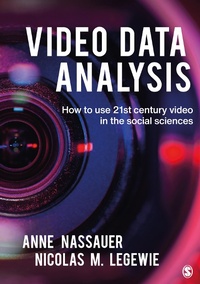
Video Data Analysis
How to Use 21st Century Video in the Social Sciences
1st Edition
Published on 17. March 2022
320 pages
978-1-5297-7915-8 (ISBN)
Description

Nominated for the Ludwik Fleck Prize - awarded annually to an exemplary book in Science and Technology Studies that contributes to the global STS community
Nominated for the Robert K. Merton Book Award - this is awarded annually in recognition of an outstanding book on science, knowledge, and/or technology.
Video data is transforming the possibilities of social science research. Whether through mobile phone footage, body-worn cameras or public video surveillance, we have access to an ever-expanding pool of data on real-life situations and interactions.
This book provides a flexible framework for working with video data and understanding what it says about social life. With examples from a range of real video research projects, the book showcases step-by-step how to analyse any kind of data, including both found and generated videos. It also includes a non-technical discussion of computer vision and its opportunities for social science research.
With this book you will be able to:
? Complete each step of the research process fully and efficiently, from data collection to management, analysis, and interpretation
? Use video data in an ethical and effective way to maximise its impact
? Utilise contemporary technology and accessible platforms such as YouTube, Twitter, Tik Tok and Facebook.
This book is an ideal toolkit for researchers or postgraduate students across the social sciences working with video data as a part of their research projects. Accessible and practical, is written for qualitative and quantitative researchers, newcomers and experienced scholars.
Features include interactive activities for different skill levels and 'what to read next' sections to help you engage further with the research mentioned in the book.
Nominated for the Robert K. Merton Book Award - this is awarded annually in recognition of an outstanding book on science, knowledge, and/or technology.
Video data is transforming the possibilities of social science research. Whether through mobile phone footage, body-worn cameras or public video surveillance, we have access to an ever-expanding pool of data on real-life situations and interactions.
This book provides a flexible framework for working with video data and understanding what it says about social life. With examples from a range of real video research projects, the book showcases step-by-step how to analyse any kind of data, including both found and generated videos. It also includes a non-technical discussion of computer vision and its opportunities for social science research.
With this book you will be able to:
? Complete each step of the research process fully and efficiently, from data collection to management, analysis, and interpretation
? Use video data in an ethical and effective way to maximise its impact
? Utilise contemporary technology and accessible platforms such as YouTube, Twitter, Tik Tok and Facebook.
This book is an ideal toolkit for researchers or postgraduate students across the social sciences working with video data as a part of their research projects. Accessible and practical, is written for qualitative and quantitative researchers, newcomers and experienced scholars.
Features include interactive activities for different skill levels and 'what to read next' sections to help you engage further with the research mentioned in the book.
Reviews / Votes
The book is beneficial for both beginning and advanced researchers in social sciences seeking an introduction to video data analysis. It addresses issues arising at various stages of a research project, helps with conceptualization, considers important questions to think about, and provides tools for analyzing video data. -- Astrid Schulz Video Data Analysis is the future of social science. It shows what people do, not just what they say they do. A picture is worth 1000 words, but only if you know what to look for in it. Nassauer and Legewie show how. -- Randall Collins Anyone from a variety of disciplines that is considering the use of video for analysis or wanting to learn more about this methodology now has a one stop resource to consider techniques and approaches. VDA frameworks, applications, limits, new directions, and more are thoughtfully presented in a comprehensive yet accessible manner for the novice and experienced researcher alike. -- John McCluskey VDA is the perfect place to start for someone newly interested in using video data for social science research. It offers a comprehensive repository of tools, resources, and concepts for pursuing effective video-based research. -- Doron Shiffer-Sebba As researchers increasingly turn to video data, there is a real need for a comprehensive repository of expertise about what to do with it. This book fulfils this need fulsomely. The authors are clear about their aims and coverage, advising readers to 'take what is useful'. For many, that will be the entire volume. -- Pamela Woolner Nassauer and Legewie provide an accessible, practice-oriented guide to handling video data; a service to students and scholars who are intrigued by the abundance of videos surrounding us and want to know how to draw empirical lessons from them. -- Charlie Zaharoff Video Data Analysis is a rare multidisciplinary textbook. The authors admirably integrate issues in the social sciences and the budding research field of digital visual analysis. Broad in scope yet accessible, this book provides novel and comprehensive methods for systematically analysing audiovisual recordings of complex real-life social phenomena. -- Chiao-I Tseng Centering thoughtful, ethical, and robust social science research, Nassauer and Legewie offer a concise methodology for engaging in Video Data Analysis. Situated within our increasingly digitized and surveilled social worlds, this book presents an essential framework for the 21stcentury study of human relation -- Malika Stuerznickel This book is an incredibly useful source for the analysis of video material. The chapters are easy to understand and require no prior knowledge on visual research methods. I fully recommend it to students interested in engaging and innovative methodology. -- Katarina DacicMore details
Edition
1. Auflage
Language
English
Place of publication
London
United Kingdom
Publishing group
Sage Publications Ltd (Digital)
Target group
College/higher education
Product notice
Reflowable
ISBN-13
978-1-5297-7915-8 (9781529779158)
Copyright in bibliographic data and cover images is held by Nielsen Book Services Limited or by the publishers or by their respective licensors: all rights reserved.
Schweitzer Classification
Other editions
Additional editions
Anne Nassauer | Nicolas Legewie
Video Data Analysis
How to Use 21st Century Video in the Social Sciences
Book
03/2022
1st Edition
SAGE Publications Ltd
€52.55
Shipment within 15-20 days
Anne Nassauer | Nicolas Legewie
Video Data Analysis
How to Use 21st Century Video in the Social Sciences
Book
03/2022
1st Edition
SAGE Publications Ltd
€142.50
Shipment within 15-20 days
Persons
Anne Nassauer is a sociologist with a research focus on interactions, deviant and collective behavior, and the use of 21st century video data for scientific inquiry. Her research lies at the intersection between sociology, social psychology, and criminology. She often combines Video Data Analysis and interdisciplinary theoretical perspectives with the ultimate goal to better understand social processes and interaction. Nicolas M. Legewie's research focuses on the impact of social networks on social inequality and mobility. He also does extensive work on research methodology, with a focus on Video Data Analysis, mixed methods, digital social science research, and research ethics.
Content
Part I: Novel Opportunities
Chapter 1: The Rise of Video Data in Social Science Research
A New Era
Novel Opportunities
Chapter 2: Video Data Analysis - A multidisciplinary Framework
What is Video Data Analysis?
What makes video data unique?
What are limitations of video data and VDA?
Part II: Conducting Video Data Analysis
Chapter 3: Step 1 - Theoretical Perspectives, Object of Analysis, and Analytical Lens
Choosing the theoretical perspective
Reflecting on the object of study
Selecting facets of analytical dimensions
Chapter 4: Step 2 - Ethical Considerations
What is research ethics?
Research Ethics and Video Data Analysis
Assessing a VDA Study from an Ethical Standpoint
Chapter 5: Step 3 - Data Collection and Management
Case Selection and Validity in VDA
Collecting Custom-Made Data
Collecting Ready-Made Data
Triangulation
Data Management
Chapter 6: Step 4 - Analyzing Video Data
Coding and concepts
Timing and sequence
Counts and quantifications
Rhythm and turn-taking
Studying Actors
Social relations and networks
Spacing
Additional analytical tools
Chapter 7: Step 5 - Presentation of Findings
How was the presented data collected?
Where do you present your VDA findings?
Part III: Future Developments in VDA
Chapter 8: Video Data Analysis and Computer Vision
Computer vision in a nutshell
How can computer vision help VDA?
What are main challenges?
Chapter 9: Conclusion: The Future of Video Data in Social Science Research
Looking ahead
The Dawn of Video Data Analysis
Chapter 1: The Rise of Video Data in Social Science Research
A New Era
Novel Opportunities
Chapter 2: Video Data Analysis - A multidisciplinary Framework
What is Video Data Analysis?
What makes video data unique?
What are limitations of video data and VDA?
Part II: Conducting Video Data Analysis
Chapter 3: Step 1 - Theoretical Perspectives, Object of Analysis, and Analytical Lens
Choosing the theoretical perspective
Reflecting on the object of study
Selecting facets of analytical dimensions
Chapter 4: Step 2 - Ethical Considerations
What is research ethics?
Research Ethics and Video Data Analysis
Assessing a VDA Study from an Ethical Standpoint
Chapter 5: Step 3 - Data Collection and Management
Case Selection and Validity in VDA
Collecting Custom-Made Data
Collecting Ready-Made Data
Triangulation
Data Management
Chapter 6: Step 4 - Analyzing Video Data
Coding and concepts
Timing and sequence
Counts and quantifications
Rhythm and turn-taking
Studying Actors
Social relations and networks
Spacing
Additional analytical tools
Chapter 7: Step 5 - Presentation of Findings
How was the presented data collected?
Where do you present your VDA findings?
Part III: Future Developments in VDA
Chapter 8: Video Data Analysis and Computer Vision
Computer vision in a nutshell
How can computer vision help VDA?
What are main challenges?
Chapter 9: Conclusion: The Future of Video Data in Social Science Research
Looking ahead
The Dawn of Video Data Analysis
