

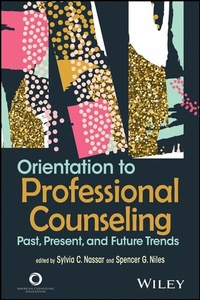
Orientation to Professional Counseling
Description

Ideal for use in introductory counseling courses, Orientation to Professional Counseling is fully aligned with the 2016 CACREP Standards and contains historical perspectives on the foundations of the profession, an overview of counseling specialties and contemporary issues in the field, and a discussion of anticipated future trends. Throughout the book, Nassar, Niles, and other counseling leaders emphasize the core content and expertise common within a unified counseling identity. To deepen practical application, chapters include learning objectives and activities, review questions, illustrative text sidebars, and "Voices From the Field." Complimentary instructor's materials, including chapter outlines, tests, and PowerPoint slides, are available by request to ACA.
*Requests for digital versions from ACA can be found on www.wiley.com
*To request print copies, please visit the ACA https://imis.counseling.org/store/detail
*Reproduction requests for material from books published by ACA should be directed to publications@counseling.org
More details
Other editions
Additional editions
Persons
Sylvia C. Nassar, PhD, is currently a professor and doctoral program coordinator of counselor education at North Carolina State University.
Spencer G. Niles, PhD, serves as dean of and professor in the School of Education at the College of William and Mary in Williamsburg, Virginia.
Content
- Intro
- Title Page
- Copyright
- Foreword
- Preface
- Acknowledgments
- About the Editors
- About the Contributors
- Section I: Foundational Elements of Professional Counseling
- Chapter 1: Professional Counseling and Ethical Practice
- Learning Objectives
- A History of the Counseling Profession
- The Philosophy of the Counseling Profession
- Professional Organizations
- Credentialing
- Ethical Practice
- Professional Activities of Counselors
- Chapter Summary
- Learning Activities
- Review Questions
- Further Resources
- References
- Chapter 2: Human Growth and Development in a Multicultural Contexts
- Learning Objectives
- Counseling Within a Multicultural and Life-Span Development Approach
- An Overview of Life-Span Human Development
- Basic Issues in Human Development
- Major Human Development Theories
- Identity Development Theories
- Resilience and Development
- Psychopathology and Development
- Implications for the Counseling Profession
- Chapter Summary
- Learning Activities
- Review Questions
- Further Resources
- References
- Chapter 3: Individual and Group Helping Relationships
- Learning Objectives
- Individual Counseling
- Group Counseling
- Chapter Summary
- Learning Activities
- Review Questions
- Further Resources
- References
- Chapter 4: Research and Assessment in Counseling
- Learning Objectives
- What Type of Research Do Counselors Do?
- Linking Research to Assessment
- The Role of Assessment in Counseling
- How We Measure
- Psychometric Properties of Assessment
- Chapter Summary
- Learning Activities
- Review Questions
- Further Resources
- References
- Section II: Counseling Specialties
- Chapter 5: Addictions Counseling
- Learning Objectives
- Theories and Etiology of Addictions and Addictive Behaviors
- The History and Development of Addictions Counseling
- The Impact of Addiction on Significant Others
- Contextual Dimensions
- Practice Dimensions
- Special Considerations in Addictions Counseling
- Chapter Summary
- Learning Activities
- Review Questions
- Further Resources
- References
- Chapter 6: Career Counseling
- Learning Objectives
- The Definition of Career Counseling
- The History of Career Counseling
- Theories of Career Counseling
- 10 Ideas That Changed the Career Field
- Special Considerations in Career Counseling
- Chapter Summary
- Learning Activities
- Review Questions
- Further Resources
- References
- Chapter 7: Clinical Mental Health Counseling
- Learning Objectives
- History
- Contextual Dimensions of Clinical Mental Health Counseling
- Practice Dimensions of Clinical Mental Health Counseling
- Special Considerations in Clinical Mental Health: Emergent Issues
- Chapter Summary
- Learning Activities
- Review Questions
- Further Resources
- References
- Chapter 8: Rehabilitation Counseling
- Learning Objectives
- The History and Development of Rehabilitation Counseling
- Contemporary Practice
- Contextual Dimensions
- Practice Dimensions
- Special Considerations in Rehabilitation Counseling
- Chapter Summary
- Learning Activities
- Review Questions
- Extension Activities for Discussion and Synthesis
- Further Resources
- References
- Chapter 9: College Counseling and Student Affairs
- Learning Objectives
- Counseling in Student Affairs
- College Counseling
- Developmental Theory and Student Affairs/College Counseling
- Professional Identity and Associations
- Mental Health Issues on a College Campus: Contextual Dimensions
- Working Together for Student Success: Practice Dimensions
- Ethics, College Counseling, and Student Affairs
- Special Considerations in College Counseling and Student Affairs
- Chapter Summary
- Learning Activities
- Review Questions
- Further Resources
- References
- Chapter 10: Marriage, Couples, and Family Counseling
- Learning Objectives
- The History and Development of Family Counseling
- The Family: Systemic and Developmental Perspectives
- Perspectives on Family Functioning: Contextual Dimensions
- Common Patterns of Family Problems or Distress
- Approaches to Couples and Family Counseling: Practice Dimensions
- Unique Ethical Issues in Couples and Family Counseling
- A Career as a Marriage and Family Counselor/Therapist (MFC/T)
- Training and Credentialing of Couples and Family Counselors/Therapists
- Special Topics and Further Considerations
- Chapter Summary
- Learning Activities
- Review Questions
- Further Resources
- References
- Chapter 11: School Counseling
- Learning Objectives
- From Guidance Counselor to School Counselor
- Contextual Dimensions in School Counseling
- Practice Dimensions in School Counseling
- Special Considerations in School Counseling
- Chapter Summary
- Learning Activities
- Review Questions
- Further Resources
- References
- Section III: Current Issues for Personal and Professional Development
- Chapter 12: Current Issues and Trends in the Counseling Profession
- Learning Objectives
- Counselor Licensure: Portability and Challenges From Other Professional Groups
- Counselor Supervision: Roles and Credentials
- Private Practice Settings
- Changing Client Demographics and Current Issues
- The Role of Diagnosis Across Settings
- Distance Counseling and Supervision
- Chapter Summary
- Learning Activities
- Review Questions
- Further Resources
- References
- Chapter 13: Personal and Professional Counselor Identity Development
- Learning Objectives
- What Does It Mean to Be a Professional Counselor?
- Developing a Personal Identity
- Developing a Professional Identity
- The Integration of Personal and Professional Identity
- Chapter Summary
- Learning Activities
- Review Questions
- Further Resources
- References
- Index
- Technical Support
- End User License Agreement
About the Contributors
Carla Adkison-Johnson, PhD, is a professor in the Department of Counselor Education and Counseling Psychology at Western Michigan University. She has published extensively in the areas of counselor preparation, clinical mental health counseling, and child-rearing practices in African American families. Her research has garnered attention in the legal, child welfare, and counselor education literature.
Aisha Al-Qimlass, MS, LPCA, CRC, LCASA, is a doctoral candidate in counseling and counselor education at North Carolina State University. Her primary areas of clinical and research interest include chemical dependency, co-occurring disorders, Islamic feminism, and career development.
Richard S. Balkin, PhD, LPC, NCC, is a professor at the University of Mississippi. He is editor of the Journal of Counseling & Development, a Fellow of the American Counseling Association, and past president of the Association for Assessment and Research in Counseling. His primary areas of interest include client-centered outcomes, assessment, research methods and statistics, and religious diversity.
Shanita Brown, PhD, LPCA, NCC, ACS, is a visiting assistant professor of counselor education at Wake Forest University. She has more than 15 years of clinical mental health experience in various work settings. Her research and service focuses on emerging contexts of intimate partner violence, multicultural counseling, social justice advocacy, and adolescence.
Rick Bruhn, EdD, LPC-S, LMT, is a professor and doctoral program director in the Department of Counselor Education at Sam Houston State University.
Craig S. Cashwell, PhD, LPC, NCC, ACS, is a professor in the Department of Counseling and Educational Development at the University of North Carolina at Greensboro and maintains a part-time private practice specializing in addiction and couples counseling. He has served as chair of the Council for Accreditation of Counseling and Related Educational Programs board; president of Chi Sigma Iota International; president of the Association for Spiritual, Ethical, and Religious Values in Counseling; and Association for Counselor Education and Supervision representative to the American Counseling Association Governing Council.
Annemarie Connor, PhD, is an assistant professor of rehabilitation sciences at Florida Gulf Coast University. She has a doctorate in rehabilitation counselor education from Michigan State University and nearly 15 years of clinical experience as a licensed occupational therapist. Her research and scholarly interests include the working alliance, psychological wellness, social participation, and vocational rehabilitation.
Darcie Davis-Gage, PhD, is an associate professor and mental health clinical counseling coordinator at the University of Northern Iowa. Her current research interests include the effectiveness of career construction groups, creative interventions in counseling and supervision, and counselor wellness and self-care.
Thelma Duffey, PhD, is a professor in and chair of the Department of Counseling at the University of Texas at San Antonio and immediate past president of the American Counseling Association (ACA). Dr. Duffey was the founding president of the Association for Creativity in Counseling, a division within the ACA, and is editor of the Journal of Creativity in Mental Health. Dr. Duffey served as guest coeditor of the Journal of Counseling & Development special issue on counseling men and the Journal of Counseling & Development special section on relational-cultural theory. Dr. Duffey, an ACA Fellow, has received numerous leadership and research awards from professional organizations, such as the Association for Counselor Education and Supervision; the ACA; the Texas Counseling Association; the Southern Association for Counselor Education and Supervision; the Association for Creativity in Counseling; the Texas Association for Counselor Education and Supervision; and the Association for Assessment, Research, and Counseling. She has more than 60 peer-reviewed publications and three edited and coedited books: Creative Interventions in Grief and Loss Therapy: When the Music Stops, a Dream Dies; A Counselor's Guide to Working With Men; and Child and Adolescent Counseling Case Studies: Developmental, Relational, Multicultural, and Systemic Perspectives.
Perry C. Francis, EdD, LPC, NCC, ACS, is a professor of counseling at Eastern Michigan University, where he also manages the College of Education Counseling Training Clinic. He has been involved in the leadership of the American College Counseling Association for more than 20 years. He has written and presented in the area of ethics and college counseling for more than 20 years and manages the college counseling program at Eastern Michigan University.
Shane Haberstroh, EdD, is an associate professor and doctoral program director in the Department of Counseling at the University of Texas at San Antonio. He is a past president of the Association for Creativity in Counseling and served on its founding board. He is currently the Association for Creativity in Counseling representative to the American Counseling Association Governing Council and the Governing Council liaison to the Research and Knowledge Committee of the American Counseling Association. Dr. Haberstroh serves as associate editor of the Journal of Creativity in Mental Health. He has published a coedited book and numerous articles and book chapters primarily focused on developmental relational counseling, online counseling, creativity in counseling, and addiction treatment and recovery. His collaborative research project on relational competencies won the 2010 Texas Counseling Association Research Award, and his collaborative publication on assessment practices in counselor education programs was recognized with the 2014 Association for Assessment and Research in Counseling/Counseling Outcome Research and Evaluation Outstanding Outcome Research Award. Dr. Haberstroh began his career in 1992 as a residential technician in a 28-day drug treatment program and has worked as a counselor and supervisor in addiction treatment centers, private practice, and criminal justice settings. He has been a counselor educator since 2003, and he joined the faculty at the University of Texas at San Antonio in 2004.
Barbara Herlihy, PhD, NCC, LPC, LPC-S, is professor emeritus in the Counselor Education Program, Department of Educational Leadership, Counseling, and Foundations, at the University of New Orleans. She has published numerous articles and book chapters on the topics of ethics, feminist therapy, social justice, and international perspectives on counseling and is the coauthor of three current textbooks on counselor ethics. She is currently engaged in efforts to further the internationalization of the counseling profession.
Cheryl Holcomb-McCoy, PhD, is dean of the School of Education and a professor of education at American University in Washington, DC. Previously she held appointments as vice provost for faculty affairs and vice dean of academic affairs at Johns Hopkins University. In counselor education, she served as associate professor of counselor education at the University of Maryland, College Park, and assistant professor and director of the School Counseling Program at Brooklyn College of the City University of New York. Dr. Holcomb-McCoy earned a doctorate in counseling and educational development from the University of North Carolina at Greensboro and a master of education in school counseling and bachelor of science in early childhood education, both from the University of Virginia. Her areas of research specialization include the measurement of multicultural self-efficacy and the examination of school counselors' influence on low-income students' college and career readiness. Dr. Holcomb-McCoy, a Fellow of the American Counseling Association, is the author of the best-selling book School Counseling to Close the Achievement Gap: A Social Justice Framework for Success.
Virginia A. Kelly, PhD, LPC, is a professor at Fairfield University in Fairfield, Connecticut. Her primary area of scholarly interest is addictions, specifically the ways in which addiction impacts families. She teaches classes in research, assessment, and addiction in the family.
Trenton Landon, PhD, is a graduate of Michigan State University with a doctorate in rehabilitation counselor education. Prior to working in academia, Dr. Landon worked for 7 years as a rehabilitation counselor. During that time, he had the opportunity to work with transition-age youth, participate in the mental health and drug courts programs, and work with the state psychiatric hospital. Currently, Dr. Landon teaches master's-level coursework in the rehabilitation counseling program at Utah State University. His research interests include the professional development of counselors, clinical supervision, ethics and ethical decision making, rural rehabilitation, and the social inclusion of individuals with disabilities.
Michael J. Leahy, PhD, LPC, CRC, is a university distinguished professor of rehabilitation counseling and director of the Office of Rehabilitation and Disability Studies at Michigan State University. He has a doctorate in rehabilitation psychology from the University of Wisconsin-Madison and more than 40 years of experience in rehabilitation as a counselor, administrator, researcher, and educator. Dr. Leahy is a licensed professional counselor and a certified rehabilitation counselor.
Matthew...
