

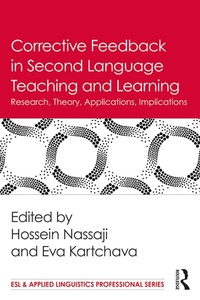
Corrective Feedback in Second Language Teaching and Learning
Research, Theory, Applications, Implications
Published on 7. April 2017
206 pages
978-1-317-21994-1 (ISBN)
Description

Bringing together current research, analysis, and discussion of the role of corrective feedback in second language teaching and learning, this volume bridges the gap between research and pedagogy by identifying principles of effective feedback strategies and how to use them successfully in classroom instruction. By synthesizing recent works on a range of related themes and topics in this area and integrating them into a single volume, it provides a valuable resource for researchers, graduate students, teachers, and teacher educators in various contexts who seek to enhance their skills and to further their understanding in this key area of second language education.
More details
Series
Language
English
Place of publication
London
United Kingdom
Publishing group
Taylor & Francis Ltd
Target group
College/higher education
Illustrations
1 s/w Abbildung, 4 s/w Tabellen, 1 s/w Zeichnung
4 Tables, black and white; 1 Line drawings, black and white; 1 Illustrations, black and white
File size
2,41 MB
ISBN-13
978-1-317-21994-1 (9781317219941)
Copyright in bibliographic data and cover images is held by Nielsen Book Services Limited or by the publishers or by their respective licensors: all rights reserved.
Schweitzer Classification
Other editions
Additional editions
Hossein Nassaji | Eva Kartchava
Corrective Feedback in Second Language Teaching and Learning
Research, Theory, Applications, Implications
Book
04/2017
1st Edition
Routledge
€231.50
Shipment within 10-20 days
Hossein Nassaji | Eva Kartchava
Corrective Feedback in Second Language Teaching and Learning
Research, Theory, Applications, Implications
Book
04/2017
1st Edition
Routledge
€60.00
Shipment within 10-20 days
Persons
Hossein Nassaji is Professor of Applied Linguistics in the Department of Linguistics at the University of Victoria, Canada.
Eva Kartchava is Assistant Professor of Applied Linguistics and TESL in the School of Linguistics and Language Studies at Carleton University, Canada.
Eva Kartchava is Assistant Professor of Applied Linguistics and TESL in the School of Linguistics and Language Studies at Carleton University, Canada.
Content
Introduction: The role of corrective feedback: Theoretical and pedagogical perspective - Hossein Nassaji and Eva Kartchava
PART 1: ORAL CORRECTIVE FEEDBACK
Chapter 1: Oral corrective feedback in L2 classrooms: What we know so far - Rod Ellis
Chapter 2: The nature of peer corrective feedback during oral interaction: Cognitive and social perspectives - Masatoshi Sato
Chapter 3: The timing of oral corrective feedback - Paul Gregory Quinn (University of Toronto) and Tatsuya Nakata
PART 2: COMPUTER-MEDIATED CORRECTIVE FEEDBACK
Chapter 4: Computer-assisted corrective feedback and language learning - Trude Heift and Volker Hegelheimer
Chapter 5: Peer corrective feedback in computer-mediated collaborative writing - Neomy Storch
Chapter 6: Interactional feedback in computer-mediated communication: A review of the state
of the art - Nicole Ziegler and Alison Mackey
PART 3: WRITTEN CORRECTIVE FEEDBACK
Chapter 7: Language-focused peer corrective feedback in second language writing - Magda Tigchelaar and Charlene Polio
Chapter 8: Negotiated oral negotiation in response to written errors - Hossein Nassaji
Chapter 9: Why some L2 learners fail to benefit from written CF Corrective Feedback - John Bitchener
PART 4: STUDENT AND TEACHER ISSUES IN CORRECTIVE FEEDBACK
Chapter 10: Student and teacher beliefs and attitudes towards corrective feedback - Shaofeng Li
Chapter 11: Non-verbal Feedback - Kimi Nakatsukasa and Shawn Loewen
Conclusion, reflections, and final remarks - Hossein Nassaji and Eva Kartchava
List of Contributors
PART 1: ORAL CORRECTIVE FEEDBACK
Chapter 1: Oral corrective feedback in L2 classrooms: What we know so far - Rod Ellis
Chapter 2: The nature of peer corrective feedback during oral interaction: Cognitive and social perspectives - Masatoshi Sato
Chapter 3: The timing of oral corrective feedback - Paul Gregory Quinn (University of Toronto) and Tatsuya Nakata
PART 2: COMPUTER-MEDIATED CORRECTIVE FEEDBACK
Chapter 4: Computer-assisted corrective feedback and language learning - Trude Heift and Volker Hegelheimer
Chapter 5: Peer corrective feedback in computer-mediated collaborative writing - Neomy Storch
Chapter 6: Interactional feedback in computer-mediated communication: A review of the state
of the art - Nicole Ziegler and Alison Mackey
PART 3: WRITTEN CORRECTIVE FEEDBACK
Chapter 7: Language-focused peer corrective feedback in second language writing - Magda Tigchelaar and Charlene Polio
Chapter 8: Negotiated oral negotiation in response to written errors - Hossein Nassaji
Chapter 9: Why some L2 learners fail to benefit from written CF Corrective Feedback - John Bitchener
PART 4: STUDENT AND TEACHER ISSUES IN CORRECTIVE FEEDBACK
Chapter 10: Student and teacher beliefs and attitudes towards corrective feedback - Shaofeng Li
Chapter 11: Non-verbal Feedback - Kimi Nakatsukasa and Shawn Loewen
Conclusion, reflections, and final remarks - Hossein Nassaji and Eva Kartchava
List of Contributors
