

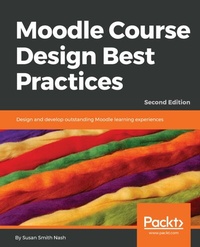
Moodle Course Design Best Practices
Design and develop outstanding Moodle learning experiences
2nd Edition
Published on 23. September 2024
164 pages
978-1-78934-960-3 (ISBN)
Description

Fast-paced guide for designing effective Moodle courses; experiment with Moodle's features for free using MoodleCloud
Key Features
Apply principles of instructional design to create great Moodle learning experiences
Enhance collaboration and spur creativity with Moodle
Bring together instructional materials, social interaction, and student management functions in your courses
Book DescriptionMoodle is a leading virtual learning environment for your online course. This book incorporates the principles of instructional design, showing you how to apply them to your Moodle courses. With this guidance, you will develop and deploy better courses, content, and assessments than ever. This book will guide you as you learn how to build and incorporate many different types of course materials and dynamic activities. You will learn how to improve the structure and presentation of resources, activities, and assessments. All this will help you to create better for self-led courses, instructor-led courses, and courses for collaborative groups. The use of multimedia features to enhance your Moodle courses is also explained in this book. Our goal is to encourage creativity, and the free MoodleCloud hosting option is an ideal place for teachers, students, trainers, and administrators to jump in and play with all the new features, which include powerful new plug-ins, new resources, and activities. Moodle can be your sandbox as well as your castle of learning! With this book, you will build learning experiences that will last your learners' lifetimes.What you will learn
Build a course structure that fits your goals
Design a unique appearance
Manage the resources and activities
Tips for better organization of your course content
Select and set up assessments
Include effective instructional strategies
Incorporate competency frameworks
Run and archive webinars
Motivate learners by incorporating badges
Explore MoodleCloud
Who this book is forIf you create courses with Moodle, this book is for you. It can be used by teachers, instructors, training managers, Moodle administrators, instructional technologists, instructional designers, and e-learning entrepreneurs. Prior experience with Moodle will be helpful.
Key Features
Apply principles of instructional design to create great Moodle learning experiences
Enhance collaboration and spur creativity with Moodle
Bring together instructional materials, social interaction, and student management functions in your courses
Book DescriptionMoodle is a leading virtual learning environment for your online course. This book incorporates the principles of instructional design, showing you how to apply them to your Moodle courses. With this guidance, you will develop and deploy better courses, content, and assessments than ever. This book will guide you as you learn how to build and incorporate many different types of course materials and dynamic activities. You will learn how to improve the structure and presentation of resources, activities, and assessments. All this will help you to create better for self-led courses, instructor-led courses, and courses for collaborative groups. The use of multimedia features to enhance your Moodle courses is also explained in this book. Our goal is to encourage creativity, and the free MoodleCloud hosting option is an ideal place for teachers, students, trainers, and administrators to jump in and play with all the new features, which include powerful new plug-ins, new resources, and activities. Moodle can be your sandbox as well as your castle of learning! With this book, you will build learning experiences that will last your learners' lifetimes.What you will learn
Build a course structure that fits your goals
Design a unique appearance
Manage the resources and activities
Tips for better organization of your course content
Select and set up assessments
Include effective instructional strategies
Incorporate competency frameworks
Run and archive webinars
Motivate learners by incorporating badges
Explore MoodleCloud
Who this book is forIf you create courses with Moodle, this book is for you. It can be used by teachers, instructors, training managers, Moodle administrators, instructional technologists, instructional designers, and e-learning entrepreneurs. Prior experience with Moodle will be helpful.
More details
Edition
2nd Revised edition
Language
English
Place of publication
Birmingham
United Kingdom
Target group
Professional and scholarly
US School Grade: College Graduate Student
Edition type
Revised edition
File size
5,28 MB
ISBN-13
978-1-78934-960-3 (9781789349603)
Copyright in bibliographic data and cover images is held by Nielsen Book Services Limited or by the publishers or by their respective licensors: all rights reserved.
Schweitzer Classification
Other editions
Additional editions
Susan Smith Nash
Moodle Course Design Best Practices
Design and develop outstanding Moodle learning experiences
Book
08/2018
2nd Edition
Packt Publishing
€39.10
Shipment within 3-4 weeks
Person
Nash Susan Smith :
Susan Smith Nash has been developing and administering online courses for more than 20 years for both academic and professional training purposes. She earned her Bachelor's of Science, Masters of Art, and Ph.D. at the University of Oklahoma. She has been widely published in the area of instructional design as well as in energy and economic development. Her books for Packt include Moodle E-Learning Course Development, Moodle 3.X Teaching Techniques, and Moodle Course Design Best Practices. Susan's interests include the development and promotion of new technologies and she enjoys studying films from the Golden Age of Mexican cinema, as well as hiking and tennis. Susan lives in Oklahoma, near her son and his family.
Susan Smith Nash has been developing and administering online courses for more than 20 years for both academic and professional training purposes. She earned her Bachelor's of Science, Masters of Art, and Ph.D. at the University of Oklahoma. She has been widely published in the area of instructional design as well as in energy and economic development. Her books for Packt include Moodle E-Learning Course Development, Moodle 3.X Teaching Techniques, and Moodle Course Design Best Practices. Susan's interests include the development and promotion of new technologies and she enjoys studying films from the Golden Age of Mexican cinema, as well as hiking and tennis. Susan lives in Oklahoma, near her son and his family.
Content
Table of Contents
Preparing to Build an Exemplary Moodle Course
Planning Your Course
Organizing Your Course
Best Practices in Content Delivery
Designing Self-Paced Independent Study Courses
Developing Cohort-Based Courses with Teacher-Student Interaction
Creating Student-Centered Project-Based Courses
Moodle for Online Communities
Preparing to Build an Exemplary Moodle Course
Planning Your Course
Organizing Your Course
Best Practices in Content Delivery
Designing Self-Paced Independent Study Courses
Developing Cohort-Based Courses with Teacher-Student Interaction
Creating Student-Centered Project-Based Courses
Moodle for Online Communities
