

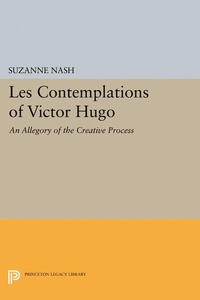
LES CONTEMPLATIONS of Victor Hugo
An Allegory of the Creative Process
1st Edition
Published on 16. June 2015
244 pages
978-1-4008-7050-9 (ISBN)
Description

Victor Hugo's work presents the reader with a paradox nowhere more apparent than in the collection of more than 150 lyric poems entitled Les Contemplations. Although he insisted upon structural unity, his complex artistic creations often seem disordered and digressive. Suzanne Nash examines this contradiction, and she proposes here a new approach to Les Contemplations that reveals how it may be read as a unified allegory of Hugo's understanding of the creative process.
The author's reading heightens the subtleties of individual poems by placing them within the context of the collection. She clarifies the poet's use of rhetorical devices and. illuminating Les Contemplations as a metapoetic creation, shows how it can serve as a guide to Hugo's other works.
The first two chapters present evidence of Hugo's narrative intention, place his work within an allegorical tradition, and describe the structure of the allegory. One poem, Pasteurs et troupeaux, is analyzed as a paradigm for the whole, and a single theme, that of Léopoldine as sacrificial muse and figure for poetic language, is traced through the six books. The author demonstrates Hugo's narrative purpose in his use of rhetorical forms and examines (according to predominance of themes, images, and technical devices) the six chapters as steps in the religio-poetic allegory.
Originally published in 1977.
The Princeton Legacy Library uses the latest print-on-demand technology to again make available previously out-of-print books from the distinguished backlist of Princeton University Press. These editions preserve the original texts of these important books while presenting them in durable paperback and hardcover editions. The goal of the Princeton Legacy Library is to vastly increase access to the rich scholarly heritage found in the thousands of books published by Princeton University Press since its founding in 1905.
The author's reading heightens the subtleties of individual poems by placing them within the context of the collection. She clarifies the poet's use of rhetorical devices and. illuminating Les Contemplations as a metapoetic creation, shows how it can serve as a guide to Hugo's other works.
The first two chapters present evidence of Hugo's narrative intention, place his work within an allegorical tradition, and describe the structure of the allegory. One poem, Pasteurs et troupeaux, is analyzed as a paradigm for the whole, and a single theme, that of Léopoldine as sacrificial muse and figure for poetic language, is traced through the six books. The author demonstrates Hugo's narrative purpose in his use of rhetorical forms and examines (according to predominance of themes, images, and technical devices) the six chapters as steps in the religio-poetic allegory.
Originally published in 1977.
The Princeton Legacy Library uses the latest print-on-demand technology to again make available previously out-of-print books from the distinguished backlist of Princeton University Press. These editions preserve the original texts of these important books while presenting them in durable paperback and hardcover editions. The goal of the Princeton Legacy Library is to vastly increase access to the rich scholarly heritage found in the thousands of books published by Princeton University Press since its founding in 1905.
More details
Other editions
Additional editions
Book
04/2016
Princeton University Press
€79.60
Article not available at the moment
Book
03/2015
Princeton University Press
€31.90
Article not available at the moment

Book
02/1977
Princeton University Press
€31.00
Article exhausted; check different version
Person
Suzanne Nash
Content
Frontmatter, pg. i
Preface, pg. vii
Contents, pg. xi
Introduction, pg. 1
I. The Allegorical Nature and Context of Hugo's Work, pg. 13
II. The Structure of Hugo's Allegory, pg. 34
III. Leopoldine-Mediating Angel, pg. 52
IV. Aurore, pg. 79
V. L'Ame en fleur, pg. 108
VI. Les Luttes et les reves, pg. 124
VII. Pauca meae, pg. 136
VIII. En marche, pg. 150
IX. Au bord de I'infini, pg. 171
X. A celle qui est restee en France, pg. 194
Conclusion, pg. 205
A Selected Bibliography, pg. 209
Index, pg. 223
Preface, pg. vii
Contents, pg. xi
Introduction, pg. 1
I. The Allegorical Nature and Context of Hugo's Work, pg. 13
II. The Structure of Hugo's Allegory, pg. 34
III. Leopoldine-Mediating Angel, pg. 52
IV. Aurore, pg. 79
V. L'Ame en fleur, pg. 108
VI. Les Luttes et les reves, pg. 124
VII. Pauca meae, pg. 136
VIII. En marche, pg. 150
IX. Au bord de I'infini, pg. 171
X. A celle qui est restee en France, pg. 194
Conclusion, pg. 205
A Selected Bibliography, pg. 209
Index, pg. 223
