

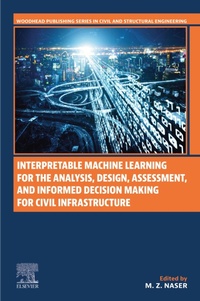
Interpretable Machine Learning for the Analysis, Design, Assessment, and Informed Decision Making for Civil Infrastructure
Published on 18. October 2023
340 pages
978-0-12-824074-8 (ISBN)
Description

The past few years have demonstrated how civil infrastructure continues to experience an unprecedented scale of extreme loading conditions (i.e. hurricanes, wildfires and earthquakes). Despite recent advancements in various civil engineering disciplines, specific to the analysis, design and assessment of structures, it is unfortunate that it is common nowadays to witness large scale damage in buildings, bridges and other infrastructure.
The analysis, design and assessment of infrastructure comprises of a multitude of dimensions spanning a highly complex paradigm across material sciences, structural engineering, construction and planning among others. While traditional methods fall short of adequately accounting for such complexity, fortunately, computational intelligence presents novel solutions that can effectively tackle growing demands of intense extreme events and modern designs of infrastructure - especially in this era where infrastructure is reaching new heights and serving larger populations with high social awareness and expectations.
Computational Intelligence for Analysis, Design and Assessment of Civil Infrastructure highlights the growing trend of fostering the use of CI to realize contemporary, smart and safe infrastructure. This is an emerging area that has not fully matured yet and hence the book will draw considerable interest and attention. In a sense, the book presents results of innovative efforts supplemented with case studies from leading researchers that can be used as benchmarks to carryout future experiments and/or facilitate development of future experiments and advanced numerical models. The book is written with the intention to serve as a guide for a wide audience including senior postgraduate students, academic and industrial researchers, materials scientists and practicing engineers working in civil, structural and mechanical engineering.
- Presents the fundamentals of AI/ML and how they can be applied in civil and environmental engineering
- Shares the latest advances in explainable and interpretable methods for AI/ML in the context of civil and environmental engineering
- Focuses on civil and environmental engineering applications (day-to-day and extreme events) and features case studies and examples covering various aspects of applications
More details
Other editions
Additional editions
Book
10/2023
Woodhead Publishing
€189.50
Shipment within 15-20 days
Content
1. Integrated schematic design method for shear wall structures: A practical application of generative adversarial networks2. Leveraging machine learning techniques to support a holistic performance-based seismic design of civil structures3. Deep learning-based damage inspection for concrete structures4. Explainable computational intelligence method to evaluate the damage on concrete surfaces compared to traditional visual inspection techniques5. Smart building fire safety design driven by artificial intelligence6. The potential of deep learning in dynamic maintenance scheduling for thermal energy storage chiller plants7. The use of IDA on GPR data to monitor road transport infrastructures8. Ai for large-scale evacuation modelling: promises and challenges9. On the application of machine learning classifiers in evaluating liquefaction potential of civil infrastructure10. Explainable machine learning model for prediction of axial capacity of strengthened CFST columns11. Harnessing data from benchmark testing for the development of spalling detection techniques using deep learning
