

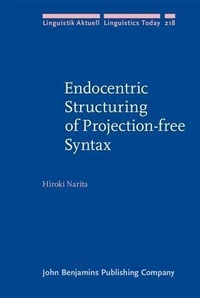
Endocentric Structuring of Projection-free Syntax
1st Edition
Published on 3. December 2014
XII, 268 pages
978-90-272-6962-1 (ISBN)
Description

Endocentric Structuring of Projection-free Syntax puts forward a novel theory of syntax that rigidly adheres to the principle of Minimal Computation, in which a number of traditional but extraneous stipulations such as referential indices and representational labels/projections are eliminated. It specifically articulates the overarching hypothesis that every syntactic object is composed by recursive, phase-by-phase embedding of the endocentric structure {H, a}, where H is a head lexical item and a is another syntactic object (order irrelevant). The proposed mechanism achieves both theory-internal simplicity and broad empirical coverage at the same time, advancing a radically reduced conception of endocentricty/headedness while deriving a number of empirically grounded constraints on human language.
More details
Other editions
Additional editions
Hiroki Narita
Endocentric Structuring of Projection-free Syntax
Book
12/2014
John Benjamins Publishing Co
€104.94
Shipment within 10-15 days
Person
Content
- Endocentric Structuring of Projection-free Syntax
- Editorial page
- Title page
- LCC data
- Table of contents
- List of abbreviations
- Acknowledgments
- 1. Preface
- 2. Bare phrase structure and cyclic derivation by phase, in light of Minimal Computation
- 2.1 Introduction
- 2.2 Towards fuller exploration of bare phrase structure
- 2.2.1 Disentangling compositional structure, labeling, and linear order
- 2.2.2 Merge, inclusiveness, and the no-tampering condition
- 2.2.3 Restricting the generative capacity
- 2.3 Transfer: Compounding Interpret and Spell-Out
- 2.4 Copy-identification and derivational simultaneity
- 2.4.1 The bifurcation of external and internal merge
- 2.4.2 Derivational simultaneity of Value/Agree and Transfer
- 2.5 Defining phases
- 2.5.1 The edge and interior of phases
- 2.5.2 Phase convergence redux
- 2.5.3 Rationale for unvalued/uninterpretable features
- 2.6 Eliminating the Merge-over-Move stipulation along with numeration and lexical (sub-)arrays
- 2.7 Copy-identification as part of Transfer
- 2.8 Head-movement in bare phrase structure
- 2.9 Concluding remarks
- 3. Minimal head detection in projection-free syntax
- 3.1 Introduction
- 3.2 Label = projection = endocentricity?
- 3.3 Why endocentricity?
- 3.4 The Endocentric Structuring Constraint (ESC)
- 3.4.1 Excluding exocentric "XP-YP" merger
- 3.4.2 Internal merge and endocentricity
- 3.4.2.1 No XP-YP Internal Merger
- 3.4.2.2 A-movement and K(ase)
- 3.4.2.3 A´-movement: Extending Cable's eliminative approach to pied-piping
- 3.4.2.4 Eliminating the EPP-feature
- 3.4.2.5 Approximating the duality of semantics
- 3.5 The ESC and the typology of movement
- 3.5.1 Deriving the complementarity of phrasal vs. head-movement
- 3.5.2 On the phasehood of vP
- 3.6 The ESC and the Condition on Extraction Domain (CED)
- 3.6.1 Freezing effects
- 3.6.2 *{t, t}
- 3.6.3 Subject condition effects and beyond
- 3.6.4 Adjunct condition effects and beyond
- 3.6.5 The Phrasal Sister Condition
- 3.6.6 Locality beyond lexicalism and barrierhood
- 3.7 Further consequences on the problem of learnability
- 3.8 Concluding remarks
- 4. Cyclic Spell-Out of projection-free syntax
- 4.1 Introduction
- 4.2 Eradicating the LCA from the ESC
- 4.2.1 Uriagereka's LCA-based ESC
- 4.2.2 The irrelevance of the LCA to the CED effect
- 4.2.3 Sheehan's projection-based resuscitation of Uriagereka's LCA
- 4.2.4 Conclusion: The LCA has no place in projection-free syntax
- 4.3 Eradicating antisymmetry from the ESC
- 4.3.1 Independence of antisymmetry and the LCA
- 4.3.2 Kayne's (2011) LCA-free but still antisymmetric ESC
- 4.3.3 Antisymmetry and cartography in the pursuit of biological adequacy
- 4.4 MHD-based linearization of endocentric structuring
- 4.5 Concluding remarks
- 5. Full Interpretation all the way through
- 5.1 Introduction
- 5.2 Endocentricity as an interface phenomenon
- 5.2.1 Head-independence of narrow-syntactic operations
- 5.2.2 Eliminating the Merge-to-Head hypothesis and edge-features
- 5.2.3 Phasing out specifiers
- 5.2.3.1 Minimal search and specifiers
- 5.2.3.2 Specifiers in pied-piping
- 5.2.3.3 Selection and specifiers
- 5.2.3.4 Spec-head licensing
- 5.2.4 MHD and the third factor
- 5.3 Further issues of endocentricity and Full Interpretation
- 5.3.1 Reviewing Chomsky's (2013) labeling algorithm
- 5.3.2 Eliminating trace invisibility
- 5.3.3 On the visibility of Agreement features at Interpret
- 5.3.4 On symmetric structures and universal endocentricity
- 5.3.5 Remarks on universal endocentricity
- 5.4 Concluding remarks
- 6. Conclusion
- Appendix: List of propositions
- Premises and definitions
- General linguistic theory
- Minimal Computation
- Universal Grammar (UG)
- Architecture
- Relations and definitions
- Semantics (Interpret)
- Phonology (Spell-Out, specifically for linearization)
- Lexicon
- Lexical items (LIs)
- Formal features
- Semantic features
- Phonological features
- Language-specific linearization rules
- Consequences
- Full Interpretation
- Cyclic derivation by phase
- Rules and relations
- The endocentric structuring constraint and conditions on movement
- Lexicon
- Acquisition
- Word order and linearization
- References
- Author index
- Subject index
