

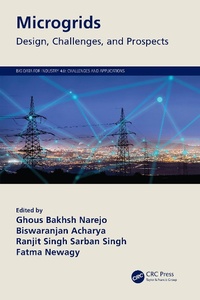
Microgrids
Design, Challenges, and Prospects
1st Edition
Published on 11. October 2021
314 pages
978-1-000-45751-3 (ISBN)
Description

This book addresses the needs of researchers on the fundamental level as well as those with more advanced knowledge of microgrids and their evolution. This book covers newly emerging trends in fields such as computer science, energy, electrical engineering, and electronics and brings the reader current on the newly emerging fields that play an important role in the power infrastructure.
Microgrids: Design, Challenges, and Prospects provides knowledge on decision making for newly evolving trends in microgrid design. It discusses techniques on how to improve the existing power quality and reduce load shedding and power imbalances. The book presents the emerging fields such as data science, machine learning, AI, and IT that now play an important role in microgrid design. The readership includes: researchers, academia, practicing engineers, consumers, power companies, and policy makers located across the globe.
Microgrids: Design, Challenges, and Prospects provides knowledge on decision making for newly evolving trends in microgrid design. It discusses techniques on how to improve the existing power quality and reduce load shedding and power imbalances. The book presents the emerging fields such as data science, machine learning, AI, and IT that now play an important role in microgrid design. The readership includes: researchers, academia, practicing engineers, consumers, power companies, and policy makers located across the globe.
More details
Series
Edition
1. Auflage
Language
English
Place of publication
London
United Kingdom
Publishing group
Taylor & Francis Ltd
Target group
Professional and scholarly
Product notice
Reflowable
Illustrations
58 Tables, black and white; 195 Line drawings, black and white; 16 Halftones, black and white; 211 Illustrations, black and white
ISBN-13
978-1-000-45751-3 (9781000457513)
Copyright in bibliographic data and cover images is held by Nielsen Book Services Limited or by the publishers or by their respective licensors: all rights reserved.
Schweitzer Classification
Other editions
Additional editions
Ghous Bakhsh Narejo | Biswaranjan Acharya | Ranjit Singh Sarban Singh
Microgrids
Design, Challenges, and Prospects
Book
10/2024
1st Edition
CRC Press
€83.00
Shipment within 15-20 days
Ghous Bakhsh Narejo | Biswaranjan Acharya | Ranjit Singh Sarban Singh
Microgrids
Design, Challenges, and Prospects
Book
12/2021
CRC Press
Unfortunately, price unknown
Available (delivery time upon request)
Ghous Bakhsh Narejo | Biswaranjan Acharya | Ranjit Singh Sarban Singh
Microgrids
Design, Challenges, and Prospects
Book
10/2021
1st Edition
CRC Press
€241.40
Shipment within 15-20 days
Persons
Ghous Bakhsh Narejo is an Associate Professor in the department of Electronic Engineering in the faculty of Electrical, Computer Engineering at NED University of Engineering & Technology in Pakistan. He has 18 years of academic experience in Electronic Engineering, and teaches undergraduate, masters and PhD courses related to Electronic Engineering, Microsystems design, Industrial Electronics, Renewable Energy, and imaging and analog ICs. He received his master's degree in microsystems, Electronic Engineering from NED University, and PhD in Electrical Engineering from Michigan Technological University, USA. He has to his credit numerous research papers and has authored many research articles which are published in international journals of repute.
Biswaranjan Acharya is an academic currently associated with Kalinga Institute of Industrial Technology Deemed to be University along with pursuing PhD in computer application from Veer Surendra Sai University of Technology (VSSUT), Burla, Odisha, India. He received his MCA in 2009 from IGNOU, New Delhi, India and M.Tech in Computer Science and Engineering in the year of 2012 from Biju Pattanaik University of Technology (BPUT), Odisha, India. He is associated with various educational and research societies like IEEE, IACSIT, CSI, IAENG, and ISC. He has along with 2 years of industry experience as a software engineer, a total of 10 years experience in both academia and industry. He currently is working in research area of multiprocessor scheduling along with other fields such as Data Analytics, Computer Vision, Machine Learning and IOT. He has published research articles in international repute journals as well as serving as a reviewer.
Ranjit Singh Sarban Singh is currently associated with the Faculty of Electronic and Computer Engineering, Universiti Teknikal Malaysia Melaka as Senior Lecturer. He is a member of Advanced Sensors & Embedded Control System Research Group under Center of Telecommunication, Research & Innovation (CeTRI), Universiti Teknikal Malatsia Melaka. Ir. Dr. Ranjit obtained his Bachelor of Elecronic Engineering (Computer Engineering) from Kolej Universiti Teknikal Kebangsaan Malaysia (KUTKM) in 2006, then pursued his Master of Science Engineering by research at Multimedia University, Melaka Malaysia and graduate in 2010. Later in 2013, Ir. Dr. Ranjit was offered a scholarship by the Ministry of Higher Education of Malaysia to pursue his PhD in Electronic and Computer Engineering at Brunel University, London, United Kingdom. Ir. Dr. Ranjit graduated in 2016. His research work is focusing on simulation, modelling and development of renewable energy system and embedded system design, development and validation. He is a registered Professional Engineer with the Board of Engineers, Malaysia and also is registered as a Chartered Engineer with The Institution of Engineering and Technology, United Kingdom.
Fatma Newagy received the B.Sc., M.Sc., and Ph.D. degrees in electronics and electrical communications engineering from Cairo University in 1998, 2002, and 2008, respectively. She was an Assistant Professor with Cairo University from 2008 to 2011. Since 2011, she has been an Assistant Professor with Ain Shams University. She also taught several courses in wireless communications, advanced digital communications, and cognitive radio. Her current research interest focuses on advanced methods of channel coding, Cognitive radio networks, and 5G mobile communications.
Biswaranjan Acharya is an academic currently associated with Kalinga Institute of Industrial Technology Deemed to be University along with pursuing PhD in computer application from Veer Surendra Sai University of Technology (VSSUT), Burla, Odisha, India. He received his MCA in 2009 from IGNOU, New Delhi, India and M.Tech in Computer Science and Engineering in the year of 2012 from Biju Pattanaik University of Technology (BPUT), Odisha, India. He is associated with various educational and research societies like IEEE, IACSIT, CSI, IAENG, and ISC. He has along with 2 years of industry experience as a software engineer, a total of 10 years experience in both academia and industry. He currently is working in research area of multiprocessor scheduling along with other fields such as Data Analytics, Computer Vision, Machine Learning and IOT. He has published research articles in international repute journals as well as serving as a reviewer.
Ranjit Singh Sarban Singh is currently associated with the Faculty of Electronic and Computer Engineering, Universiti Teknikal Malaysia Melaka as Senior Lecturer. He is a member of Advanced Sensors & Embedded Control System Research Group under Center of Telecommunication, Research & Innovation (CeTRI), Universiti Teknikal Malatsia Melaka. Ir. Dr. Ranjit obtained his Bachelor of Elecronic Engineering (Computer Engineering) from Kolej Universiti Teknikal Kebangsaan Malaysia (KUTKM) in 2006, then pursued his Master of Science Engineering by research at Multimedia University, Melaka Malaysia and graduate in 2010. Later in 2013, Ir. Dr. Ranjit was offered a scholarship by the Ministry of Higher Education of Malaysia to pursue his PhD in Electronic and Computer Engineering at Brunel University, London, United Kingdom. Ir. Dr. Ranjit graduated in 2016. His research work is focusing on simulation, modelling and development of renewable energy system and embedded system design, development and validation. He is a registered Professional Engineer with the Board of Engineers, Malaysia and also is registered as a Chartered Engineer with The Institution of Engineering and Technology, United Kingdom.
Fatma Newagy received the B.Sc., M.Sc., and Ph.D. degrees in electronics and electrical communications engineering from Cairo University in 1998, 2002, and 2008, respectively. She was an Assistant Professor with Cairo University from 2008 to 2011. Since 2011, she has been an Assistant Professor with Ain Shams University. She also taught several courses in wireless communications, advanced digital communications, and cognitive radio. Her current research interest focuses on advanced methods of channel coding, Cognitive radio networks, and 5G mobile communications.
Content
1. Microgrid Design Evolution & Architecture. 2. Renewable Energy (RE) Sources Design in the Microgrid. 3. Microgrid Power System Control Designs. 4. Microgrid Communication. 5. Microgrid Energy Management System. 6. Microgrid Energy Management System using AI Techniques. 7. Microgrid predictive Control Model. 8. Trends in Microgrid Control. 9. Microgrid Control Optimization. 10. Power Assessment Design in Microgrid. 11. Microgrid Energy Design with Management and Economics Focus. 12. Design Stability and Protection for Microgrid. 13. Futuristic Microgrid Designs. 14. Utility and Industry Perspectives. 15. Challenges in Microgrid Control Systems Design as a Case Study Prospective. 16. Security and Protection of Microgrid. 17. Microgrids in Remote Communities. 18. Hybrid Microgrid Design. 19. Microgrid Optimization in Distributed Environment. 20. Development of Multi-Microgrids and Analytics. 21. Cloud Based Microgrid Applications. 22. Energy Internet.
23. Realtime Microgrid Analytics for Power and Energy.
23. Realtime Microgrid Analytics for Power and Energy.
