

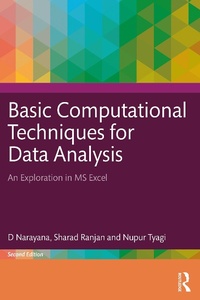
Basic Computational Techniques for Data Analysis
An Exploration in MS Excel
2nd Edition
Published on 20. June 2023
300 pages
978-1-000-89074-7 (ISBN)
Description

This book is designed to equip students to navigate through MS Excel and basic data computation methods, which are essential tools in research or professional settings and in classrooms. It illustrates the concepts used in research and data analysis and economic and financial decision-making in business and in daily life. The book will help students acquire knowledge and develop skills in statistical techniques and financial analysis using MS Excel. With illustrations and examples, it will help the readers to:
Visualize, present, and analyze data through MS Excel spreadsheets and tables and create personal or business spreadsheets
Learn how to work with spreadsheets, use formulae, and perform calculations and analysis
Create tables including Pivot Tables
Become familiar with basic statistical and financial measures
Design creative spread sheets and communicate effectively in business using spreadsheets and data analysis
This revised and updated second edition will be an essential resource for students of economics, commerce, management, and other social science subjects, and will be useful to those studying econometrics, financial technology, basic computational techniques, data analysis, and applied economics.
Content
The book intends to illustrate the concepts used in economic and financial decision-making in business and in daily life; it helps demonstrate a deeper understanding from both theoretical and practical perspectives. An effort has been made to make the book student-friendly by using simple language and giving a number of illustrations in each chapter, solved in such a simple manner that they can be easily understood by the students. Practical questions have been included at the end of each chapter so that the students can independently solve them and test their understanding of the concepts and computations introduced in the chapter.
Outcome
At the end, students will be able to describe what a spreadsheet is and what Excel's capabilities are and can work with elements that make up the structure of a worksheet. They will be able to work with spreadsheets and enter data in Excel, use formulae and calculations, and create tables, charts and pivot tables. They will be familiar with basic statistical and financial measures of general use. They will be able to do basic computations in statistics and finance in Excel. Students will acquire the capacity to create personal and/or business spreadsheets following current professional and/or industry standards. Their potential for critical thinking to design and create spreadsheets and communicate in a business setting using spreadsheet vocabulary will be enhanced.
The educational background required for the student to understand the text is some basic English and Mathematics of school-leaving level. Some fl air for numbers will be an asset and for them it will be a breeze; others will have to make an effort but ample illustrations and practice questions make life simple, whether it is basic statistics or slightly intricate finance!
Visualize, present, and analyze data through MS Excel spreadsheets and tables and create personal or business spreadsheets
Learn how to work with spreadsheets, use formulae, and perform calculations and analysis
Create tables including Pivot Tables
Become familiar with basic statistical and financial measures
Design creative spread sheets and communicate effectively in business using spreadsheets and data analysis
This revised and updated second edition will be an essential resource for students of economics, commerce, management, and other social science subjects, and will be useful to those studying econometrics, financial technology, basic computational techniques, data analysis, and applied economics.
Content
The book intends to illustrate the concepts used in economic and financial decision-making in business and in daily life; it helps demonstrate a deeper understanding from both theoretical and practical perspectives. An effort has been made to make the book student-friendly by using simple language and giving a number of illustrations in each chapter, solved in such a simple manner that they can be easily understood by the students. Practical questions have been included at the end of each chapter so that the students can independently solve them and test their understanding of the concepts and computations introduced in the chapter.
Outcome
At the end, students will be able to describe what a spreadsheet is and what Excel's capabilities are and can work with elements that make up the structure of a worksheet. They will be able to work with spreadsheets and enter data in Excel, use formulae and calculations, and create tables, charts and pivot tables. They will be familiar with basic statistical and financial measures of general use. They will be able to do basic computations in statistics and finance in Excel. Students will acquire the capacity to create personal and/or business spreadsheets following current professional and/or industry standards. Their potential for critical thinking to design and create spreadsheets and communicate in a business setting using spreadsheet vocabulary will be enhanced.
The educational background required for the student to understand the text is some basic English and Mathematics of school-leaving level. Some fl air for numbers will be an asset and for them it will be a breeze; others will have to make an effort but ample illustrations and practice questions make life simple, whether it is basic statistics or slightly intricate finance!
Reviews / Votes
The book is a self-composite in terms of explaining the concept, definition and computation of statistical methods with numerical examples and with MS Excel....In addition to beginning students, researchers and teachers in social sciences, business and management, the book is useful to all in other subjects if they wish to pursue a quantitative approach.Professor M R Narayana, Fiscal Policy Institute, Bengaluru
Basic Computational Techniques for Data Analysis: An Exploration in MS-Excel (second edition) is quite handy for mastering computational techniques in Excel and could be a lifelong companion, much beyond a student's educational career. The authors D Narayan, Sharad Ranjan and Nupur Tyagi, have filled a gap that was lying vacant for more than three decades.
Sudip Mohapatra, Senior Economist, IMF
This book by Professors Narayana, Ranjan and Tyagi skillfully and uniquely combines Excel-based tools for statistical and financial analysis with the revised version, even including ways for growth rate calculation and use of Census data gainfully for research. It is a very useful text for economics students and communicators to help them make meaningful inferences from data.
Professor Sukhpal Singh, Indian Institute of Management, Ahmedabad
This an important and comprehensive work on various data analysis techniques. It provides an in-depth and clear understanding on the use of multiple data with a systematic and stepwise explanation of statistical and financial concepts-a must-read for everyone in the domain.
Dr K S James, Director and Senior Professor, International Institue for Population Sciences, Mumbai
'A handy and useful book on data analysis & techniques. It offers clarity on various financial and statistical concepts. This is useful to researchers, beginners in the area and all those involved in data analysis.'
Rashmi Arora, Associate Professor, University of Bradford, UK. "The book is a self-composite in terms of explaining the concept, definition and computation of statistical methods with numerical examples and with MS Excel. . . . In addition to beginning students, researchers, and teachers in social sciences, business, and management, the book is useful to all in other subjects if they wish to pursue a quantitative approach."
Professor M R Narayana, Fiscal Policy Institute, Bengaluru
"Basic Computational Techniques for Data Analysis: An Exploration in MS Excel (second edition) is quite handy for mastering computational techniques in Excel and could be a lifelong companion, much beyond a student's educational career. The authors D Narayana, Sharad Ranjan, and Nupur Tyagi, have filled a gap that was lying vacant for more than three decades."
Sudip Mohapatra, Senior Economist, IMF
"This book by Professors Narayana, Ranjan, and Tyagi skillfully and uniquely combines Excel-based tools for statistical and financial analysis with the revised version, even including ways for growth rate calculation and use of Census data gainfully for research. It is a very useful text for economics students and communicators to help them make meaningful inferences from data."
Professor Sukhpal Singh, Indian Institute of Management, Ahmedabad
"This is an important and comprehensive work on various data analysis techniques. It provides an in-depth and clear understanding on the use of multiple data with a systematic and stepwise explanation of statistical and financial concepts - a must-read for everyone in the domain."
Dr K S James, Director and Senior Professor, International Institute for Population Sciences, Mumbai
'A handy and useful book on data analysis & techniques. It offers clarity on various financial and statistical concepts. This is useful to researchers, beginners in the area and all those involved in data analysis.'
Rashmi Arora, Associate Professor, University of Bradford, UK.
More details
Edition
2nd edition
Language
English
Place of publication
London
United Kingdom
Publishing group
Taylor & Francis Ltd
Target group
College/higher education
Illustrations
113 Tables, black and white; 41 Line drawings, black and white; 172 Halftones, black and white; 213 Illustrations, black and white
ISBN-13
978-1-000-89074-7 (9781000890747)
Copyright in bibliographic data and cover images is held by Nielsen Book Services Limited or by the publishers or by their respective licensors: all rights reserved.
Schweitzer Classification
Other editions
Additional editions
D. Narayana | Sharad Ranjan | Nupur Tyagi
Basic Computational Techniques for Data Analysis
An Exploration in MS Excel
Book
06/2023
2nd Edition
Routledge India
€65.50
Shipment within 10-20 days
D. Narayana | Sharad Ranjan | Nupur Tyagi
Basic Computational Techniques for Data Analysis
An Exploration in MS Excel
Book
06/2023
2nd Edition
Routledge India
€206.80
Shipment within 10-20 days
Persons
D Narayana is Former Director of the Gulati Institute of Finance and Taxation, Thiruvananthapuram, and Chairman of Kerala Public Expenditure Review Committee. He is a renowned economist, researcher, and statistician. He holds a PhD from Indian Statistical Institute (ISI), Kolkata. He held the Reserve Bank of India (RBI) Chair at Centre for Development Studies (CDS), Thiruvananthapuram from 2001 to 2012. He has published numerous articles in reputed national and international journals on health, state finance, decentralization, issues of SC/ST Communities, agriculture, irrigation, and migrant labour and has authored and co-edited many books. He also served as a member of many important committees, including the Expert Committee on Goods and Services Tax (GST), committee for revising the rates for the medical procedures under the centrally sponsored Rashtriya Swasthya Bima Yojana (RSBY), and the Contributory Pension Review Committee, constituted by the Government of Kerala.
Sharad Ranjan is a professor in economics at Zakir Husain Delhi College (Evening) (University of Delhi) with a teaching experience of nearly three decades. He is a PhD from the Centre for Economic Studies and Planning, Jawaharlal Nehru University, New Delhi. He has published many research papers in various journals and has also authored five books. He has conducted workshops on financial literacy for the Securities and Exchange Board of India (SEBI) as a resource person and has also co-supervised and evaluated PhD theses.
Nupur Tyagi is assistant professor at Gargi College, University of Delhi. She completed her post-graduation and MPhil from Delhi School of Economics, University of Delhi. Her areas of interest are finance and accounting.
Sharad Ranjan is a professor in economics at Zakir Husain Delhi College (Evening) (University of Delhi) with a teaching experience of nearly three decades. He is a PhD from the Centre for Economic Studies and Planning, Jawaharlal Nehru University, New Delhi. He has published many research papers in various journals and has also authored five books. He has conducted workshops on financial literacy for the Securities and Exchange Board of India (SEBI) as a resource person and has also co-supervised and evaluated PhD theses.
Nupur Tyagi is assistant professor at Gargi College, University of Delhi. She completed her post-graduation and MPhil from Delhi School of Economics, University of Delhi. Her areas of interest are finance and accounting.
Content
1. Getting Started with Microsoft Excel 2. Basic Arithmetic Operations in Excel 3. Data: Input Into Excel and Sources 4. Visualization of Data Using Charts in Excel 5. Measures of Central Tendency 6. Measures of Dispersion 7. Correlation Coefficient 8. Regression Analysis 9. Hypothesis Testing in Regression Analysis 10. Understanding Growth Rates 11. Growth Rate Using Regression Analysis 12. Compounding: Future Value of Money 13. Investment Decision Criteria: NPV and IRR 14. Loan Amortization
