
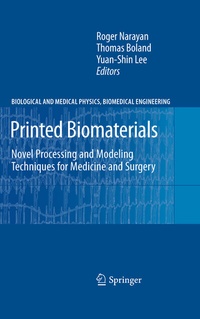
Printed Biomaterials
Description
Alles über E-Books | Antworten auf Fragen rund um E-Books, Kopierschutz und Dateiformate finden Sie in unserem Info- & Hilfebereich.
Recent studies have shown that novel processing and modeling techniques may be used to create patient-specific prostheses, artificial tissues, and other implants using data obtained from magnetic resonance imaging, computed tomography, or other imaging techniques. For example, customized prostheses may be fabricated that possess suitable features, including geometry, size, and weight, for a given medical condition. Many advances have been made in the development of patient-specific implants in the past decade, yet this information is not readily available to scientists and students. Printed Biomaterials: Novel Processing and Modeling Techniques for Medicine and Surgery provides the biomaterials scientist and engineer, as well as advanced undergraduate or graduate students, with a comprehensive discussion of contemporary medical implant research and development. The development of printed biomaterials is multidisciplinary, and includes concepts traditionally associated with engineering, materials science, medicine, and surgery. This text highlights important topics in these core fields in order to provide the fundamentals necessary to comprehend current processing and modeling technologies and to develop new ones.
More details
Other editions
Additional editions

Content
System requirements
File format: PDF
Copy protection: Watermark-DRM (Digital Rights Management)
System requirements:
- Computer (Windows; MacOS X; Linux): Use the free software Adobe Reader, Adobe Digital Editions, or any other PDF viewer of your choice (see eBook Help).
- Tablet/Smartphone (Android; iOS): Install the free app Adobe Digital Editions or another reading app for eBooks, e.g., PocketBook (see eBook Help).
- E-reader: Bookeen, Kobo, Pocketbook, Sony, Tolino and many more (only limited: Kindle).
The file format PDF always displays a book page identically on any hardware. This makes PDF suitable for complex layouts such as those used in textbooks and reference books (images, tables, columns, footnotes). Unfortunately, on the small screens of e-readers or smartphones, PDFs are rather annoying, requiring too much scrolling.
This eBook uses Watermark-DRM, a „soft” copy protection. This means that there are no technical restrictions to prevent illegal distribution. However, there is a personalised watermark embedded in the eBook that can be used to identify the purchaser of the eBook in the event of misuse and to provide evidence for legal purposes.
For more information, see our eBook Help page.