

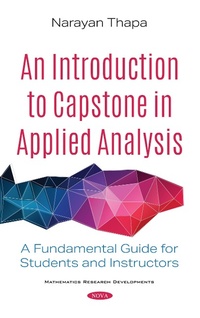
Introduction to Capstone in Applied Analysis: A Fundamental Guide for Students and Instructors
Published on 15. May 2020
191 pages
978-1-5361-7459-5 (ISBN)
Description

Inverse problems are one of the oldest, most important mathematical problems in science and engineering. However, the field of inverse problems has undergone rapid development in the last two decades due to the massive increase in computing power and the development of powerful numerical techniques such as finite difference method, finite element method, finite volume method and spectral method. Because of their applications in medical imaging, underground prospecting, nondestructive testing, astronomical imaging, image processing, remote sensing, and data mining, the Business, Industry and Government (BIG) sectors are very interested in applied inverse problems. Despite its great importance and demand, there is no project oriented applied and computational inverse problem book that can be adapted as a text for senior undergraduates as their capstone experience and pathway to research in applied analysis. The goal of this book is to fill this gap and provide opportunity to students, professors and researchers in biosciences, applied sciences, applied-computational mathematics, engineering, mathematical programming, mathematical economics, mathematical biology and optimization via applied and computational inverse problem projects. This book is sequenced as three major parts. The part of the book that includes chapters 1, 2 and 3 highlights major concepts including results in applied analysis. The second part of the book that includes chapters 4 and 5 displays the key numerical methods and programming in MATLAB. The final part of the book that includes chapters 6, 7, 8, 9, 10, 11 and 12 showcases several inverse-problem-related projects done with students.
More details
Other editions
Additional editions

Narayan Thapa
An Introduction to Capstone in Applied Analysis
A Fundamental Guide for Students and Instructors
Book
04/2020
Nova Science Publishers Inc
€211.28
Shipment within 15-20 days
Content
- Intro
- AN INTRODUCTION TOCAPSTONE IN APPLIED ANALYSISA FUNDAMENTAL GUIDE FORSTUDENTS AND INSTRUCTORS
- AN INTRODUCTION TOCAPSTONE IN APPLIED ANALYSISA FUNDAMENTAL GUIDE FORSTUDENTS AND INSTRUCTORS
- Contents
- Foreword
- Preface
- Chapter 1Vector Spaces
- 1.1. Definitions and Examples
- 1.2. Metric Spaces
- 1.3. Linear Combinations and Subspaces
- 1.4. Convexity and Cones
- 1.5. Linear Dependence, Linear Independenceand Dimension
- 1.6. Exercises
- Suggested Reading
- Chapter 2Normed Linear Spaces
- 2.1. Definitions and Examples
- 2.2. Open Sets, Closed Sets and Convergence
- 2.3. Continuity and Transformations
- 2.4. Banach Spaces
- 2.5. Exercises
- Suggested Reading
- Chapter 3Hilbert Spaces
- 3.1. Introduction
- 3.2. Inner Product Spaces and Examples
- 3.3. Orthogonal and Orthonormal Projections
- 3.4. Approximations and Optimizations
- 3.5. The Projection Theorem
- 3.6. Exercises
- Suggested Reading
- Chapter 4NumericalMethods
- 4.1. Finite DifferenceMethod
- The Discrete Mesh
- DerivativeApproximations
- Forward Time Central Space (FTCS) Scheme
- Backward Time Central Space (BTCS) Scheme
- Crank-Nicolson Scheme
- 4.2. Successive Approximation
- 4.3. Newton's Method
- Suggested Reading
- Chapter 5Programming with MATLAB
- 5.1. Introduction
- If-Then-Else
- For Loops
- 5.2. MATLAB Scripts and Functions
- Vectors and Matrices
- zeros
- Example Code
- Output
- ones
- Example Code
- Output
- linspace
- Example Code
- Output
- meshgrid
- Example Code
- Output
- ManipulatingMatrices
- 5.3. Data Formatting and Graphics
- format
- fprintf
- plot
- surf
- Figures
- Documentation
- 5.4. MATLAB in Action
- Approximating a Root Using Newton'sMethod
- Numerical Analysis of 1-D Heat Diffusion Using Finite DifferenceMethods
- Forward Time Central Space (FTCS)
- Backward Time Central Space (BTCS)
- Crank-NicolsonMethod (C-N)
- Output
- Suggested Reading
- Chapter 6Inverse Problem in Finance
- 6.1. Introduction
- 6.2. Existence and Uniqueness of Weak Solution
- 6.3. Existence of Optimal Parameters
- 6.4. Conclusion
- References
- Suggested Reading
- Chapter 7Inverse Problem in Physics 1
- 7.1. Introduction
- 7.2. The Inverse Problem with Over-Specification Data
- 7.3. Finite DifferenceMethod
- 7.4. Derivative Approximations
- 7.5. Forward Time, Central Space Scheme
- 7.6. Numerical Experiments and Results
- 7.7. Conclusion
- References
- Additional Suggested Reading
- Chapter 8Inverse Problem in Physics 2
- 8.1. Introduction
- 8.2. Problem Setup
- 8.3. Weak Formulation of the Problem
- 8.4. Spectral Method and Computational Algorithm
- 8.5. Numerical Results
- 8.6. Conclusion
- References
- Chapter 9Inverse Problem in Medicine 1
- 9.1. Introduction
- 9.2. PharmacokineticModel
- 9.3. Analytical Solutions
- 9.4. Numerical Results
- 9.5. Conclusion
- References
- Chapter 10Inverse Problem in Physics 3
- 10.1. Introduction
- 10.2. Existence, Uniqueness and Continuity of WeakSolution
- 10.3. Weak G^ateaux Differentiability of the SolutionMap
- 10.4. Optimal Parameters
- References
- Additional Suggested Reading
- Chapter 11Inverse Problem in PDE
- 11.1. Introduction
- 11.2. Existence and Uniqueness of Weak Solution
- 11.3. Existence of Optimal Parameters
- References
- Chapter 12Inverse Problem in Medicine 2
- 12.1. Introduction
- 12.2. Parameter EstimationModel
- 12.3. Mathematical Model
- 12.4. Analytical Solution
- 12.5. Facility PlacementModel
- 12.6. Mathematical Problem
- 12.7. Computational Algorithm
- 12.8. Numerical Results
- 12.9. Conclusion
- References
- Additional Suggested Reading
- About the Author
- Index
- Blank Page
